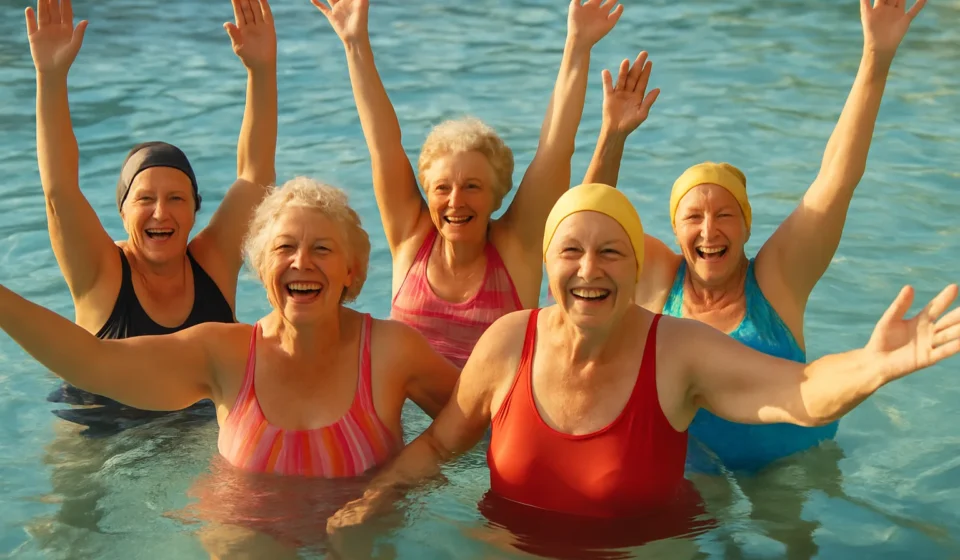

Aquatic exercise occupies a unique and clinically underutilized position in geriatric rehabilitation and preventive fitness. For seniors managing osteoarthritis, chronic joint pain, balance disorders, obesity, or cardiovascular deconditioning, water aerobics delivers training intensities comparable to land-based exercise at a fraction of the musculoskeletal stress — making it simultaneously one of the most accessible and most evidence-supported forms of physical activity available to adults over 65. If your physician has told you that your joints cannot handle traditional exercise, this is the protocol worth understanding in full.
Table of Contents
- The Physics That Make Aquatic Exercise Different
- What the Clinical Evidence Actually Shows
- 8 Clinically Documented Benefits for Seniors
- Core Water Aerobics Exercises with Correct Form
- How to Monitor Intensity in the Pool
- Safety Protocols and Medical Precautions
- Medicare and Insurance Coverage for Aquatic Therapy
- 12-Week Starter Program for Beginners
- Frequently Asked Questions
The Physics That Make Aquatic Exercise Different
Three physical properties of water — buoyancy, hydrostatic pressure, and viscosity — fundamentally alter how the musculoskeletal and cardiovascular systems respond to exercise, and understanding them explains why aquatic programs achieve outcomes that land-based alternatives often cannot.
Buoyancy reduces effective body weight proportional to submersion depth. At chest-depth water, a 180-pound individual exerts approximately 18 pounds of compressive force on weight-bearing joints — a 90% reduction. This makes movements accessible to patients with bone-on-bone knee osteoarthritis, recent hip or knee arthroplasty, severe obesity, or osteoporosis-related fracture risk who cannot safely perform equivalent exercises on land.
Hydrostatic pressure acts as a full-body compression garment, increasing venous return to the heart, reducing peripheral edema, and improving cardiac preload. This is why aquatic exercise produces cardiovascular conditioning effects at lower heart rates than equivalent land exercise — the heart is already receiving more efficient venous return. For seniors with chronic venous insufficiency or lower-extremity edema, an hour in chest-deep water is genuinely therapeutic.
Viscosity — water’s resistance to flow — provides multidirectional resistance that simultaneously engages agonist and antagonist muscle groups without the need for resistance equipment. Moving your arm forward through water trains the anterior deltoid; the return stroke trains the posterior deltoid and rhomboids. This co-contraction pattern is highly favorable for joint stability and is simply not replicable with free weights or resistance bands.
What the Clinical Evidence Actually Shows
The evidence base for aquatic exercise in older adults has matured substantially over the past decade. A 2014 Cochrane systematic review of 16 RCTs (881 participants, mean age 68) concluded that aquatic exercise produced significant improvements in pain, physical function, and quality of life in knee and hip osteoarthritis compared to controls — with effect sizes comparable to land-based exercise and superior tolerability.
A 2022 meta-analysis in PLOS ONE (23 RCTs, 1,384 older adults) found aquatic exercise superior to land-based exercise specifically for balance improvement in adults 60+, with standardized mean differences indicating clinically meaningful reductions in postural sway and Timed Up and Go test times. The proposed mechanism: immersion requires continuous proprioceptive recalibration against the moving water surface, stimulating vestibular and somatosensory systems more dynamically than static land exercises.
For cardiovascular outcomes, a 2019 Journal of Aging and Physical Activity trial found that 12 weeks of water aerobics three times weekly produced a 9.4% reduction in systolic blood pressure and significant improvements in VO2 max in hypertensive seniors — outcomes comparable to antihypertensive medication titration in mild-to-moderate hypertension.
8 Clinically Documented Benefits for Seniors
| Benefit | Supporting Evidence | Magnitude of Effect |
|---|---|---|
| Osteoarthritis pain reduction | Cochrane Review 2014, 16 RCTs | 40–60% reduction in pain VAS scores |
| Fall risk reduction | PLOS ONE meta-analysis 2022 | Significant improvement in TUG, Berg Balance Scale |
| Systolic blood pressure reduction | J. Aging Phys. Activity 2019 | Mean 9.4 mmHg reduction over 12 weeks |
| Improved VO2 max / aerobic capacity | Multiple RCTs | 8–15% improvement in 8–12 weeks |
| Muscle strength (lower extremity) | Multiple RCTs — quadriceps, hamstrings | 10–25% increase vs. baseline |
| Reduced chronic lower back pain | Spine 2012 RCT; Cochrane 2016 | Significant vs. land-based controls |
| Improved depression and anxiety scores | Multiple observational + 2 RCTs | Moderate effect — PHQ-9 reduction |
| Fibromyalgia symptom reduction | Arthritis Care & Research RCT | Greater improvement than land-based in tender point count |
Core Water Aerobics Exercises with Correct Form
1. Water Walking (Foundation Exercise)
Walk forward and backward in chest-deep water with an exaggerated heel-toe gait pattern. Keep your core engaged and resist the urge to lean forward. Walking backward specifically activates the gluteus medius and posterior tibialis — muscles critical for lateral stability and ankle proprioception — more effectively than forward walking. Start at 5 minutes, build to 20 continuous minutes over 6 weeks.
2. Lateral Shuffles
Side-step in chest-deep water with feet hip-width apart, maintaining a slight squat position. The water’s viscosity provides frontal-plane resistance that challenges the hip abductors and adductors — muscles that are chronically undertrained in most seniors and directly implicated in fall mechanism research. Perform 3 sets of 20 steps each direction.
3. Aqua Jogging (Deep-Water Running)
In deep water with a flotation belt, perform a running motion without touching the pool floor. This eliminates all compressive joint loading while delivering cardiovascular intensity equivalent to land running. Heart rate will run 10–15 BPM lower than equivalent-effort land running due to hydrostatic pressure effects — account for this in target heart rate calculations.
4. Standing Hip Abduction
Hold pool wall for balance (one hand only — do not grip with two hands, which eliminates proprioceptive challenge). Slowly lift one leg to the side to 45 degrees against water resistance. Return controlled — do not drop the leg. Targets gluteus medius, the single most important muscle for gait stability and fall prevention. Perform 15 reps each side, 2–3 sets.
5. Noodle Squats (Supported)
Place a pool noodle under each arm for additional buoyancy support. Perform squats in chest-deep water, lowering until thighs are parallel to the pool floor. Buoyancy reduces tibiofemoral compressive force by 85% compared to a land squat of equivalent depth — allowing seniors with grade III knee osteoarthritis or post-arthroplasty restrictions to train quadriceps safely and progressively. Perform 3 sets of 12–15 reps.
6. Arm Circles with Paddles
Using aqua resistance paddles (or cupped hands), perform large forward and backward arm circles at shoulder height. The frontal area of the paddle dramatically increases the resistive force — progressively overloading the rotator cuff, deltoids, and periscapular muscles without the eccentric loading stress that causes rotator cuff tears in older adults performing overhead land exercises. Essential for seniors with shoulder impingement or post-rotator cuff surgery.
How to Monitor Intensity in the Pool
Standard heart rate targets used on land require downward adjustment of 10–17 BPM in aquatic settings due to hydrostatic pressure effects. Use this modified zone system based on the American College of Sports Medicine’s aquatic exercise guidelines:
| Intensity Zone | Land HR Target (% max) | Aquatic Adjustment | RPE (1–10 scale) |
|---|---|---|---|
| Light / Warm-up | 50–60% | Subtract 13 BPM | 3–4 |
| Moderate / Fat-burn | 60–70% | Subtract 13 BPM | 5–6 |
| Vigorous / Cardio | 70–80% | Subtract 13 BPM | 7–8 |
Alternatively, use Rating of Perceived Exertion (RPE) — more practical and equally valid. Target RPE 5–6 (you can hold a conversation but feel mildly breathless) for most senior aquatic exercise sessions. Beta-blockers suppress heart rate response; RPE is preferable for these patients.
Safety Protocols and Medical Precautions
Aquatic exercise is one of the safest exercise modalities available, but specific contraindications and precautions apply:
- Active open wounds, skin infections, or incontinence with fecal component: Absolute contraindications due to infection risk and public health considerations.
- Uncontrolled heart failure or severe pulmonary hypertension: Hydrostatic pressure increases cardiac preload and may precipitate acute decompensation. Obtain cardiologist clearance before initiating aquatic exercise.
- Severe chlorine allergy or reactive airway disease: Evaluate indoor pool suitability; outdoor or saltwater pools may be preferable.
- Recent surgical incisions: Generally wait until wounds are fully healed and waterproof — typically 4–6 weeks post-op, surgeon clearance required.
- Water temperature: Pool temperature of 83–88°F (28–31°C) is optimal for senior aquatic exercise. Water below 80°F increases cardiovascular strain; above 92°F risks hyperthermia and orthostatic hypotension upon exiting.
- Pool exit strategy: The vasodilatory effect of warm water causes significant blood pressure drop when exiting rapidly. Always exit slowly using steps or ramp — never ladder — and rest poolside for 2–3 minutes before standing fully upright.
Medicare and Insurance Coverage for Aquatic Therapy
The coverage distinction that matters most: aquatic therapy (medically supervised, physician-ordered therapeutic intervention) versus recreational water aerobics (community fitness class). Medicare Part B covers the former, not the latter.
To obtain Medicare Part B coverage for aquatic physical therapy, you need: a physician referral establishing medical necessity (typically diagnosis of OA, balance disorder, fibromyalgia, post-surgical rehabilitation, neurological condition); services delivered by a licensed physical therapist or occupational therapist at an approved outpatient facility; documentation showing skilled intervention beyond what a non-professional could provide. Coverage applies under the same $2,230 KX modifier threshold as land-based physical therapy — there is no separate aquatic therapy cap.
For community water aerobics classes, some Medicare Advantage plans cover SilverSneakers membership (which includes aquatic programs at participating facilities). YMCA SilverSneakers aquatic classes are available through many MA plans at no additional cost.
For a complete overview of Medicare-covered fitness and rehabilitation services, see our Senior Fitness & Exercise Guide 2026.
12-Week Starter Program for Beginners
| Phase | Weeks | Frequency | Session Duration | Focus |
|---|---|---|---|---|
| Foundation | 1–4 | 2x/week | 20–30 min | Water walking, basic arm movements, pool acclimation, breathing pattern |
| Development | 5–8 | 3x/week | 30–40 min | Add lateral shuffles, hip abduction, noodle squats; increase speed and range |
| Consolidation | 9–12 | 3–4x/week | 40–50 min | Full circuit incorporating all exercises; introduce aqua jogging intervals; RPE 6–7 |
Frequently Asked Questions
Is water aerobics effective enough to replace land-based exercise for seniors?
For most seniors, aquatic exercise should complement — not replace — land-based activity, because bone loading (walking, weight-bearing exercise) is essential for maintaining bone mineral density and preventing osteoporosis. Immersion in water eliminates gravitational stress, which is beneficial for arthritic joints but eliminates the osteogenic stimulus that bones need. Ideally, combine aquatic exercise 2–3 days per week with weight-bearing activity (even short walks) on alternating days.
Do I need to know how to swim to do water aerobics?
No. Water aerobics classes are conducted in chest-deep water where participants stand on the pool floor throughout. Swimming ability is not required and is never tested. Flotation belts and pool noodles provide additional stability for participants who are uncomfortable in water. The vast majority of senior aquatic exercise participants are not swimmers.
How does water aerobics compare to swimming for seniors?
Both are excellent low-impact options, but they serve different populations. Swimming requires technical proficiency and breath-holding that some seniors with lung disease or anxiety find challenging. Water aerobics is more accessible, more social (group format), and better suited to structured resistance training for specific muscle groups. Swimming provides superior cardiovascular stimulus for conditioned seniors. If you can swim comfortably, combining lap swimming with water aerobics maximizes benefits.
Related Articles You May Find Helpful
- Senior Fitness & Exercise Guide 2026
- Best Exercises for Seniors Over 75: Doctor-Approved 2026 Guide
- Arthritis Pain Relief for Seniors 2026: What Actually Works
- Medicare Physical Therapy Coverage 2026: No Annual Cap
- Fall Prevention for Seniors 2026: 10 Proven Strategies
Sources