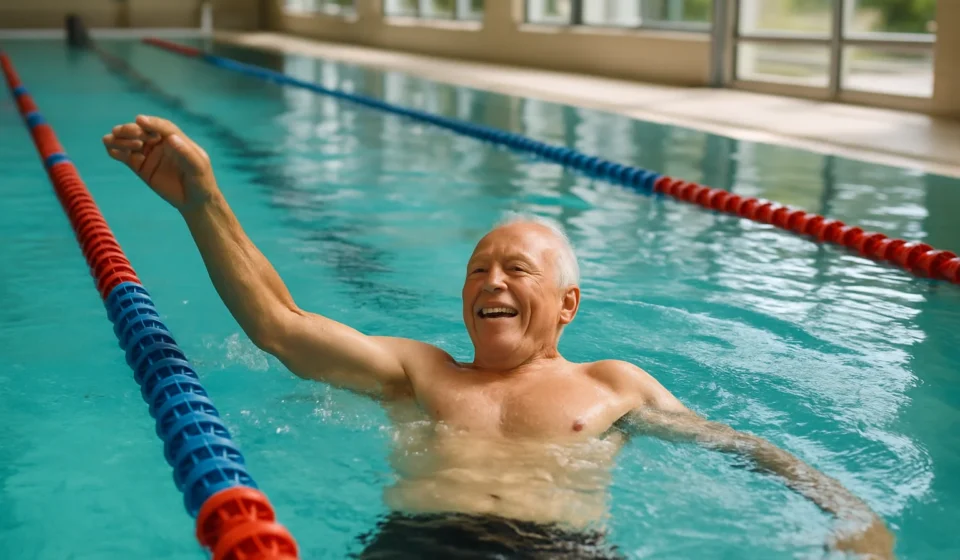

There is a reason physical therapists keep sending their most complicated patients to the pool. Swimming for seniors offloads up to 90% of your body weight through buoyancy, works the heart and every major muscle group at once, and asks almost nothing of arthritic knees, hips, and spines. In one of the largest exercise cohorts ever assembled (over 40,000 men followed for years), swimmers had roughly half the all-cause mortality of walkers and non-exercisers — and trials in adults 60 and older show regular swimming can lower systolic blood pressure by a clinically meaningful margin within about 12 weeks. As a senior health educator, here is how to start (or restart) swimming safely, which strokes suit which bodies, and how it compares with water aerobics.
Table of Contents
- Why Water Is the Senior-Friendly Gym
- What the Research Shows
- Choosing Your Stroke (Joint by Joint)
- A 4-Week Return-to-the-Pool Plan
- Swimming vs. Water Aerobics
- Safety, Cost & Free Pool Access
- Frequently Asked Questions
Why Water Is the Senior-Friendly Gym
Three physics facts make the pool special. Buoyancy: chest-deep water supports most of your body weight, so joints load gently even while muscles work hard. Hydrostatic pressure: water squeezes the legs and abdomen, pushing blood back toward the heart — circulation help you wear, which is also why many people with mild leg swelling feel better after pool sessions. Resistance in every direction: water resists each movement 12–14 times more than air, so you strength-train and do cardio simultaneously, without a single dumbbell.
What the Research Shows
The headline cohort finding: in a large long-term study of men 20–90, swimmers had substantially lower all-cause mortality than walkers, runners’ equals or better — with the usual caveat that swimmers may differ in other healthy ways. The trial evidence is more direct: in a randomized study of previously sedentary adults over 60 with mild hypertension, swimming a few times weekly cut systolic blood pressure by roughly 9 mmHg over 12 weeks — comparable to a starting dose of medication. For osteoarthritis, a trial comparing swimming with cycling in middle-aged and older adults found equal improvements in joint pain and function. One honest limitation: swimming is not weight-bearing, so it does little for bone density — keep some walking or resistance work in the week for your skeleton (our exercise guide for seniors over 75 shows how to mix the two).
Choosing Your Stroke (Joint by Joint)
Backstroke is my first recommendation for most seniors: face out of the water (no breathing anxiety), spine long, and it counteracts the rounded-forward posture of the sitting decades. Breaststroke offers easy breathing and a relaxed pace, but its whip kick can aggravate arthritic knees — if yours complain, switch to a gentle flutter kick with a kickboard. Freestyle is efficient but demands shoulder mobility; if your rotator cuffs are cranky, warm up with the moves in our shoulder mobility guide and shorten your stroke. Sidestroke — the forgotten stroke — is superb for anyone who wants steady, calm laps with minimal shoulder strain. Skip butterfly; nobody’s spine needs it at 70.
A 4-Week Return-to-the-Pool Plan
| Week | Sessions | What to Do |
|---|---|---|
| 1 | 2 × 20 min | Water walking + 4–6 easy widths of any stroke; rest freely at the wall |
| 2 | 2–3 × 25 min | Alternate 1 length swimming / 1 length water walking; add kickboard laps |
| 3 | 3 × 30 min | Continuous easy laps in 5-minute blocks; try backstroke-breaststroke alternation |
| 4 | 3 × 30–40 min | Steady swimming, brief rests; you should be able to talk a sentence between lengths |
Effort guide: aim for “somewhat hard” — breathing deeper but never gasping. Federal activity guidelines for older adults (150 minutes of moderate activity weekly) are fully satisfiable in the pool; three 40-minute swims gets you most of the way, and balance work on land (see our balance exercises guide) covers the rest.
Swimming vs. Water Aerobics
They are cousins, not twins. Water aerobics is a vertical, instructor-led group class — better for beginners, social motivation, and anyone not comfortable putting their face near the water; intensity is typically light-to-moderate. Lap swimming is horizontal, self-paced, usually higher intensity per minute, with bigger cardiovascular ceilings — better once you have basic stroke comfort. Many seniors do both: aerobics classes twice a week for community, laps once or twice for the engine. If knee pain limits your land options, the pool pairs beautifully with our knee strengthening program on dry days.
Safety, Cost & Free Pool Access
Non-negotiables: swim where a lifeguard is present, never alone; walk pool decks like they are icy (wet tile causes more senior pool injuries than the water does); use handrails on steps; and if you have heart disease, uncontrolled blood pressure, or seizures, clear your plan with your doctor first. Ear care: dry ears gently and consider drops if you are prone to swimmer’s ear. Cost: many Medicare Advantage plans include SilverSneakers or similar fitness benefits that cover pool access at participating YMCAs and gyms — call your plan and ask specifically about “fitness benefit pool access.” Community centers and senior centers often offer $2–4 senior lap swim hours as well.
Frequently Asked Questions
Is swimming good exercise for seniors?
Yes — among the best. Buoyancy removes up to 90% of joint load while the heart and all major muscles work. Trials in adults over 60 show meaningful blood pressure reductions within 12 weeks of regular swimming.
How often should a senior swim?
Two to four sessions weekly of 25–40 minutes at a “somewhat hard” effort meets most of the federal 150-minute weekly activity guideline. Build up over about four weeks if you are returning after years away.
Which swim stroke is easiest on the knees?
Freestyle and backstroke with a gentle flutter kick are kindest to knees. Breaststroke’s whip kick loads the inner knee and can aggravate arthritis — use a kickboard flutter instead if you feel it.
Does swimming build bone density?
Not meaningfully — water removes the impact that stimulates bone. Pair swimming with walking or light resistance training on land to protect your skeleton.
Related Articles You May Find Helpful
- Senior Fitness & Exercise Guide 2026
- Water Aerobics for Seniors: Clinical Benefits & Exercises
- Best Exercises for Seniors Over 75
- Knee Strengthening Exercises: 7 Safe Moves
- Shoulder Exercises for Seniors: 8 Moves for Stiffness
Sources
- CDC — Physical Activity Guidelines for Older Adults
- NIH PubMed — Swimming training and blood pressure in adults over 60
- National Institute on Aging — Exercise and Physical Activity
This article is for educational purposes only and is not medical advice. Check with your doctor before starting a new exercise program. See our medical disclaimer.