Does Medicare Cover Skilled Nursing and Nursing Home Care? The 3-Day Rule, the 100 Days and What You’ll Pay in 2026

Medicare covers short-term care in a skilled nursing facility (SNF) after a qualifying hospital stay, for up to 100 days in each benefit period. It doesn’t cover long-term custodial care in a nursing home, the help with bathing, dressing and eating that most nursing home residents need. That distinction drives almost every coverage question families have.
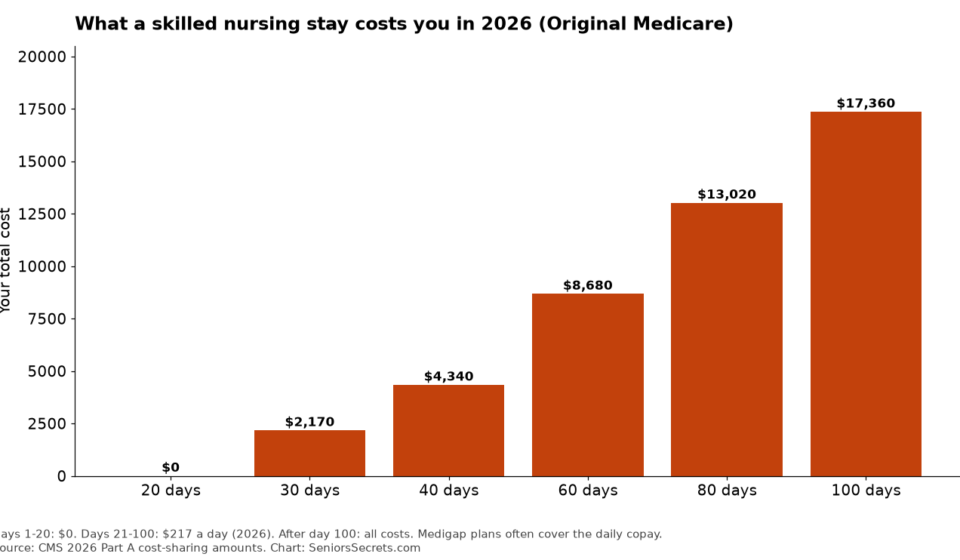
In 2026, Original Medicare pays the full cost of days 1 to 20 in a skilled nursing facility. For days 21 to 100 you pay $217 a day, and after day 100 you pay everything.
I’m a researcher, not a medical professional or licensed agent. The rules below come from Medicare.gov and CMS, and I link to them. For free help with a specific case, contact your State Health Insurance Assistance Program (SHIP).
Skilled nursing vs. nursing home care
People use “nursing home” for two different kinds of care. Medicare treats them very differently.
| Skilled nursing care | Custodial (long-term) care | |
|---|---|---|
| What it is | Daily care that needs nurses or therapists: wound care, IV drugs, physical therapy after surgery or a stroke | Help with daily activities: bathing, dressing, eating, using the bathroom |
| Usual length | Days or weeks | Months or years |
| Does Medicare pay? | Yes, if you meet the conditions, up to 100 days per benefit period | No, when that’s the only care you need |
| Who usually pays | Medicare, then Medigap or you for days 21-100 | You, long-term care insurance, or Medicaid |
Often the same building provides both. A person may start in the skilled unit, covered by Medicare, and move to custodial care when they stop needing daily skilled services. Medicare stops paying at that point.
When Medicare covers a skilled nursing facility
According to Medicare.gov’s skilled nursing coverage page, Part A covers SNF care when all of these are true:
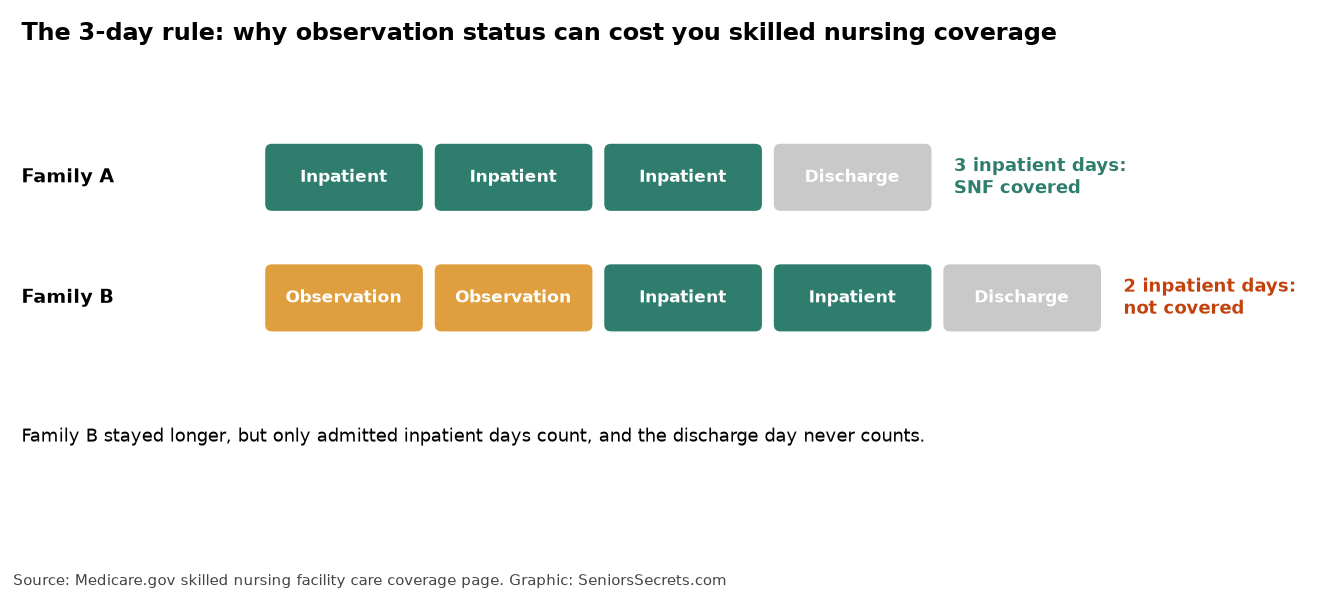
- You have a qualifying inpatient hospital stay. That means at least 3 days in a row as an admitted inpatient. The day you’re discharged doesn’t count.
- You enter the SNF soon after. Generally within 30 days of leaving the hospital.
- Your doctor orders daily skilled care that, as a practical matter, can only be given in a SNF as an inpatient.
- The care is for the condition treated in the hospital, or a condition that started while you were in the SNF for that condition.
- The facility is Medicare-certified.
You don’t have to be getting better to qualify. Medicare covers skilled care needed to maintain your condition or slow a decline, not just to improve it. That was clarified in a 2013 court settlement, Jimmo v. Sebelius, and CMS has since confirmed it in its manuals.
What you’ll pay in 2026
| Days in the SNF (per benefit period) | What you pay with Original Medicare |
|---|---|
| Days 1-20 | $0 |
| Days 21-100 | $217 per day |
| Day 101 and beyond | All costs |
The daily copay comes from the CMS 2026 Part A cost-sharing figures. It was $209.50 in 2025.
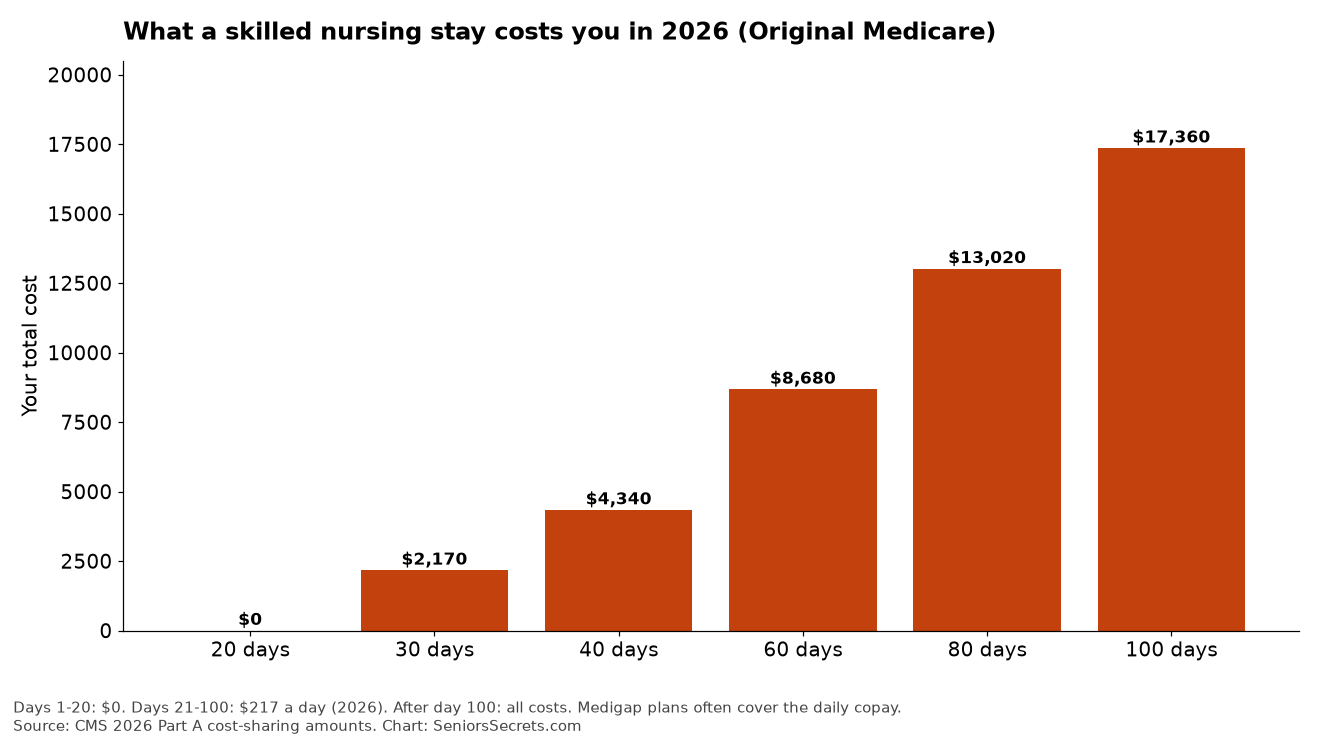
Those copays add up fast. A full 100-day stay costs you $17,360 in 2026 (80 days × $217) if you have no other coverage. Most Medigap plans cover the SNF coinsurance in full or in part, which is one reason people buy them.
What “100 days” really means
Medicare’s 100 days aren’t guaranteed. Coverage lasts only as long as you need and get daily skilled care. Many stays end well before day 100 because the person no longer needs skilled care, even though they may still need help.
How benefit periods reset
The 100 days are per benefit period. A benefit period starts the day you’re admitted as a hospital inpatient and ends after you’ve gone 60 days in a row without inpatient hospital or skilled nursing care. After that, a new hospital stay of 3 days starts a new benefit period with a fresh 100 days, and a new Part A hospital deductible of $1,736 in 2026.
The observation-status trap
This is where families lose coverage without realizing it. If you’re in the hospital under observation status, you’re an outpatient, even if you stay overnight in a regular room. Days under observation don’t count toward the 3-day inpatient requirement.
So a person who spends 4 nights in the hospital, 2 as an outpatient under observation and 2 as an inpatient, doesn’t qualify for SNF coverage.
What to do:
- Ask every day: “Is my parent an inpatient or under observation?” Write it down.
- Look for the notice. Hospitals must give you a Medicare Outpatient Observation Notice (MOON) if you’re under observation for more than 24 hours.
- Ask the doctor whether inpatient admission is medically appropriate. The doctor decides, not the family, but questions can prompt a review.
- Know your newer appeal right. Since February 2025, people in Original Medicare who were admitted as inpatients and then switched to observation can appeal the change. CMS explains the process on its patient status appeals page. Winning can restore the inpatient days needed for SNF coverage.
For more on how hospital days are covered, see what Medicare covers for hospital stays.
Medicare Advantage and skilled nursing
Medicare Advantage plans must cover SNF care, but their rules differ:
- Many plans waive the 3-day hospital stay requirement.
- Copays differ. Plans set their own SNF copays, often starting earlier than day 21. Check the plan’s Evidence of Coverage.
- Prior authorization is common. The plan may need to approve the stay before you’re admitted and may review it every few days.
- Networks matter. You may need to use a SNF in the plan’s network.
During Open Enrollment (October 15 to December 7), compare how plans handle SNF stays if you have a condition that makes one likely.
What isn’t covered
- Custodial care when it’s the only care you need.
- Long-term stays after your skilled needs end.
- Personal items like phones, TVs or private rooms, unless medically necessary.
- Days beyond 100 in a benefit period.
For long-term nursing home costs, the main payer in the U.S. is Medicaid. If your income is too high to qualify outright, read my guide to Medicaid spend-down. For broader options and costs, see long-term care planning.
When coverage is ending: fast appeals
When a SNF decides Medicare coverage should end, it must give you a Notice of Medicare Non-Coverage at least 2 days before your covered services end. If you disagree, call the Quality Improvement Organization (QIO) listed on the notice by noon of the day before services end. The SNF can’t charge you for covered care while the QIO decides.
My guide to Medicare appeals covers the other deadlines. If the person is going home, ask about Medicare home health care, which can cover part-time skilled care at home with no 3-day hospital stay requirement.
A worked example
Ruth, 81, falls and breaks her hip. She’s admitted to the hospital as an inpatient on Monday, has surgery and is discharged Thursday. That’s 3 inpatient days, Monday through Wednesday, since the discharge day doesn’t count. She moves to a Medicare-certified SNF the same day for daily physical therapy.
- Days 1-20: $0.
- Days 21-35: 15 days × $217 = $3,255, unless her Medigap plan pays it.
- On day 36, her therapist reports she can walk safely with a walker and no longer needs daily skilled therapy. Medicare coverage ends. She gets a Notice of Medicare Non-Coverage 2 days before and decides not to appeal.
If Ruth had spent her first night under observation, she’d have had only 2 inpatient days and no SNF coverage at all. That’s why the inpatient question matters.

FAQ
Does Medicare pay for nursing home care?
Only short-term skilled nursing care after a qualifying hospital stay, up to 100 days per benefit period. It doesn’t pay for long-term custodial care.
How much does Medicare pay for days 21 to 100?
Medicare pays everything except a daily copay, which is $217 in 2026. Medigap plans often cover that copay.
Does observation status count toward the 3-day rule?
No. Only days as an admitted inpatient count, and the discharge day doesn’t count.
Can I get another 100 days?
Yes, after a new benefit period starts. That requires 60 days in a row out of the hospital and SNF, followed by a new qualifying inpatient stay.
Do I have to be improving to keep coverage?
No. Medicare covers skilled care needed to maintain your condition or prevent decline, not only care that improves it.
Related guides