
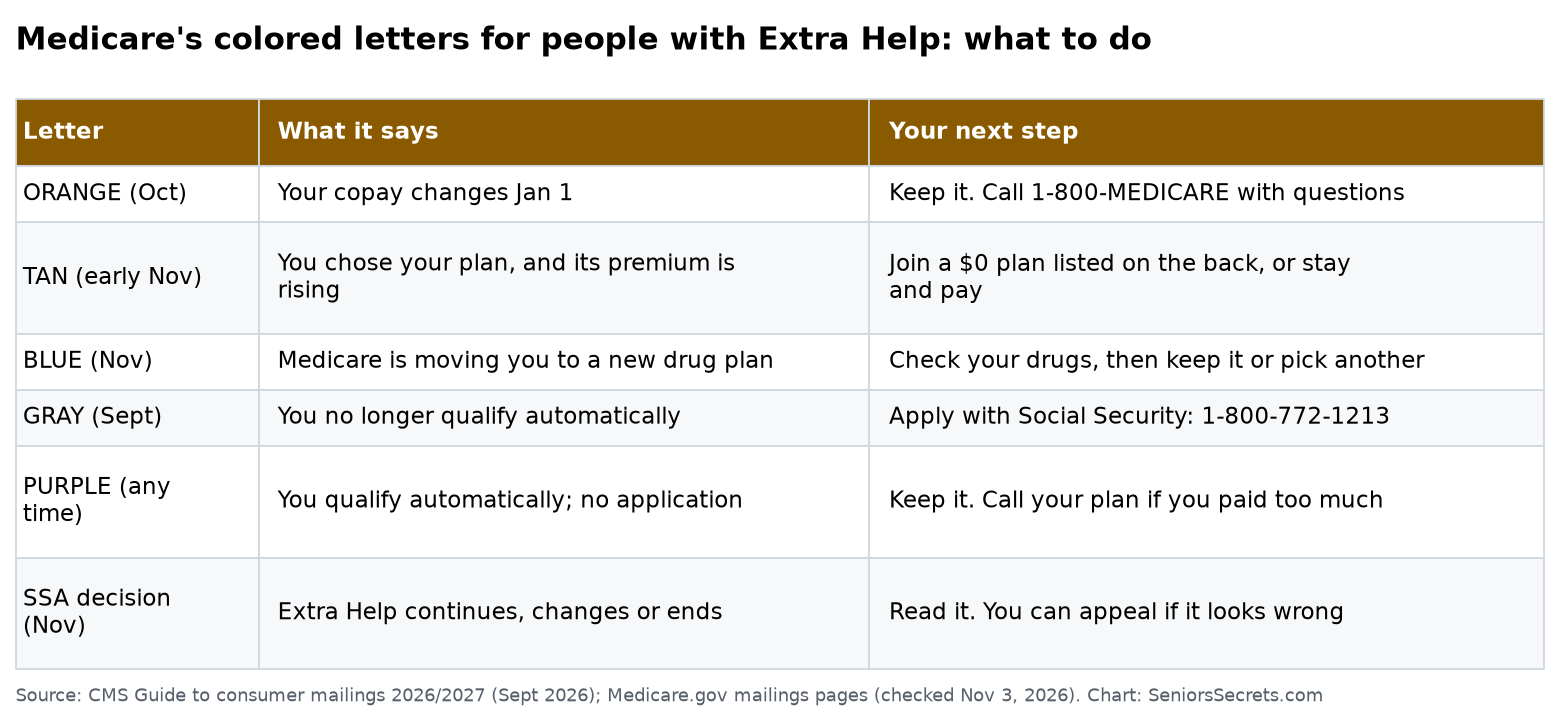
If you get Extra Help with Medicare drug costs, a colored letter from Medicare this fall is real mail, not a scam. A tan letter means your plan’s premium is rising and you can switch to a $0 plan. A blue letter means Medicare plans to move you to a new drug plan on Jan 1, 2027. An orange letter means your copays are changing. Keep every one, read the deadline printed on it, and call 1-800-MEDICARE (1-800-633-4227) if you are unsure (CMS).
Medicare uses paper colors so people can tell these notices apart. Some need no action. A few can cost you money if you ignore them. This guide covers the main ones, using the official CMS mailing guide for 2026 and 2027.

Who gets these letters?
These colored notices are for people with Extra Help, also called the Low-Income Subsidy. It is a program that lowers Part D drug plan costs. You get it automatically if you have full Medicaid, a Medicare Savings Program, or Supplemental Security Income (SSI). Others apply through Social Security (Medicare.gov).
The 2026 limits to apply are $23,940 in income and $18,090 in resources for one person, and $32,460 and $36,100 for a married couple. If you have Extra Help and get no notice, Medicare.gov says you keep the same plan and the same help next year.
The quick guide to each color
Tan letter: “Your plan’s premium is changing”
The tan notice goes to people with Extra Help who picked their own plan instead of being placed in one by Medicare. CMS calls it the LIS Choosers notice, and it is mailed in early November. It says your plan’s monthly premium is changing. You will pay part of it next year unless you move to a $0 premium plan (CMS).
The back of the letter lists $0 premium plans in your area. You have two choices:
- Stay put. You do nothing, and you pay the new premium each month starting in January.
- Switch. Call 1-800-MEDICARE or one of the listed plans. The sample letter says to join by Dec 7 for coverage to start Jan 1 (Medicare.gov).
The sample letter also says you may be able to switch after Jan 1. That fits what Medicare.gov says about people with Extra Help, who may change drug coverage once per month. CMS’s own staff notes mention Dec 31 in one place and Dec 7 in another. Follow the date on your letter. When in doubt, move before Dec 7.
Blue letter: “Medicare is moving you to a new plan”
Blue letters are sent in November to people with Extra Help whose plan is raising its premium above the regional subsidy amount or leaving Medicare. Medicare picks a new $0 premium plan for you (CMS notice 11209).
You can do one of three things:
- Do nothing. You are moved on Jan 1, 2027.
- Stay in your old plan. Call that plan right away and tell them. You will pay the higher premium.
- Pick a different plan. Any plan on the list in your letter has a $0 premium.
CMS says to decide by Dec 31. In December, Medicare sends a second blue letter that tells you which of your drugs the new plan covers. Do not skip that one. A $0 premium helps little if your medicine is not on the plan’s list. If you take brand-name drugs, check each one now at Medicare.gov’s Plan Finder.
If you are in a Medicare Advantage plan that is leaving, a different blue notice says Medicare will move you to Original Medicare and a drug plan. Our guide to a Medicare Advantage plan ending in 2027 explains your choices.
Orange letter: “Your copays are changing”
The orange notice came out in October. It goes to people who keep Extra Help next year and tells them their copays change on Jan 1. You do not need to act. CMS says to keep it and call 1-800-MEDICARE with questions.
For most people with Extra Help in 2027, Medicare.gov lists these costs:
- $0 premium in a benchmark plan, and $0 deductible.
- Up to $5.80 per generic drug and up to $14.40 per brand-name drug.
- $0 per covered drug once total drug costs reach $2,400.
For comparison, the 2026 copays were $5.10 and $12.65 (CMS). Some people pay less, such as those who have full Medicaid. Your letter lists your exact amounts.
Gray letter: “You no longer qualify automatically”
The gray notice is mailed in September. It means you got Extra Help without applying, but you will not next year. This is not a final no. You can apply through Social Security online, by mail with the form in the envelope, or by phone at 1-800-772-1213 (SSA). Without a new approval, the help ends Jan 1.
Purple, yellow and green letters
These come any time during the year. Purple means you automatically qualify and need no application. Yellow and green are about being signed up for a drug plan. If you filled prescriptions before your help started, call your plan or the LI NET program at 1-800-783-1307 to ask about getting money back (Medicare.gov).
Letters from Social Security
Social Security sends its own mail. In November, people with Extra Help get a decision letter saying the help will continue, change or end. If you think it is wrong, the letter explains how to appeal. Some people also get a review form earlier in the fall. Return it by the date shown.
In December, you will get your cost-of-living letter that shows your 2027 benefit. Your Part B premium will come out of it. We cover that in our guide to the 2027 raise. Higher earners also get a letter about the income-related Medicare surcharge, called IRMAA (our IRMAA guide shows how to appeal).
Dates to know
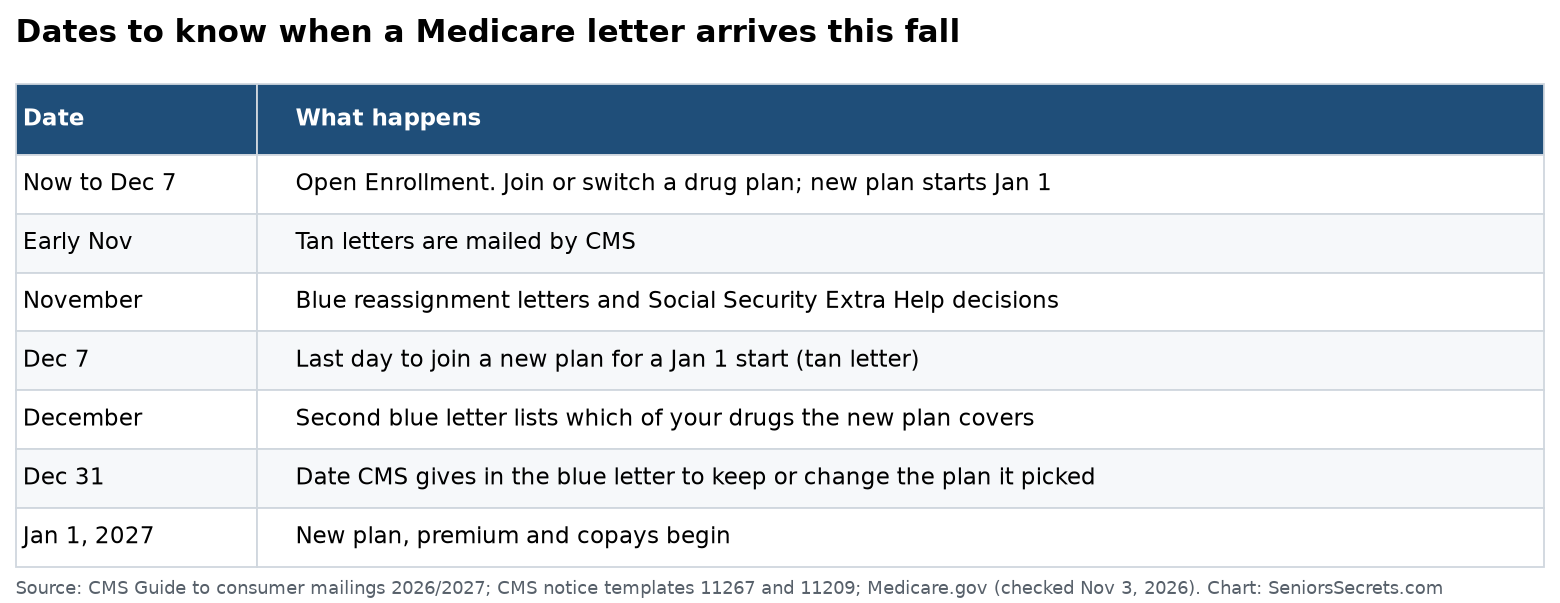
Open Enrollment runs until Dec 7, 2026, the main deadline for anyone to change a drug plan. Our Part D 2027 guide shows the new $2,400 yearly cap on out-of-pocket drug costs for everyone.
How to tell a real letter from a fake one
Real letters come by mail from Medicare, Social Security or your plan. If a caller says you must act today to keep your help, or asks for your bank number, hang up and call 1-800-MEDICARE yourself. Our list of Medicare scam red flags shows what real marketing rules allow.
The gotchas
- Throwing away the tan letter. A “do nothing” choice still means paying a new premium.
- Missing the second blue letter. It is the only notice that lists which of your drugs the new plan covers.
- Trusting a $0 premium alone. Check that your drugs and pharmacy are in the plan.
- Sample letters differ. The copies on CMS sites are templates, so your wording and dates may differ.
- Free help is available. Your State Health Insurance Assistance Program (SHIP) gives free counseling. Call 1-800-MEDICARE for your local number, or visit shiphelp.org. Also see our guide to how to get Extra Help.
Common questions
What does the tan Medicare letter mean?
The tan letter says your drug plan’s premium is changing. It goes to people with Extra Help who chose their own plan. You can stay and pay the new premium, or switch to a plan with a $0 premium listed on the back of the letter. The sample letter says to join a new plan by Dec 7 for a Jan 1 start.
What happens if I ignore the blue Medicare letter?
You will be moved to the new plan named in the letter on Jan 1, 2027. You will pay a $0 premium there. If you want to stay in your old plan, you must call it and say so. Medicare will send a second blue letter in December listing your drugs.
Do I need to do anything about the orange letter?
No. The orange letter says your Extra Help copays change on Jan 1. Keep it for your records. You can call 1-800-MEDICARE if you have questions about the amounts.
How do I reapply after a gray letter?
Apply for Extra Help with Social Security. You can use ssa.gov, mail in the form that came with the letter, or call 1-800-772-1213.
I get Extra Help and got no letter. Is something wrong?
No. Medicare.gov says that if you get no notice from Medicare or Social Security, you keep Extra Help and the same plan next year. Medicare mails a notice only if you no longer qualify or you are moved to a different plan.
Written by Khasim Basha Shaik. I research Medicare and senior benefits and compare plans for readers. I am not a lawyer, financial adviser or licensed insurance agent. This article summarizes information from CMS, Medicare.gov and Social Security and is not advice about a specific plan. Last reviewed November 3, 2026.
Related guides