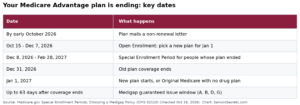

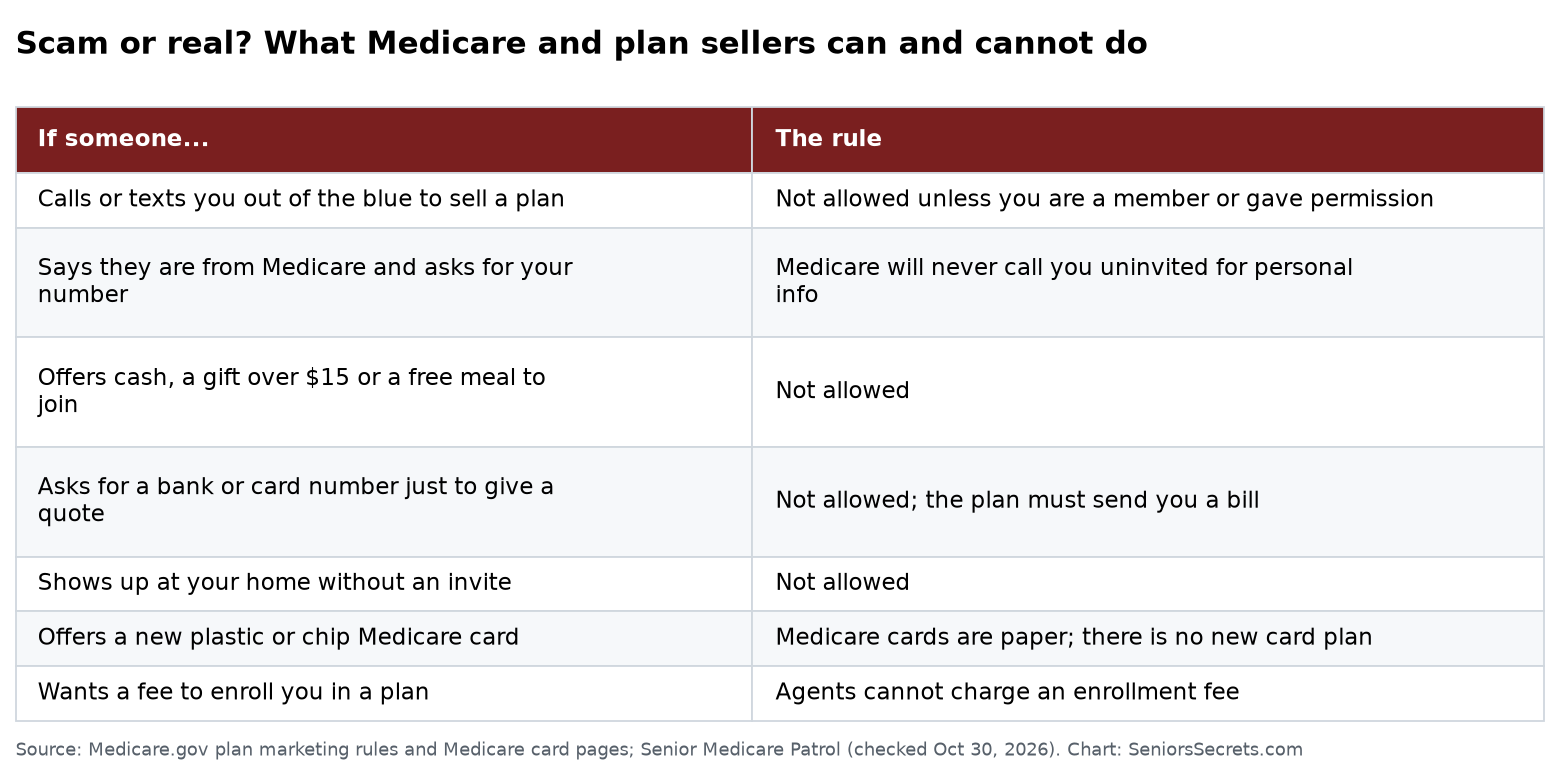
Medicare will not call you out of the blue to sell you a plan or ask for your Medicare number. If someone does, hang up and call 1-800-MEDICARE (1-800-633-4227) yourself. During Open Enrollment, which runs from Oct 15 to Dec 7, 2026, plan sellers also must follow strict rules. They can’t call or text you without your permission, offer gifts worth more than $15, or ask for your bank card just to give you a quote (Medicare.gov).
This fall gives scammers extra bait. There is the yearly plan switch window. There is a one-time $90 Part B rebate that went out in October. And there is a new 3.6% Social Security raise for 2027. Each one is a reason for a fake caller to sound real. Here is how to spot the tricks.
Why scams spike this time of year
Open Enrollment is when you can change your Medicare Advantage plan or Part D drug plan for next year. Changes take effect Jan 1, 2027 (Medicare.gov). That means millions of people expect calls, mail and ads about Medicare right now. Scammers hide in that noise.
The Senior Medicare Patrol (SMP), a federal program that helps people spot Medicare fraud, says to report anyone who claims to be from Medicare, Social Security or Medicaid while trying to sell you a plan (SMP). Real Medicare staff don’t sell plans.
The 8 red flags
1. A call “from Medicare” you didn’t ask for
Medicare.gov says Medicare will never call you or visit your home to sell you anything. It only calls in a few cases, such as when you have already called and asked for a call back (Medicare.gov). If a caller says “This is Medicare,” that is your cue to hang up.
The HHS Office of Inspector General (OIG) warns that scammers also pretend to be government staff, even OIG agents. Caller ID can be faked, so a real-looking number proves nothing (HHS-OIG).
2. An offer of a “new plastic” or “chip” Medicare card
Your Medicare card is paper, with a blue band on top and a red band on the bottom. SMP says there is no plan to change the card again, and there is no plastic or chip card (SMP). Anyone who says you must “verify” your number to get a new card is fishing.
One honest note: in March and April 2026, some people did get new cards with new numbers. Medicare mailed those with a letter that explains why. If you are not sure a letter is real, call 1-800-MEDICARE and ask (SMP).
3. A “fee” to get your $90 rebate
About 20.8 million people with Original Medicare Part B are getting a one-time $90 payment in October 2026. Those with direct deposit from Social Security got it around Oct 8. Others get a paper check from the U.S. Treasury. The memo line reads “Medicare Improvement Fund Payment; $90 Payment to Offset October Premium” (CMS).
CMS does not list any form to fill out or fee to pay. People in Medicare Advantage plans are not eligible. So if someone calls about “releasing” your rebate, or wants your bank number to send it, that is a scam. To check your own payment, call Social Security at 1-800-772-1213. Our guide to the $90 Part B rebate explains who qualifies.
4. A caller who wants to “confirm” your COLA
Social Security announced a 3.6% raise for 2027 on Oct 14, 2026. Your COLA notice will show up online in late November if you have a personal my Social Security account. If you don’t have one, you need to create one and turn on paperless notices by Nov 18 to see it online. Otherwise, your notice comes by mail in December (SSA).
You don’t need to call anyone or pay anything to get your raise. The Social Security OIG says SSA will never ask you to move money to protect it, pay with gift cards, crypto or gold bars, or keep a call secret (SSA OIG). See what the 3.6% COLA means for your check and how to set up your my Social Security account safely.
5. Calls or texts from plans you never contacted
Plans and their agents can’t call or text you unless you are already a member or you gave them permission. They also can’t come to your home without an invite (Medicare.gov). Medicare.gov’s advice is simple: don’t join a plan over the phone unless you made the call (Medicare.gov).
6. Gifts, cash or a free meal to sign up
Plans may offer small promo items, but nothing worth more than $15. They can’t give you cash or a free meal for coming to a sales event (Medicare.gov). Medicare.gov also warns never to take money or gifts in exchange for “free” medical care (Medicare.gov).
7. A request for your bank or card number up front
A plan can’t ask for your bank account or credit card number just to give you a quote. It also can’t make you pay by phone or online. The plan has to send you a bill (Medicare.gov).
8. Pressure, fees and side sales
Agents must be licensed by your state. They can’t charge you a fee to enroll, and they can’t pressure you. During a Medicare pitch, they also can’t try to sell you annuities or life insurance (Medicare.gov). “You have to decide today” is a red flag. You have until Dec 7.
What an honest agent does
Not every call about Medicare is a scam. Licensed agents and brokers help people pick plans every day. Here is what the rules say an honest one must do:
- Say who they work for. Before talking about benefits, they must tell you how many companies and plans they represent (Medicare.gov).
- Point you to the full list. They must tell you that Medicare.gov and 1-800-MEDICARE (TTY 1-877-486-2048) can show you every plan in your area.
- Get your OK for a meeting. A sales visit needs your agreement and a form that lists what you will talk about.
- Use the real plan type in the name. Ads must say “HMO” or “PPO” in the plan name. They can’t misuse the Medicare logo to look official.
How to protect yourself this week
- Let unknown calls go to voicemail. A real plan or agent will leave a name and number. Look up the number yourself before you call back.
- Guard your Medicare number. It is not your Social Security number. Only share it with your doctors, your insurance plans, a licensed agent you chose, or your State Health Insurance Assistance Program (SHIP) (Medicare.gov).
- Shop with tools you control. Compare plans at Medicare.gov’s Plan Finder or with free help from SHIP at shiphelp.org. SHIP counselors don’t sell plans.
- Read your statements. Check your Medicare Summary Notice or plan Explanation of Benefits for care you never got. SMP lists billing for supplies you never ordered as a common scheme (SMP).
- Watch for “plan changes” you didn’t make. If you get a welcome letter from a plan you never joined, call 1-800-MEDICARE right away.
If you are still choosing a plan, our list of Open Enrollment mistakes to avoid and the 2-week prep checklist can help.
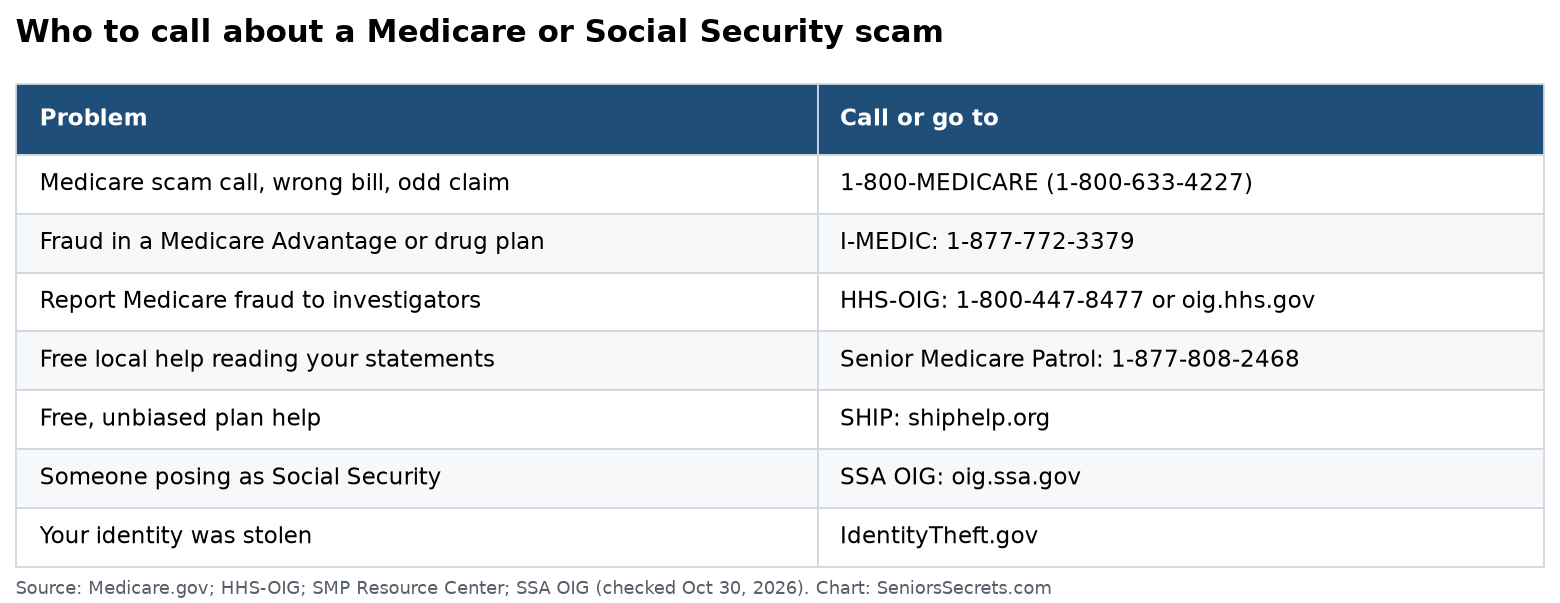
If you think you were scammed
Act fast. The sooner you report it, the easier it is to fix.
- Call 1-800-MEDICARE to report a fake call, a plan you didn’t choose, or a strange charge. You can also report fraud online with HHS-OIG at oig.hhs.gov/fraud/report-fraud or call 1-800-HHS-TIPS (1-800-447-8477) (HHS-OIG).
- For Medicare Advantage or drug plan fraud, call the I-MEDIC line at 1-877-7SAFERX (1-877-772-3379) (Medicare.gov).
- Get free local help from your Senior Medicare Patrol at 1-877-808-2468 (SMP).
- If someone posed as Social Security, report it to the SSA OIG at oig.ssa.gov.
- If you gave out your bank or card number, call your bank now. If your identity was stolen, make a plan at IdentityTheft.gov.
Scams aimed at older adults go far beyond Medicare. Our guide to financial scams targeting seniors covers the FBI’s latest numbers and the most costly tricks.
The gotchas
- A “permission” you forgot. If you filled out an online form for a “free Medicare quote,” you may have agreed to calls. Those calls can be legal. You can still say no and ask to be put on the company’s do-not-call list.
- Fake caller ID. Scammers can make a call look like it comes from Medicare or a real agency. Hang up and call the number on your card or on Medicare.gov (HHS-OIG).
- Some real mail looks odd. The 2026 card replacements and the $90 Treasury check are real. When in doubt, call 1-800-MEDICARE instead of the number in the letter.
Common questions
Does Medicare ever call people?
Rarely. Medicare.gov says it will not call you to sell anything or visit your home. It may call in limited cases, such as when you already called and asked for a call back. If you are unsure, hang up and call 1-800-MEDICARE yourself.
Is there a new plastic Medicare card for 2027?
No. Medicare cards are paper, and SMP says there is no plan to change them. Anyone offering a plastic or chip card is running a scam. Some people did get new paper cards with new numbers in March and April 2026, sent with a letter.
Do I need to do anything to get the $90 Part B rebate?
No form or fee is listed by CMS. The one-time payment went to eligible Original Medicare Part B enrollees in October 2026. Direct deposit came around Oct 8, and others get a Treasury check. Call Social Security at 1-800-772-1213 to check your payment.
Can a Medicare plan agent call me?
Only if you are already a member of that plan or you gave permission, such as through a form or a request for a call. Plans can’t make cold calls or send texts you didn’t agree to. They also can’t visit your home without an invite.
Where can I get free, honest help picking a plan?
Your State Health Insurance Assistance Program (SHIP) gives free, unbiased counseling. Find yours at shiphelp.org. You can also call 1-800-MEDICARE or use the Plan Finder at Medicare.gov. Open Enrollment ends Dec 7, 2026.
Written by Khasim Basha Shaik. I research Medicare and senior benefits and compare plans for readers. I am not a lawyer, financial adviser or licensed insurance agent. This article summarizes rules and warnings from Medicare.gov, CMS, Social Security, HHS-OIG, SSA OIG and the Senior Medicare Patrol and is not advice about a specific plan. Last reviewed October 30, 2026.
Related guides