

National Family Caregiver Support Program: Free Respite, Training and Help in 2026
The National Family Caregiver Support Program (NFCSP) is a federal program for unpaid family caregivers. It pays for respite breaks, counseling, support groups, training and some supplies. You apply through your local Area Agency on Aging, which you can find by calling the Eldercare Locator at 1-800-677-1116 (ACL).
There’s no national sign-up form and no single price list. Services and waitlists vary by county. This guide shows who qualifies, what’s offered, what other help exists, and how to ask for it.
What the program is
Congress created the NFCSP in 2000 under Title III-E of the Older Americans Act. The federal Administration for Community Living (ACL) gives grants to states based on their share of people 70 and older. States pass the money to local Area Agencies on Aging (ACL).
The goal is simple: help families care for loved ones at home for as long as possible.
Who qualifies
You may qualify if you are an unpaid family member or other informal caregiver who is (ACL):
- caring for someone 60 or older
- caring for someone of any age with Alzheimer’s or a related dementia
- a relative 55 or older (not the parent) raising a child under 18
- a relative 55 or older, including a parent, caring for an adult 18 to 59 with a disability
Gotcha: there’s no federal income limit, but local agencies often have limited money and may put people with the greatest need first. Ask how they rank requests and whether there’s a waitlist.
The 5 types of help
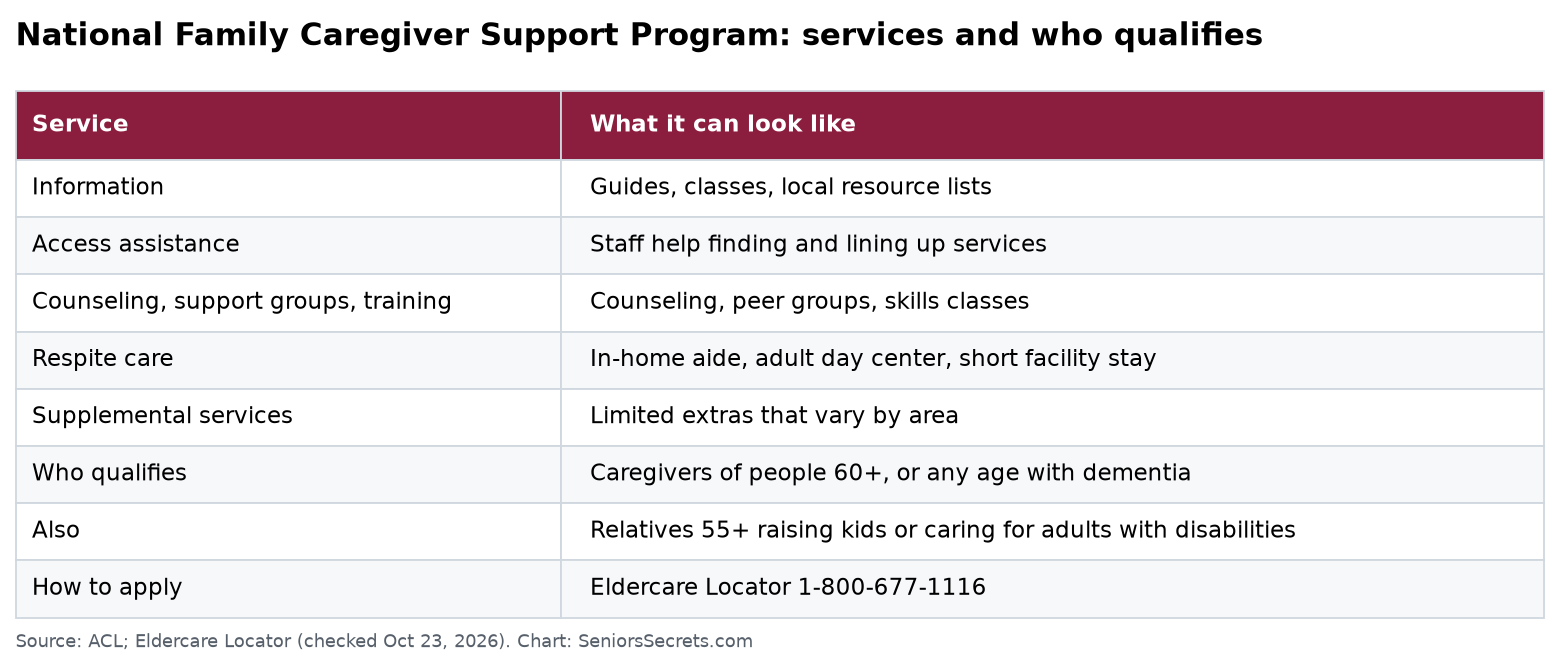
| Service | What it can look like |
|---|---|
| Information | Guides, classes and local resource lists |
| Access assistance | A staff member who helps you find and line up services |
| Counseling, support groups and training | One-on-one counseling, peer groups, caregiving skills classes |
| Respite care | In-home aide, adult day center, or a short stay in a facility |
| Supplemental services | Limited extras that vary by area, such as home safety items or supplies |
How much it actually helps
ACL’s most recent service data, from fiscal year 2014, shows (ACL):
- more than 700,000 caregivers got services
- respite went to more than 604,000 caregivers, for nearly 6 million hours of relief
- more than 100,000 caregivers got counseling, support groups or training
In ACL’s national caregiver survey:
- 74% said services let them give care longer than they otherwise could
- 88% said services helped them be a better caregiver
- nearly 62% said that without the services, their loved one would be in a nursing home
My take: respite is the service most people want, and the one with the longest waits. Ask for it early, before you burn out, not after.
Medicare help that works alongside it
Caregiver training. Medicare Part B now covers caregiver training when your loved one’s provider decides it’s part of the treatment plan. Training can cover giving medicines, moving the patient safely, preventing bedsores and managing the condition. You can attend without the patient present. The patient pays 20% of the Medicare-approved amount after the Part B deductible (Medicare.gov).
Hospice respite. If your loved one is on Medicare hospice, the hospice can arrange a short inpatient stay to give you a rest. The patient may pay 5% of the Medicare-approved amount (Medicare.gov). See our hospice coverage guide.
Watch out for: Original Medicare doesn’t pay for ongoing custodial care or regular home aides. For that, look at Medicaid waivers and PACE.
Other programs to ask about
- Medicaid home and community-based waivers may pay for home care, and in many states can pay a family member. See our Medicaid waiver guide.
- VA Caregiver Support Program. If you care for a veteran, call the Caregiver Support Line at 1-855-260-3274, Monday to Friday, 8 a.m. to 8 p.m. ET. VA has 2 programs. One gives general support. The other gives a monthly stipend to eligible caregivers. VA has extended protection for “legacy” stipend participants through September 30, 2028 (VA Caregiver Support).
- Lifespan Respite programs in many states help families find and pay for respite.
How to apply, step by step
- Call the Eldercare Locator at 1-800-677-1116 or search at eldercare.acl.gov. Ask for your Area Agency on Aging’s caregiver program.
- Describe your situation clearly. Who you care for, their age and diagnosis, how many hours you help, and what you need most.
- Ask for an assessment. Many agencies send someone to talk through needs.
- Ask about every service, not just respite: training, support groups, supplies and counseling.
- Ask about cost sharing. Some agencies ask for a voluntary contribution or use a sliding scale.
- Get on the waitlist if there is one, and ask how often to check back.
If your loved one has dementia, our guide to sundowning has practical tips for hard evenings.

Common questions
Who is eligible for the National Family Caregiver Support Program?
Unpaid caregivers of adults 60 and older qualify. So do caregivers of people of any age with Alzheimer’s. Relatives 55 and older who raise children or care for adults with disabilities can also qualify.
Does the caregiver program pay family members?
Usually no. It funds services like respite and training. Some Medicaid programs can pay family caregivers. So can the VA’s main caregiver program.
How do I apply for caregiver respite care?
Call the Eldercare Locator at 1-800-677-1116 to reach your local Area Agency on Aging and ask about its family caregiver program.
Is there an income limit?
There’s no federal income limit, but local agencies often have limited funds and may serve people with the greatest need first.
Does Medicare cover caregiver training?
Yes. Part B covers caregiver training when your loved one’s provider decides it’s part of their treatment plan. The patient pays 20% after the Part B deductible.
Written by Khasim Basha Shaik. I research Medicare and senior benefits and compare plans for readers. I am not a lawyer, financial adviser or licensed insurance agent. This article summarizes ACL, Medicare.gov and VA information and is not legal or financial advice. Last reviewed October 23, 2026.
Related guides

Social Security Survivor Benefits 2026: What Widows and Widowers Get, and the 2027 Raise
How Much Can You Earn on Social Security? 2026 and 2027 Earnings Limits, Worked Examples and What Happens at Full Retirement Age

