Medicare Diabetic Supplies Coverage 2026: Test Strips, CGMs, Diabetic Shoes and $35 Insulin
Medicare Part B covers most diabetes testing supplies, including blood sugar meters, test strips, lancets and continuous glucose monitors (CGMs), at 20% after the Part B deductible ($283 in 2026, $292 in 2027). If you use insulin, you can get up to 300 test strips and 300 lancets every three months (100 of each if you don’t). Insulin costs no more than $35 a month under Part B or Part D, with no deductible. Syringes, needles and alcohol swabs are covered by Part D.
Diabetic shoes are covered too. If the doctor treating your diabetes certifies you need them, Part B pays for one pair of therapeutic shoes plus inserts every calendar year. You pay 20% after the deductible. The full rules for shoes are in their own section below.
One correction to claims circulating online: CGMs are not moving to Part D. They stay under Part B. What changes is how Medicare pays suppliers: starting January 1, 2028, CGMs and insulin pumps move to a bundled monthly rental under Part B.
Who pays for what
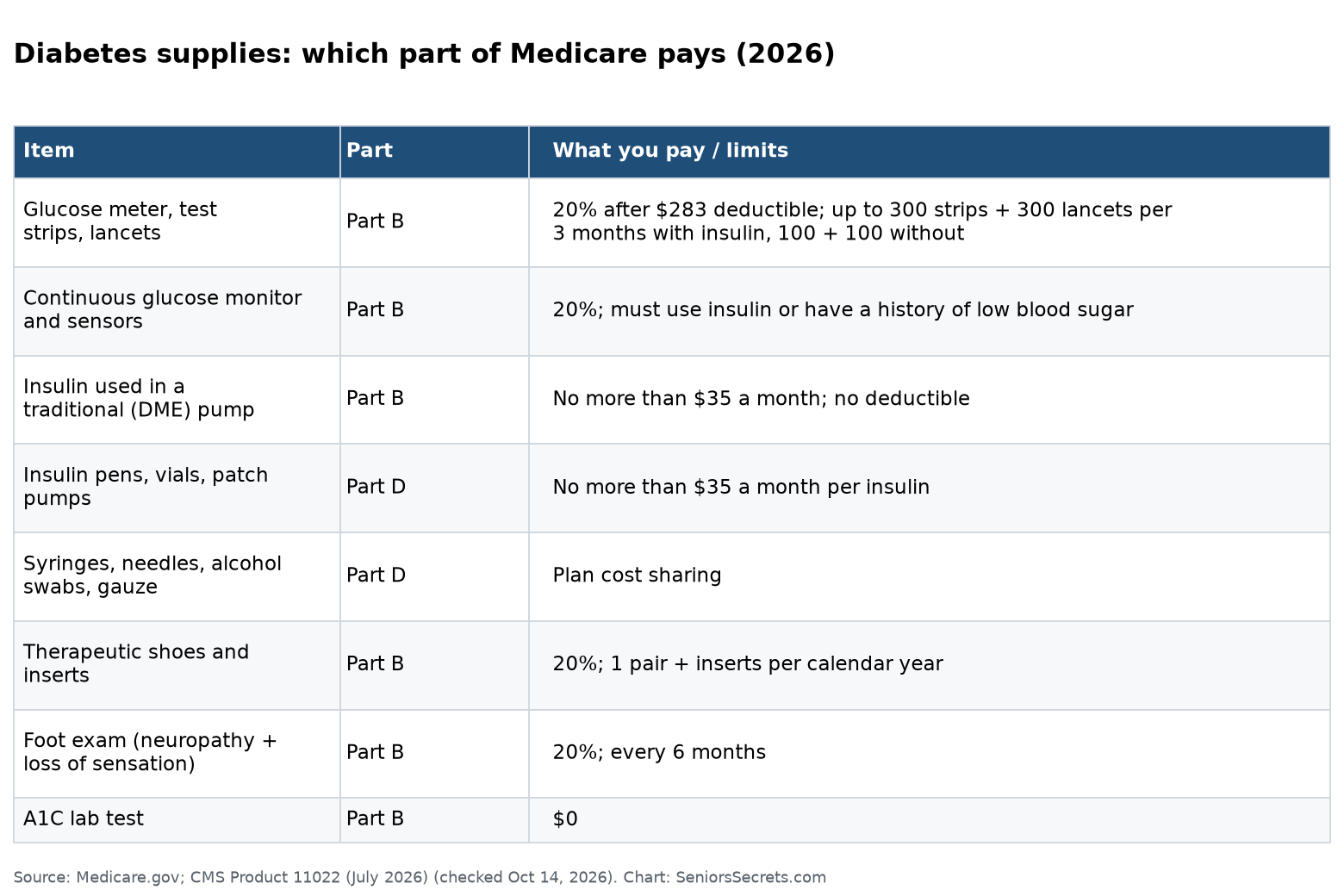
| Item | Medicare part | What you pay / limits |
|---|---|---|
| Glucose meter, test strips, lancets | Part B | 20% after deductible; up to 300 strips and 300 lancets per 3 months with insulin, 100 of each without |
| CGM and sensors | Part B | 20%; must use insulin or have a history of low blood sugar |
| Insulin used in a traditional insulin pump | Part B | No more than $35 a month; no deductible |
| Insulin pens and vials, and insulin used in disposable patch pumps | Part D | No more than $35 for a month’s supply of each covered insulin |
| Syringes, needles, alcohol swabs, gauze | Part D | Your plan’s cost sharing |
| Therapeutic shoes and inserts | Part B | 20% after deductible; one pair plus 2 or 3 pairs of inserts per calendar year, with a certifying doctor |
| Foot exam for diabetic neuropathy with loss of feeling | Part B | 20%; every 6 months |
| Hemoglobin A1C lab test | Part B | $0 |
Sources: Medicare.gov test strips and the CMS booklet Medicare Coverage of Diabetes Supplies & Services (July 2026).
Test strips, lancets and meters
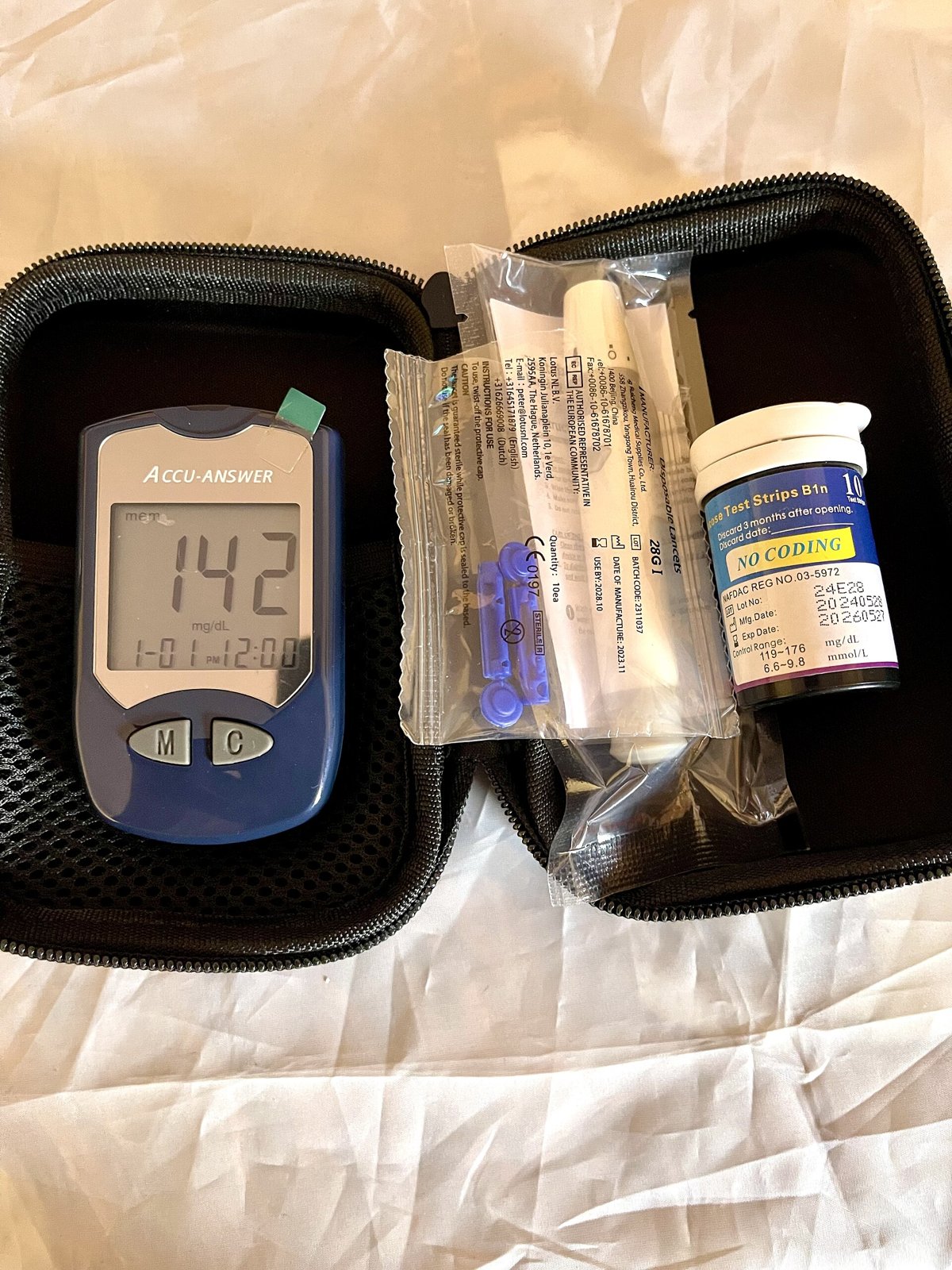
The quantity limits are 300 strips and 300 lancets every three months if you use insulin, and 100 of each if you don’t. If your doctor says more is medically necessary and you meet the other requirements, Medicare will allow extra strips and lancets. You may need to keep a log showing how often you actually test.
The CMS booklet adds three rules that cause a lot of claim problems:
- You need a new prescription every 12 months for test strips and lancets.
- You must ask for refills yourself. Medicare won’t pay for supplies a company sends you automatically.
- Use a Medicare-enrolled supplier, such as a pharmacy or medical supply company, that accepts assignment. If you get misleading ads or unrequested shipments, call 1-800-MEDICARE.
Continuous glucose monitors
Part B may cover a CGM and its sensors if your doctor evaluates you and confirms that:
- You take insulin, or you have a history of problems with low blood sugar.
- You or your caregiver have had enough training to use it.
After you start, you need routine in-person or Medicare-approved telehealth visits with your doctor. My Medicare CGM guide goes through the paperwork and costs in more detail.
The 2028 change
CMS has announced that from January 1, 2028, CGMs and insulin pumps covered under Part B will be paid on a bundled monthly rental basis, with one monthly payment covering the device and supplies (CMS supplier notice). If you already own your device as of December 31, 2027, Medicare will keep paying for your supplies until the device reaches the end of its useful life, is lost or damaged, or you need a new one, though for many devices you’ll need to use a contract supplier. Your coverage stays under Part B.
Insulin and syringes
Since 2023, insulin has been capped at $35 for a month’s supply:
- Part B covers insulin used with a traditional insulin pump that’s covered as durable medical equipment. You pay no more than $35 a month and no deductible.
- Part D covers insulin you inject with pens or syringes, and insulin in disposable patch-style pumps, for no more than $35 for each covered insulin per month, with no deductible (Medicare.gov insulin).
Part D also covers syringes, needles, alcohol swabs and gauze used to inject insulin, plus oral diabetes medicines and newer injectable drugs. Since 2025, Part D has an out-of-pocket cap, $2,100 in 2026 and $2,400 in 2027. If you’re comparing plans during Open Enrollment (October 15 to December 7), my Part D 2027 guide explains how.
Diabetic shoes: what Medicare covers and how to qualify
Yes, Medicare covers diabetic shoes, but only one kind and only with paperwork. Part B calls them “therapeutic shoes and inserts.” Here is what you can get each calendar year, from Medicare.gov and the CMS diabetes supplies booklet (July 2026):
| Option | What you get each year | When it fits |
|---|---|---|
| Extra-depth shoes (also called depth-inlay) | 1 pair of shoes and 3 pairs of inserts | Most people. The shoe has extra room for a custom insert. |
| Custom-molded shoes | 1 pair of shoes (inserts included) and 2 more pairs of inserts | Only if a foot deformity means you cannot wear extra-depth shoes |
| Inserts or shoe changes instead | Separate inserts or changes to a shoe, in some cases | When your doctor says that works better than new shoes |
| Regular “orthopedic” shoes | Not covered | Shoes for feet that are impaired but intact are on Medicare’s not-covered list |
Who qualifies. You must have diabetes and severe diabetes-related foot disease. The doctor who treats your diabetes has to certify three things:
- You have diabetes.
- You have at least one of these in one or both feet: a foot deformity, calluses that could lead to ulcers, nerve damage from diabetes with signs of callus problems, a past foot ulcer, poor circulation, or a partial or full foot amputation.
- You are treated under a full diabetes care plan and need the shoes because of your diabetes.
How to get them covered, step by step:
- Ask the doctor who manages your diabetes to certify your need. This is often your primary care doctor, not the foot doctor.
- Get the prescription from a podiatrist (foot doctor) or another qualified provider.
- Get fitted by a supplier who is enrolled in Medicare: a podiatrist, pedorthist (a shoe fitting specialist), orthotist or prosthetist.
- Ask the supplier if they accept assignment. If they do, they can charge only your 20% and any deductible left. If they do not, Medicare.gov says there is no limit on what they can charge you.
What I would do before December 31: the shoe benefit resets every calendar year, and so does the Part B deductible. If you have already met the 2026 deductible and have not used this year’s pair, getting fitted in December means you pay only the 20%. Wait until January and you may owe the new $292 deductible first. The most common reason claims fail is paperwork. Make sure the certifying doctor saw you for your diabetes and wrote it down before you order.
If you have diabetic peripheral neuropathy with loss of protective sensation, Part B also covers a foot exam and treatment every six months. See my Medicare foot care guide.
Training and other services
- Diabetes self-management training: up to 10 hours in the first year (1 hour one-on-one and 9 hours in a group), then 2 hours of follow-up each year, with a written order from your provider.
- Medical nutrition therapy with a registered dietitian, at no cost if your provider accepts assignment, when referred by a doctor.
- A1C tests at no cost.
- The ACCESS model: starting July 5, 2026, Original Medicare is testing a voluntary program that connects your doctor with partners to help manage chronic conditions like diabetes, including at-home tech tools.
My guide to diabetes management for seniors covers the treatment side.
Lowering your costs
The 20% for supplies adds up over a year. A Medigap Plan G vs Plan N guide can cover most or all of it. Medicare Advantage plans cover the same supplies, but often require you to use preferred brands or suppliers, so check before you switch.
Common questions
How many test strips does Medicare cover?
Up to 300 test strips and 300 lancets every three months if you use insulin, and 100 of each if you don’t. More may be covered if your doctor documents the need.
Does Medicare cover CGMs in 2026?
Yes, under Part B, if you take insulin or have a history of low blood sugar, you’ve been trained to use it, and you keep up routine visits with your doctor. You pay 20% after the deductible.
Are CGMs moving to Part D?
No. CGMs stay under Part B. Starting January 1, 2028, Medicare will pay suppliers for CGMs and insulin pumps through a bundled monthly rental, still under Part B.
Does Medicare cover insulin syringes and pen needles?
Yes, under Part D, as long as they’re used to inject insulin. Insulin itself costs no more than $35 a month.
Does Medicare cover diabetic shoes, and how often?
Yes. Part B covers one pair of extra-depth shoes with 3 pairs of inserts, or one pair of custom-molded shoes with 2 more pairs of inserts, every calendar year. The doctor treating your diabetes must certify the need, and you pay 20% after the deductible.
Why was my diabetic supply order denied?
Common reasons are an expired prescription (you need a new one every 12 months), automatic shipments you didn’t request, a supplier not enrolled in Medicare, or quantities above the limit without your doctor’s documentation.
2027 amounts added Nov 18, 2026 from the CMS 2027 Parts A and B fact sheet.
Written by Khasim Basha Shaik. I research and compare Medicare coverage rules for readers. I’m not a licensed insurance agent or medical professional. This article summarizes Medicare.gov and CMS materials and isn’t medical advice. Last reviewed November 23, 2026.