Medicaid for Seniors in 2026: Eligibility Limits, Spend-Down Rules and How to Qualify for Nursing Home Care

Medicaid is the main payer for long-term nursing home care in the U.S., and Medicare isn’t. Medicare covers only short-term skilled nursing after a hospital stay. When a parent needs months or years of care, families usually end up asking two questions: does Mom qualify for Medicaid, and if not, what’s a “spend-down”?
A spend-down is how people whose income or savings are above Medicaid’s limits can still qualify. You either use excess income on medical bills, or reduce countable assets to the limit in ways the rules allow. Do it wrong, especially by giving money away, and you can trigger months of ineligibility.
I’m a researcher, not an elder law attorney or a licensed agent. Medicaid rules differ a lot by state, and the stakes are high. Before you move money, talk to your state Medicaid office, a SHIP counselor, or an elder law attorney. The federal figures below come from CMS and Social Security.
Three ways seniors qualify for Medicaid
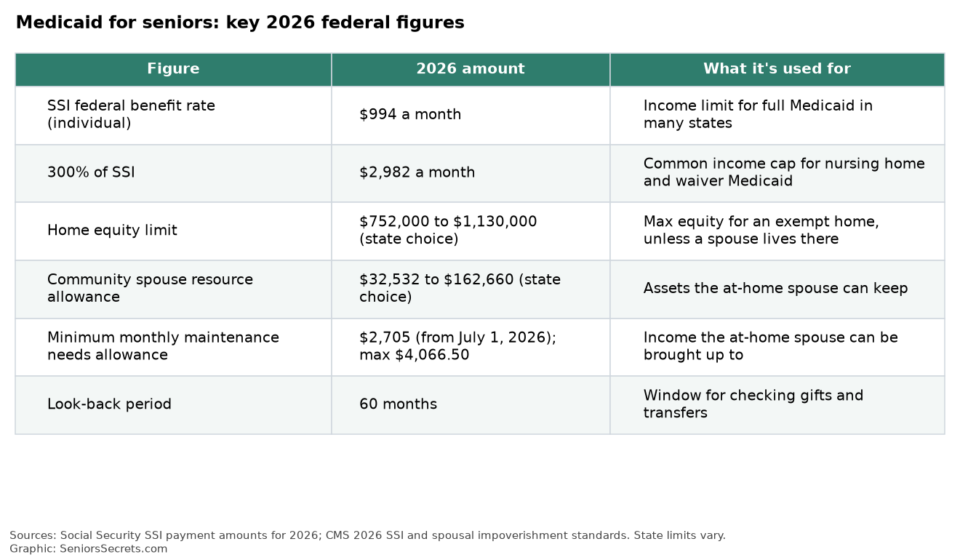
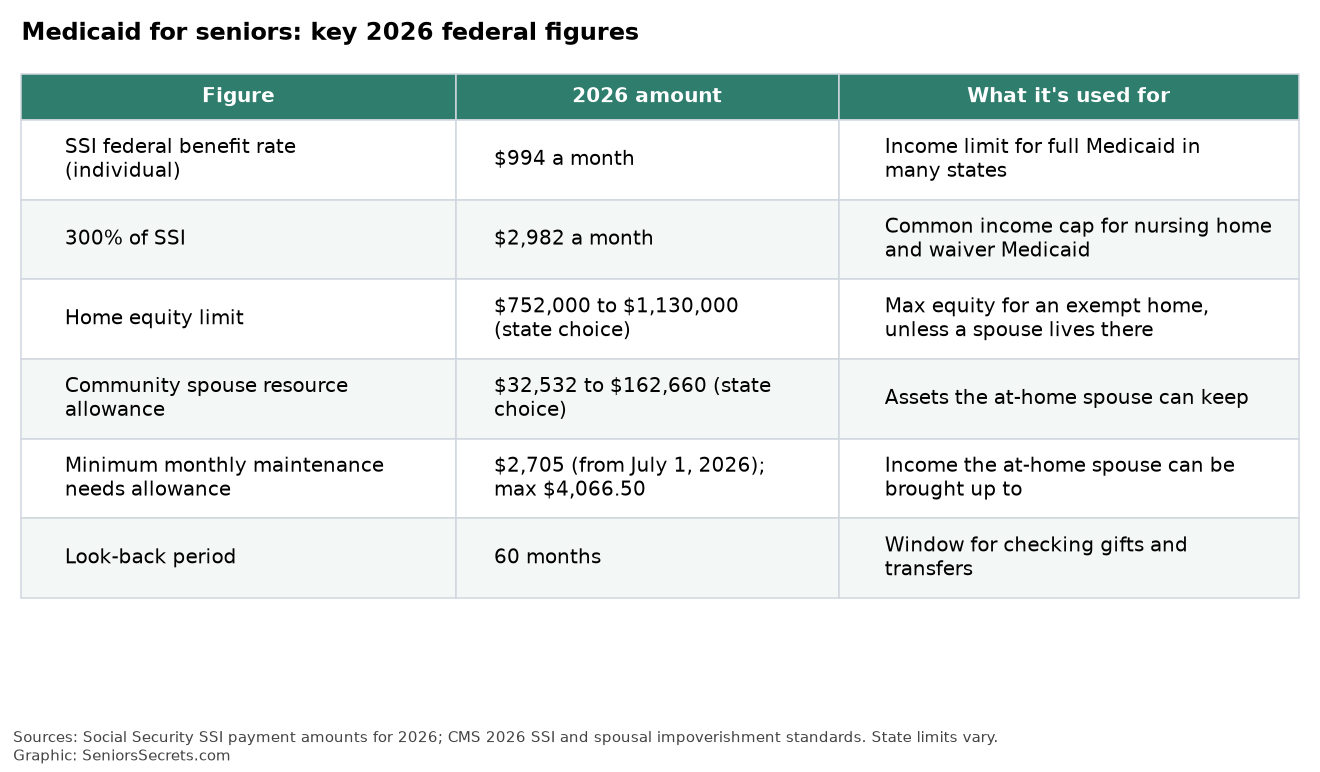
- Full Medicaid based on low income and assets. In many states, the income limit for people 65 and older is tied to the federal SSI benefit, $994 a month for an individual in 2026 according to Social Security. Some states go higher. The asset limit is often $2,000 for a single person, but it varies.
- Medicaid for nursing home or home care (long-term services). These programs often allow higher income, sometimes up to 300% of the SSI rate, which is $2,982 a month in 2026. People above that may still qualify through spend-down or a special trust, depending on the state.
- Medicare Savings Programs. These are run by Medicaid offices but only help with Medicare costs. They have their own, higher limits. See my guide to Medicare Savings Programs.
How income spend-down works
Many states run a “medically needy” program. If your income is above the Medicaid limit, you can still qualify once your medical bills have “used up” the excess. It works a bit like a deductible.
Example: Say your state’s medically needy income limit is $1,000 a month and your income is $1,600. Your spend-down amount is $600 a month. Once you’ve had $600 in medical expenses that month, Medicaid covers the rest. States may measure this monthly or over a longer period.
Income-cap states work differently. Some states don’t have a medically needy program for nursing home care. Instead, they set a hard income cap, often $2,982 a month in 2026. If your income is higher, you may need a Qualified Income Trust, often called a “Miller trust.” Your excess income goes into the trust each month and is used for care costs. The rules are technical, so this is where an elder law attorney earns their fee.
How asset spend-down works
If your countable assets are above your state’s limit, you need to reduce them before Medicaid will pay. The key word is countable.
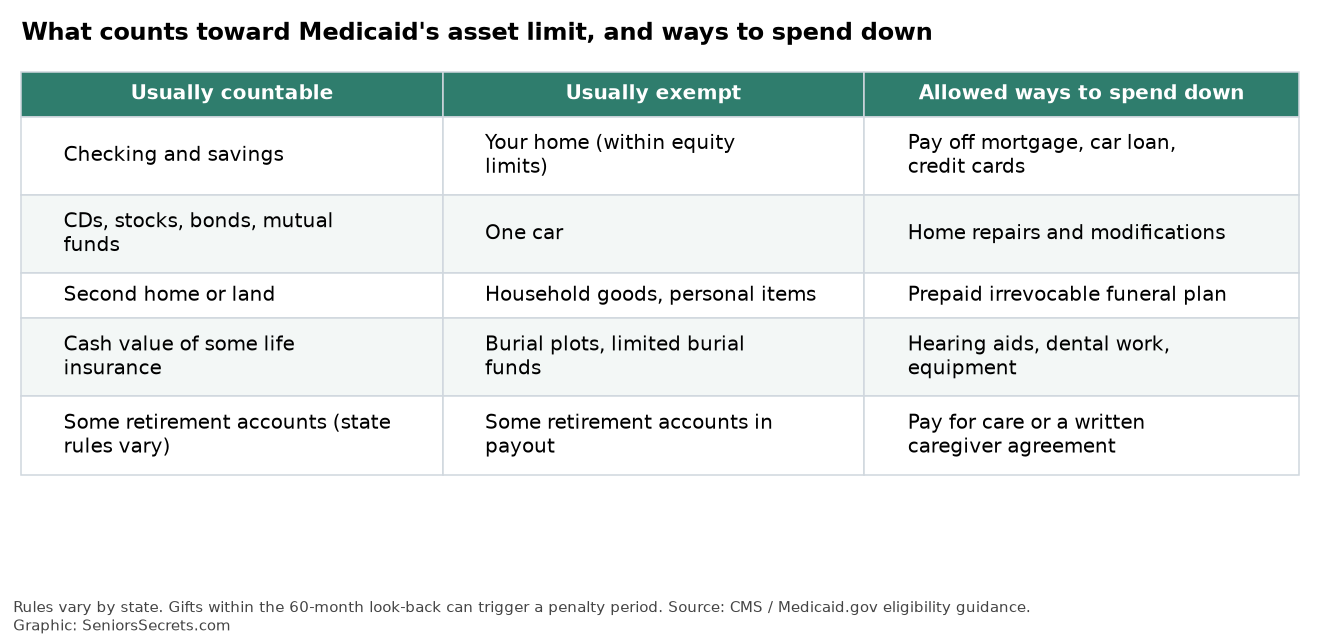
What usually doesn’t count
- Your home, within limits. If you or your spouse live there, or you intend to return, it’s usually exempt. Federal rules cap the home equity you can have, between $752,000 and $1,130,000 in 2026 depending on the state, unless a spouse or certain relatives live there.
- One car.
- Household goods and personal belongings.
- Burial plots and, within limits, money set aside for burial.
- Some retirement accounts, depending on the state and whether they’re paying out.
What usually counts
Checking and savings accounts, CDs, stocks, bonds, mutual funds, second homes, and the cash value of some life insurance.
Legitimate ways to spend down
- Paying off debts like a mortgage, car loan or credit cards.
- Home repairs and modifications, such as a ramp, a walk-in shower or a new roof.
- Buying a prepaid, irrevocable funeral plan.
- Replacing an old car with a reliable one, since one car is exempt.
- Paying for care, medical equipment, hearing aids or dental work.
- Paying a family caregiver under a written, fair-market caregiver agreement.
The 5-year look-back
This is the rule that costs families the most. When you apply for long-term care Medicaid, the state looks back 60 months at every asset transfer. Gifts or sales below fair value during that time can trigger a penalty period when Medicaid won’t pay for care.
The penalty length is the amount transferred divided by your state’s average monthly cost of nursing home care, called the penalty divisor. If your state’s divisor is $10,000 and you gave your son $60,000 three years ago, you’d face roughly 6 months without Medicaid coverage, starting when you’d otherwise qualify. That’s often the worst possible time.
A few transfers are allowed without penalty, such as transfers to a spouse or to a disabled child. Your state’s rules list them. Keep receipts for every spend-down purchase, because the state will ask.
Protections for a spouse at home
When one spouse needs nursing home care and the other stays at home, federal “spousal impoverishment” rules keep the at-home spouse from losing everything. CMS sets the ranges each year (see Medicaid.gov’s spousal impoverishment page):
- Community spouse resource allowance: the at-home spouse can keep a share of the couple’s countable assets. In 2026 the federal range is $32,532 to $162,660, and each state chooses where it falls.
- Monthly income allowance: if the at-home spouse’s own income is low, some of the nursing home spouse’s income can be shifted to them. The minimum standard is $2,705 a month from July 1, 2026, and the maximum is $4,066.50.
- The home stays exempt while the spouse lives there.
These rules are why couples should never spend down blindly. The at-home spouse may be entitled to keep much more than a single person could.
Estate recovery: will Medicaid take the house?
Federal law requires states to try to recover what Medicaid paid for long-term care for people 55 and older, usually from the estate after death. The house is often the main asset in the estate.
There are important protections. States can’t recover while a surviving spouse is alive, or while a child under 21 or a disabled child is living. Many states offer hardship waivers. Medicare Savings Program benefits are exempt from estate recovery. Ask your state for its specific rules before you apply.
How to apply
- Contact your state Medicaid agency or Area Agency on Aging. Ask specifically about long-term care Medicaid, home and community-based services, and medically needy rules.
- Gather five years of financial records: bank statements, investment statements, property deeds, insurance policies, and records of any gifts.
- Apply as soon as you might qualify. Many states can cover up to three months before the application month if you qualified then.
- Don’t move money until you understand the look-back. Even well-meant gifts to family can delay coverage.
Medicaid also pays for care at home in many states through waiver programs, often with waitlists. See my guide to Medicaid waiver programs. If your loved one has Medicare and Medicaid, a D-SNP can coordinate both.
A worked example
Margaret, 84, is widowed and moving to a nursing home. She has $38,000 in savings and $1,850 a month in Social Security and pension. Her state’s long-term care asset limit is $2,000, and it has a medically needy program.
- Margaret’s daughter pays off Margaret’s $4,000 credit card balance, buys a $9,000 irrevocable funeral plan and replaces her hearing aids for $5,000, all from Margaret’s own money.
- The remaining $20,000 or so goes toward nursing home bills for a couple of months.
- Once her countable assets are under $2,000, she applies. Most of her monthly income goes to the nursing home as her share of cost, minus a small personal needs allowance. Medicaid pays the rest.
What she doesn’t do is give $30,000 to her grandchildren. That gift would have triggered a penalty period right when she needed coverage.
For how Medicare’s short-term skilled nursing coverage fits in before Medicaid starts, see Medicare skilled nursing coverage. For the bigger picture, read long-term care planning.

FAQ
What is the Medicaid income limit for seniors in 2026?
It depends on your state and the program. Many states use the SSI level, $994 a month for an individual in 2026, for full Medicaid. Nursing home programs often allow up to $2,982 a month, and spend-down or a Miller trust can help people above that.
Can I give money to my children to qualify for Medicaid?
Gifts made within 5 years before you apply for long-term care Medicaid can trigger a penalty period. Talk to an elder law attorney before making any transfers.
Does Medicaid take your house?
The home is usually exempt while you or your spouse live there. After death, states may seek repayment from the estate for long-term care costs, with protections for surviving spouses and certain children.
How much money can I keep and still get Medicaid?
Often $2,000 for a single person, though some states allow more. A spouse living at home can keep much more, between $32,532 and $162,660 in 2026, depending on the state.
Do all states offer a Medicaid spend-down?
No. Many states have medically needy spend-down programs. Others use an income cap and a Qualified Income Trust instead.
Related guides

Social Security Retroactive Benefits: Who Can Get a Lump Sum of Up to 6 Months, and What It Costs You

CSFP Senior Food Box: Who Qualifies for the Free Monthly USDA Groceries, 2026 Income Limits, and How to Apply

Weatherization Assistance Program for Seniors: Who Qualifies, What It Covers, and How to Apply