Weatherization Assistance Program for Seniors: Who Qualifies, What It Covers, and How to Apply

The U.S. Department of Energy’s Weatherization Assistance Program (WAP) pays for free energy upgrades that make homes safer and cheaper to heat and cool. DOE says households save about $372 or more a year on average after the work, and the program has helped more than 7.2 million families since 1976. With DOE funds, it supports about 8,500 jobs and weatherizes roughly 32,000 homes a year. Older adults get priority, along with households with a disability, children, or a high energy burden.
You apply through your state or local weatherization agency, not directly with DOE. Details below come from DOE’s WAP page and How to Apply, checked October 12, 2026.
Who qualifies
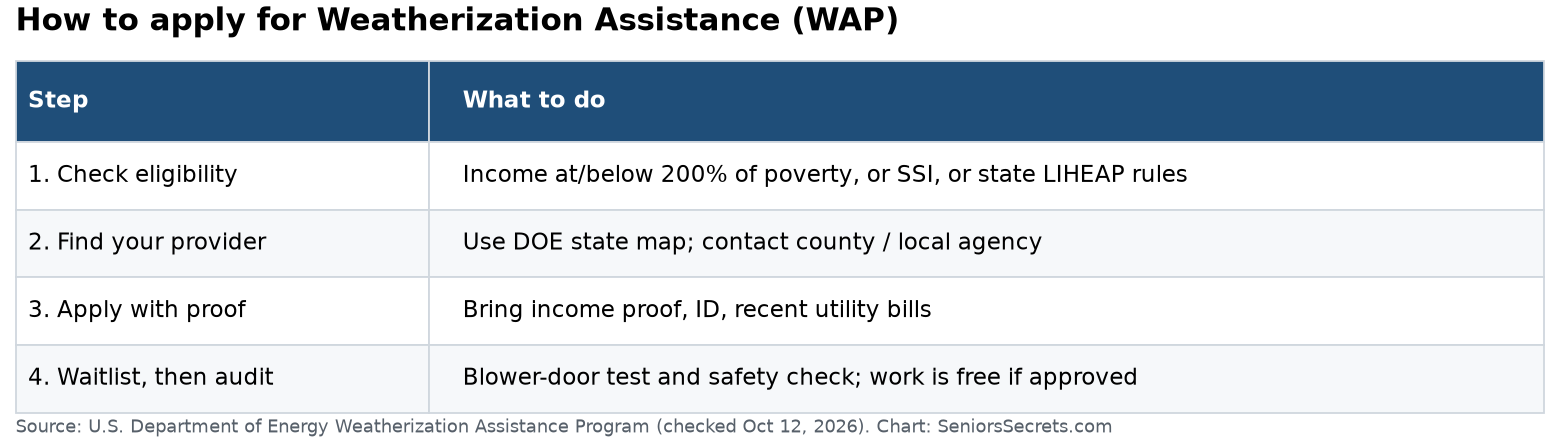
Under DOE rules, your household is eligible if:
- Income is at or below 200% of the federal poverty guidelines, or
- Someone in the household receives Supplemental Security Income (SSI), or
- Your state uses LIHEAP income rules (up to 60% of state median income)
Both homeowners and renters can apply. Renters need the landlord’s permission. Priority goes to seniors, people with disabilities, families with children, and high-energy users.
Exact income cutoffs and documents vary by state. Use DOE’s state map on the how-to-apply page to find your agency. Bring proof of income for the prior year — Social Security statements, an SSI award letter, a tax return or pay stubs are the usual set.
What the work usually includes
After you’re income-approved and reach the top of the waitlist, a trained energy auditor visits your home. The audit typically includes a review of your energy bills, a blower-door test for air leaks, and a safety check on heating equipment and living areas (attic, basement, living space). Then a crew or contractor does the most cost-effective fixes, which often include:
- Sealing air leaks around windows, doors and attic hatches
- Adding insulation in the attic, walls or floors
- Tuning or replacing unsafe heating systems
- Fixing ventilation and moisture problems that affect health and energy use
When the work is done, an inspector checks that it meets DOE’s Standard Work Specifications. You don’t pay for the audit or the approved measures. Window replacement sometimes happens when a cost-effectiveness test supports it, but sealing leaks and adding insulation are the more common first steps.
How to apply
- Find your state weatherization agency on DOE’s how-to-apply map.
- Call or apply online with the local provider for your county. Bring proof of income.
- Get on the waitlist if you’re income-eligible. Wait times vary by county and season.
- Prepare for the audit. Be home for the visit, clear access to the attic and furnace, and have recent utility bills ready.
If you’re a renter, the provider will work with you and your landlord for written permission before work starts. Don’t wait for a cold snap to call; winter waitlists are often longest.
Documents to gather before you call
Having paperwork ready shortens the intake call and keeps you from bouncing between offices:
- Photo ID and Social Security number for each household member on the application
- Proof of income for the past 12 months (award letters, 1099s, tax return, or pay stubs)
- Recent electric and gas bills (12 months if you have them)
- Proof of homeownership or a lease, plus a landlord contact if you rent
- A list of health or safety concerns (gas smell, no heat, mold, broken stairs to the attic)
If English isn’t your first language, ask the agency whether they offer interpreter help. Many Community Action Agencies already do.
How WAP fits with LIHEAP and other help
WAP is about permanent fixes to the house. LIHEAP is about paying the bill this month. Many households use both. DOE also points people to related programs such as USDA single-family repair loans and grants for very low-income rural homeowners, Community Services Block Grant help through local Community Action Agencies, and disaster aid after a declared emergency.
If the bigger problem is a leaking roof or unsafe stairs rather than drafts, see my guide to free home-repair programs for seniors. If phone or internet bills are the squeeze, see Lifeline.
What to expect on audit day
Plan on being home for a few hours. The auditor needs access to the attic, basement or crawl space, furnace or heat pump, and exterior walls. Pets should be secured. Ask for a written scope of work before crews arrive, and keep copies of every form you sign. After the work, insist on the final inspection — that’s your check that equipment is operating safely.
Common questions
Is weatherization free for seniors?
Yes, if you qualify. The program covers the energy audit and approved weatherization work at no cost to the household.
Can renters get weatherization help?
Yes. Both homeowners and renters can apply; renters need the landlord’s permission.
What income qualifies for WAP?
DOE sets eligibility at or below 200% of the poverty guidelines, or SSI receipt. States may also use LIHEAP income rules (up to 60% of state median income).
How long does weatherization take?
After you’re selected from the waitlist, the audit and work are usually completed over several days to a few weeks, depending on the home and local crew schedules.
Does WAP replace windows?
Sometimes, when a cost-effectiveness test supports it, but sealing leaks and adding insulation are more common first steps.
Written by Khasim Basha Shaik. I research benefit programs for seniors and compare official sources for readers. I’m not affiliated with DOE or any weatherization contractor. Figures come from energy.gov. Last reviewed October 12, 2026.
Related guides
Social Security Retroactive Benefits: Who Can Get a Lump Sum of Up to 6 Months, and What It Costs You

CSFP Senior Food Box: Who Qualifies for the Free Monthly USDA Groceries, 2026 Income Limits, and How to Apply

Lifeline for Seniors 2026: The $9.25 Phone and Internet Discount, Who Qualifies, and How to Apply