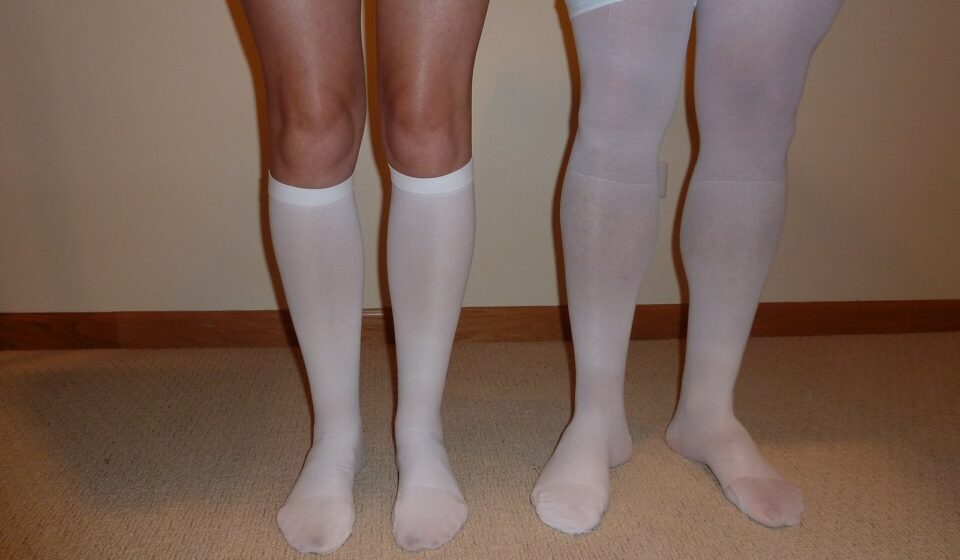

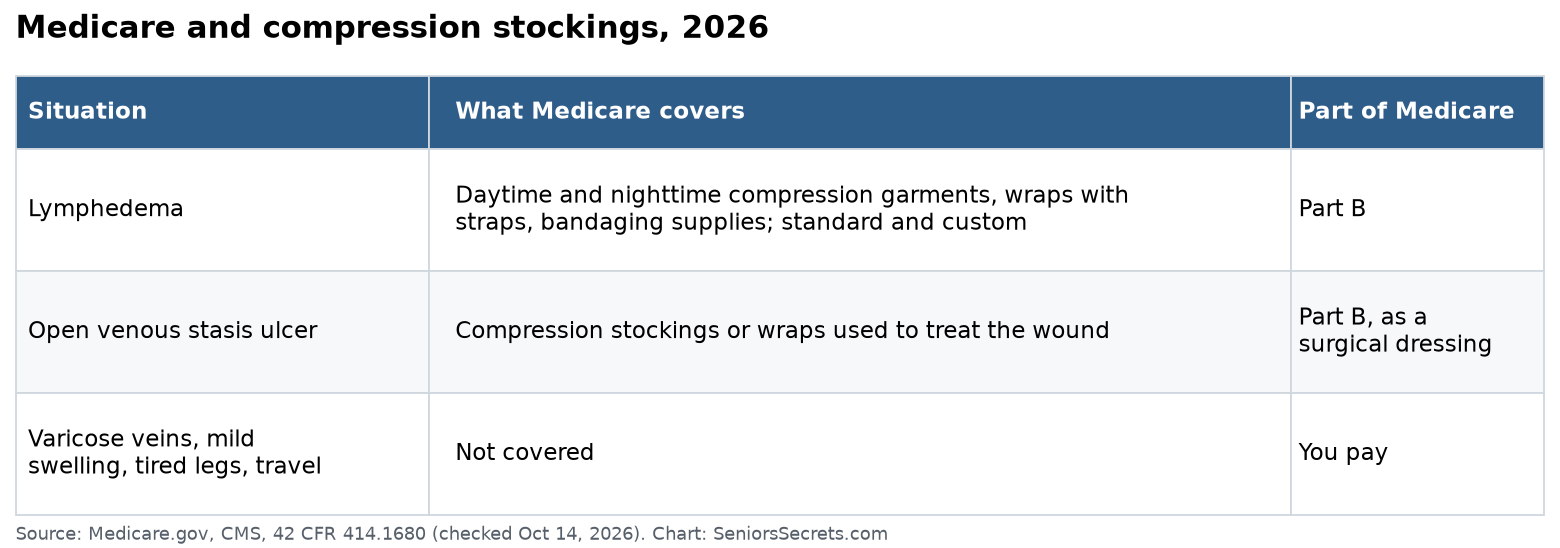
Yes, Medicare covers compression stockings in 2026, but only in two cases: when you have lymphedema, or when they are part of treating an open venous stasis ulcer (a leg wound from poor vein flow). For tired legs, mild swelling, varicose veins or travel, Original Medicare does not pay. When covered, you pay 20% after the $283 Part B deductible (Medicare.gov).
Many people are surprised by this. A doctor may tell you to wear compression, but that alone does not make it covered. This guide explains the two paths to coverage, how often Medicare replaces garments, what you pay and how to avoid a denial.
The two ways Medicare pays
| Situation | What Medicare covers | Part of Medicare |
|---|---|---|
| Lymphedema | Daytime and nighttime compression garments, wraps with straps, bandaging supplies; standard and custom | Part B |
| Open venous stasis ulcer | Compression stockings or wraps used to treat the wound | Part B, as a surgical dressing |
| Varicose veins, mild swelling, tired legs, travel | Not covered | You pay |
Path 1: Lymphedema
Lymphedema is long-lasting swelling caused by a damaged lymph system. It often follows cancer surgery, radiation or infection. Before 2024, Medicare treated compression garments for lymphedema as comfort items. The Lymphedema Treatment Act changed that on January 1, 2024.
Now Part B covers, if your doctor orders them:
- Gradient compression garments, standard and custom-fitted
- Compression wraps with adjustable straps (like Velcro wraps)
- Nighttime garments
- Bandaging supplies used in treatment
Path 2: An open venous ulcer
This rule is older. If you have an open leg ulcer caused by poor vein flow, Medicare covers compression as part of wound care. The wound must be open. Once it heals, this path ends, unless you also have lymphedema.
How often Medicare replaces garments
Under federal rules (CMS and 42 CFR 414.1680), for each affected body part:
| Item | How many | How often |
|---|---|---|
| Daytime garments or wraps | Up to 3 | Every 6 months |
| Nighttime garments | Up to 2 | Every 2 years |
Medicare can replace items sooner if they are lost, stolen or damaged beyond repair, or if your body changes and you need a new size or type.
Three daytime garments lets you wear one, wash one and keep a spare. Compression wears out with washing, so stick to the schedule.
What you pay in 2026
- Part B deductible: $283 for the year
- Coinsurance: 20% of the Medicare-approved amount after that
- Medigap: most Medigap plans pay some or all of the 20%
- Medicare Advantage: must cover what Original Medicare covers, but may need prior approval and in-network suppliers
Example: if Medicare approves $150 for a set of custom garments and you have met your deductible, you pay $30.
Use a supplier that accepts Medicare assignment. Then they cannot charge you more than the approved amount. Find one with Medicare’s supplier directory.
Lymphedema or ordinary swelling?
This difference decides coverage, so it helps to know the signs. Ordinary swelling (edema) often gets better overnight or when you raise your legs. It is common with heart, kidney or vein problems, long standing, and some medicines like amlodipine.
Lymphedema is different:
- It often affects one side more than the other
- Swelling does not go away fully overnight
- The skin may feel thick, tight or hard over time
- It often follows cancer surgery, lymph node removal, radiation or a serious infection
- Your second toe or finger may be hard to pinch up (called Stemmer’s sign)
If you think you have lymphedema, ask your doctor for an exam. A referral to a certified lymphedema therapist can confirm it and start treatment. That therapy, often called complete decongestive therapy, may also be covered by Part B as physical or occupational therapy.
How to get them covered, step by step
- Get a diagnosis in your record. Your doctor must document lymphedema or an open venous ulcer. “Leg swelling” or “edema” alone is not enough.
- Get a written order. It should name the item, the pressure level and the body part.
- Get measured. A trained fitter or therapist should measure you. Custom garments need careful measurements.
- Pick a Medicare-enrolled supplier that accepts assignment.
- Keep copies of the order and notes.
- Track the dates, so you know when you can reorder.
Why claims get denied
- The record says “edema” or “varicose veins,” not lymphedema
- The ulcer had already healed
- The supplier is not enrolled in Medicare
- The order is missing the item details
- You reordered before the 6-month or 2-year limit
If you get denied, ask the supplier which detail was missing. You have the right to appeal. The steps are on your Medicare Summary Notice.
If you are not covered
Many older adults wear compression for mild swelling or varicose veins. If Medicare will not pay:
- Off-the-shelf stockings cost about $15 to $60 a pair at drugstores and online.
- Medicare Advantage extras: some plans give an over-the-counter allowance you can use for support hose. Check your plan.
- HSA or FSA funds may cover them if you still have one from work.
Wearing them correctly
- Put them on in the morning, before swelling builds.
- Use a donning aid or rubber gloves if your hands are weak.
- Take them off at night unless your doctor says otherwise.
- Check your skin daily for redness or sores, especially if you have diabetes.
- Wash by hand and air dry.
Important: people with poor artery blood flow (peripheral artery disease) can be harmed by strong compression. Your doctor may check the pulse in your feet or do a simple test first.
Common questions
Does Medicare cover compression stockings for varicose veins?
No, not on their own. Coverage needs lymphedema or an open venous ulcer.
How many compression garments does Medicare cover?
For lymphedema, up to 3 daytime garments per affected body part every 6 months and up to 2 nighttime garments every 2 years.
Does Medicare cover custom compression garments?
Yes, for lymphedema, if custom-fitted garments are medically needed.
How much do I pay for compression stockings with Medicare?
20% of the approved amount after the $283 Part B deductible in 2026. Medigap may cover the 20%.
Do Medicare Advantage plans cover compression stockings?
They must cover lymphedema items like Original Medicare. Some also give extra allowances for support hose.
Do I need a prescription for Medicare to pay?
Yes. You need a written order from your doctor or other provider, and a diagnosis of lymphedema or an open venous ulcer in your record.
Does Medicare cover compression pumps?
Medicare may cover pneumatic compression devices for lymphedema under separate rules. Ask your doctor.
Written by Khasim Basha Shaik. I research Medicare and senior health for readers and summarize official sources. I’m not a doctor or licensed insurance agent. Check with your doctor and your plan before you order. Last reviewed October 14, 2026.