Does Medicare Cover Cancer Treatment? What Parts A, B and D Pay, at Any Age, and How to Limit Your Costs
Yes. Medicare covers cancer treatment, and there is no age limit. A 76-, 86- or 96-year-old with Medicare has the same coverage for medically necessary chemotherapy, radiation, surgery and cancer drugs as a 66-year-old. Age limits apply only to some screening tests, not to treatment once cancer is found.
What changes is who pays: Part A covers hospital stays, Part B covers most treatment you get as an outpatient (usually 20% coinsurance after the $283 ($292 in 2027) deductible in 2026), and Part D covers many cancer pills you take at home, with a $2,100 yearly out-of-pocket cap in 2026.
Which part of Medicare pays for what
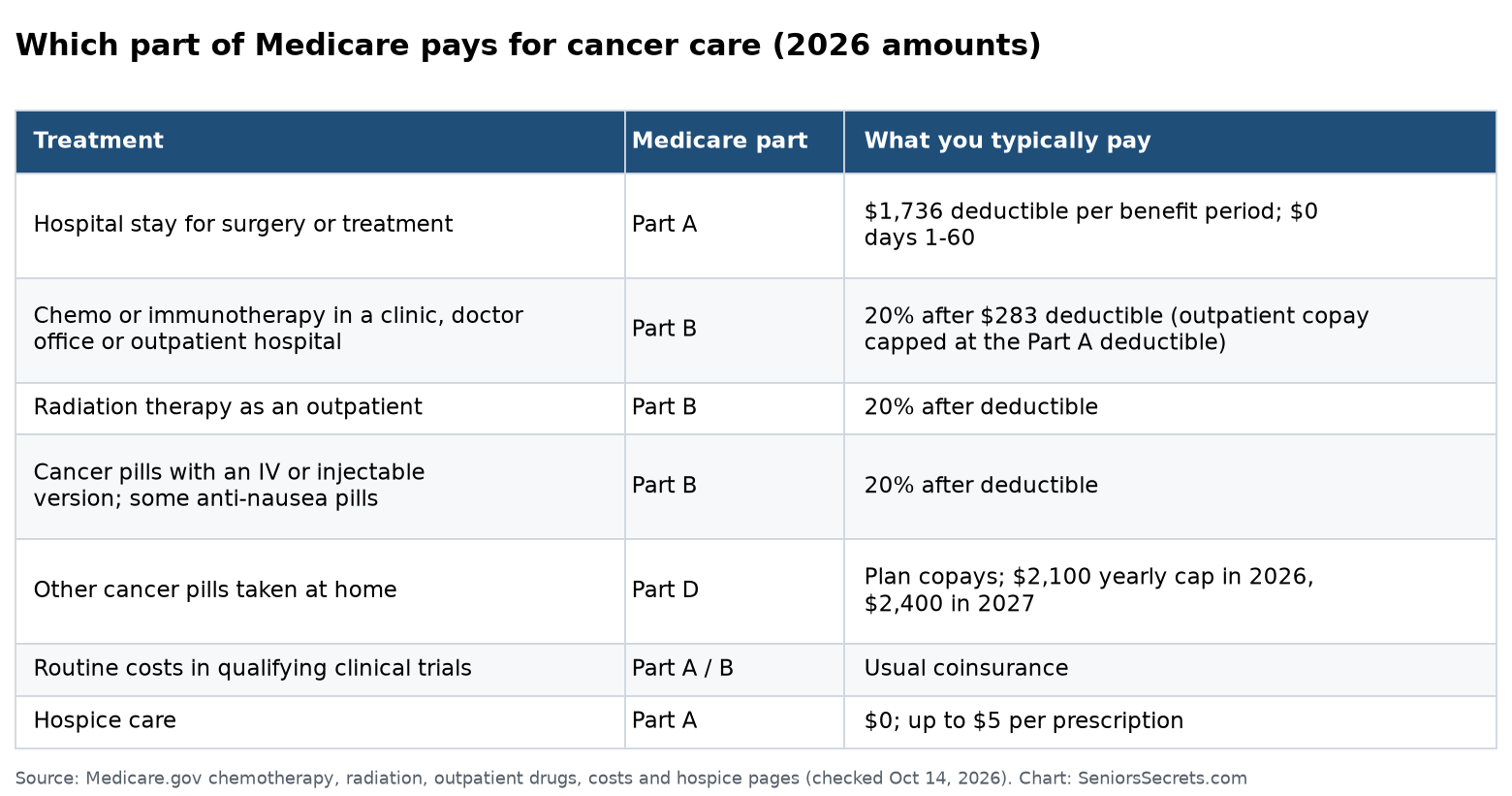
| Treatment | Medicare part | What you typically pay in 2026 |
|---|---|---|
| Hospital stay for surgery or treatment | Part A | $1,736 ($1,776 in 2027) deductible per benefit period, then $0 for days 1 to 60 |
| Chemotherapy or immunotherapy in a clinic, doctor’s office or hospital outpatient department | Part B | 20% after the $283 deductible |
| Outpatient radiation therapy | Part B | 20% after the deductible |
| Cancer pills that also come as an IV or injection (or a prodrug of one), and some anti-nausea pills | Part B | 20% after the deductible |
| Other cancer pills taken at home | Part D | Plan copays, up to the $2,100 cap |
| Hospice care | Part A | $0, plus up to $5 per prescription for symptom relief |
Sources: Medicare.gov chemotherapy, radiation therapy, Part B drugs, and costs.
Chemotherapy, immunotherapy and other infused drugs
Part A covers chemotherapy if you’re a hospital inpatient. Part B covers it if you’re an outpatient or get it in a doctor’s office or freestanding clinic. Medicare.gov notes that in a hospital outpatient setting, your copayment for chemotherapy won’t be more than the Part A inpatient deductible ($1,736 in 2026) for a single service.
Part B also covers most injectable and infused drugs a licensed provider gives you, which includes most immunotherapy and targeted drugs given by IV. Because these drugs can be very expensive, 20% of the approved amount can add up quickly. For some Part B drugs whose prices rise faster than inflation, your coinsurance can be lower; Medicare updates that list each quarter.

Cancer pills: Part B or Part D?
This trips up a lot of people. Medicare.gov says Part B covers some cancer drugs you take by mouth if the same drug is available in an injectable form, or if it’s a prodrug that breaks down into the injectable drug’s active ingredient. Part B also covers anti-nausea pills taken before, during or within 48 hours of chemotherapy.
Most other oral cancer drugs fall under Part D. Since 2025, Part D has a yearly out-of-pocket cap: $2,100 in 2026, rising to $2,400 in 2027. Once you hit it, you pay nothing more for covered drugs that year. If a big bill early in the year is a problem, the Medicare Prescription Payment Plan lets you spread those costs into monthly payments.
If you’re picking a 2027 drug plan during Open Enrollment (October 15 to December 7), check that your exact cancer drugs are on the plan’s list and whether the plan uses a specialty pharmacy. My Part D 2027 guide walks through the comparison.
Radiation, surgery and reconstruction
- Radiation therapy: Part A covers it for inpatients; Part B covers it for outpatients and freestanding clinics, at 20% after the deductible.
- Surgery: inpatient surgery falls under Part A (the $1,736 deductible each benefit period); outpatient surgery under Part B.
- After a mastectomy: Part A covers surgically implanted breast prostheses if the surgery is inpatient, and Part B covers it in an outpatient setting. Part B also covers some external breast prostheses, including a post-surgical bra (Medicare.gov breast prostheses).
Newer treatments and clinical trials
- CAR T-cell therapy: Medicare covers this personalized immune-cell treatment for medically accepted cancer uses under a national coverage determination (CMS NCD 110.24).
- Clinical trials: Parts A and B cover some costs in certain clinical research studies, such as office visits and tests, usually with your normal 20% coinsurance (Medicare.gov clinical research studies). Ask the trial team which costs the study pays and which go to Medicare.
Screening has age limits; treatment doesn’t
Some screenings stop at certain ages, which is likely where the “age cutoff” idea comes from:
- Lung cancer screening with low-dose CT is covered yearly from ages 50 to 77 for people with at least a 20 pack-year smoking history who smoke now or quit within 15 years (Medicare.gov).
- Screening mammograms are covered every 12 months for women 40 and older, with no upper age limit (Medicare.gov).
- My list of free Medicare preventive screenings covers the rest, including colorectal screening.
Once a doctor diagnoses cancer, tests and treatment are judged on medical need, not age.
Keeping the 20% from adding up
Original Medicare has no yearly out-of-pocket limit on Part A and B costs. For cancer care, that’s the biggest risk. Your options:
- Medigap. A supplement policy covers most or all of the 20% coinsurance and Part A deductible. Plan G and Plan N are common choices. My Medigap comparison explains the differences. Outside your first enrollment window, insurers in most states can ask health questions, so don’t drop a Medigap policy after a diagnosis.
- Medicare Advantage. Plans have a yearly in-network out-of-pocket maximum, but they usually require prior authorization and in-network cancer centers. Check that your oncologist and hospital are in the network before you enroll.
- Help with costs. If your income is limited, Medicare Savings Programs and Extra Help can lower premiums and drug costs.
- Ask for estimates. Ask the cancer center’s financial counselor for an estimate of your share for each phase of treatment.
If treatment stops working or you decide to focus on comfort, Medicare hospice coverage pays for symptom control at little or no cost.
Common questions
Does Medicare cover cancer treatment after age 76?
Yes. Medicare has no age limit on cancer treatment. Some screening tests have age ranges, such as lung cancer screening at 50 to 77, but treatment is covered when it’s medically necessary.
How much does chemotherapy cost with Medicare?
With Original Medicare, outpatient chemotherapy usually costs 20% of the approved amount after the $283 ($292 in 2027) Part B deductible in 2026. A hospital outpatient copay for a service won’t exceed the Part A deductible. Medigap can cover most of the 20%.
Does Medicare pay for oral chemotherapy pills?
Part B covers some oral cancer drugs that also come in an injectable form. Most other cancer pills are covered by Part D, with a $2,100 out-of-pocket cap in 2026 and $2,400 in 2027.
Does Medicare cover immunotherapy?
Yes. Infused immunotherapy given by a provider is generally covered under Part B at 20% after the deductible. CAR T-cell therapy is covered under a national coverage decision.
Does Medicare cover cancer clinical trials?
Medicare covers some costs in certain clinical trials, like office visits and tests, usually with your normal coinsurance. Ask the trial team what the study pays.
2027 amounts added Nov 18, 2026 from the CMS 2027 Parts A and B fact sheet.
Written by Khasim Basha Shaik. I research and compare Medicare coverage rules for readers. I’m not a licensed insurance agent or medical professional. This article summarizes Medicare.gov and CMS materials and isn’t medical, financial or legal advice. Last reviewed October 14, 2026.
Related guides