

If you have both Medicare and Medicaid, your mail this fall probably looks different from your neighbor’s. More of the ads, phone calls and glossy brochures are for one kind of plan: the Dual Eligible Special Needs Plan, or D-SNP. These plans are real, they can be a good fit, and they’ve grown fast. They also come with rules the advertising tends to skip.
This guide covers who can join a D-SNP, what you actually get, the enrollment windows that apply to you (they’re not the same as everyone else’s), and the changes that start in 2027. Medicare Open Enrollment runs October 15 to December 7, 2026, and new coverage starts January 1, 2027.
I’m a researcher who reads Medicare.gov, CMS documents and plan data for readers. I’m not a licensed insurance agent, I don’t sell plans, and no insurer pays this site. For free, unbiased one-on-one help, contact your State Health Insurance Assistance Program (SHIP). Everything below was checked against official sources on October 7, 2026.

What a D-SNP is
A D-SNP is a Medicare Advantage plan that only people with both Medicare and Medicaid can join. Like any Medicare Advantage plan, it’s run by a private insurer, covers everything Part A and Part B cover, and becomes the way you get your Medicare benefits instead of Original Medicare. You keep your Medicaid. According to Medicare.gov’s special needs plan page, every SNP:
- Includes Medicare drug coverage (Part D).
- Is an HMO or a PPO, so the network matters. Some cover out-of-network care at a higher cost; others only cover emergencies, urgent care away from home and dialysis outside the network.
- Provides care coordination and tailors its benefits, doctors and drug list to the group it serves.
- Can keep you only while you still qualify.
That last rule catches people out. If your Medicaid lapses, maybe because a renewal form got lost, the plan doesn’t have to drop you right away. CMS lets a special needs plan keep covering you for a “deemed continued eligibility” period of one to six months while you requalify. Each plan sets its own length and has to tell you what it is. If you don’t requalify in time, you’re disenrolled, and you get a Special Enrollment Period to choose other coverage. My advice: answer every Medicaid renewal letter the week it arrives.
D-SNPs are no longer a niche product. KFF counts nearly 8.2 million people in special needs plans in 2026, with 78% of that enrollment in D-SNPs (KFF, 2026 enrollment update). That works out to roughly 6.4 million people.
Who qualifies: full-benefit vs. partial-benefit duals
“Dual eligible” covers several situations. CMS sorts them into two groups, and your group decides which plans you can join and which monthly enrollment windows you get.
- Full-benefit duals have full Medicaid coverage. Some also have a Medicare Savings Program on top (you may see this written as QMB+ or SLMB+).
- Partial-benefit duals get help only with Medicare costs through a Medicare Savings Program: QMB only, SLMB only, QI, or QDWI.
Here’s what each Medicare Savings Program pays, according to Medicare.gov: QMB covers Part A and B premiums plus deductibles, coinsurance and copays; SLMB and QI cover the Part B premium; QDWI covers the Part A premium for certain people with disabilities who work. If you’re in QMB, Medicare providers aren’t allowed to bill you for Medicare-covered deductibles, coinsurance or copays.
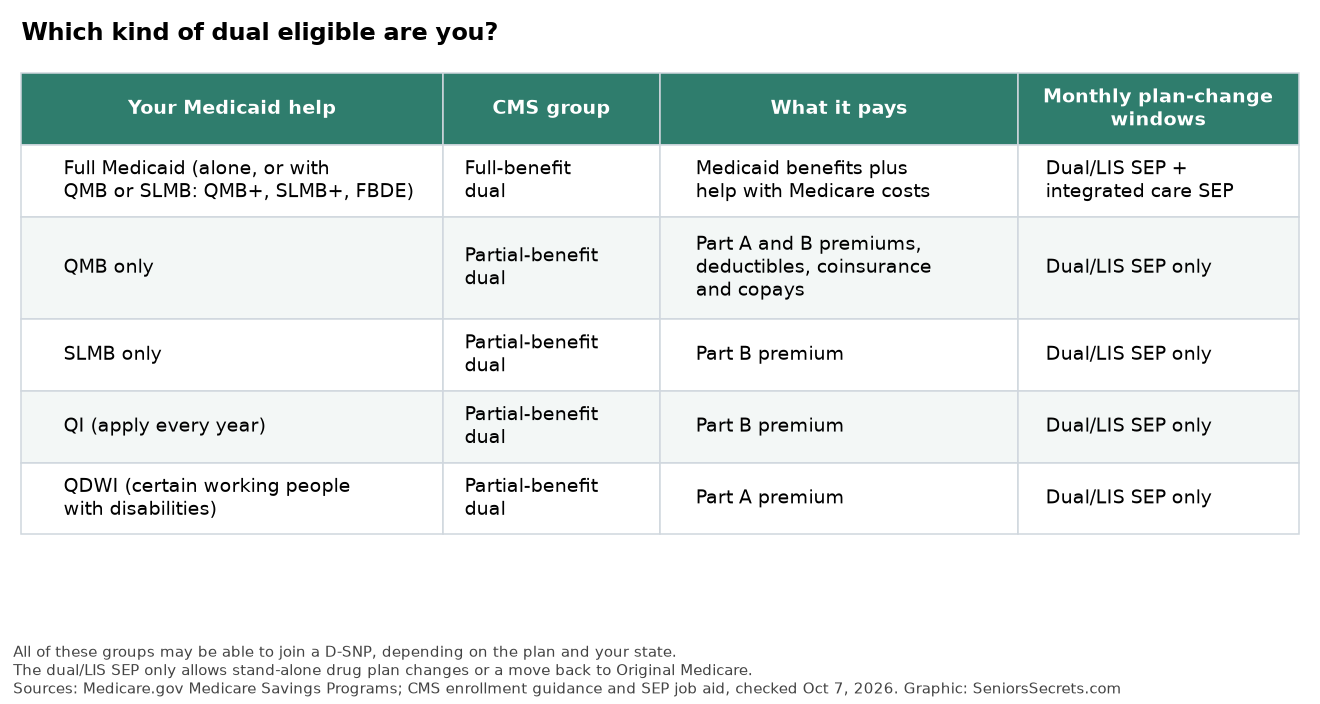
CMS’s enrollment guidance says people in all of these categories may be eligible for a D-SNP, “to the extent permitted” by the plan’s contract with the state. In practice, some D-SNPs only take full-benefit duals, some take partial-benefit duals too, and states set the rules. The plan’s Summary of Benefits or member services line will tell you which groups it accepts.
Not sure where you stand? Your state Medicaid office can tell you, and so can your approval letter. If you have Medicare and a limited income but no Medicaid help at all, start with our guide to Medicare Savings Programs, because qualifying for one of those is what makes you dual eligible. For full Medicaid limits and spend-down rules, see Medicaid for seniors.
What you actually get
The ads lead with the extras, and the extras are real. KFF’s 2026 review of plan benefits found that people in special needs plans are far more likely than other Medicare Advantage members to be in plans offering transportation to care (73% vs. 22%), meals (81% vs. 65%), over-the-counter allowances (98% vs. 68%) and in-home support services (38% vs. 10%). KFF also notes that many dual eligibles can already get similar help through Medicaid, so some of these perks overlap with what you have.
Other things that come with being dual eligible, whichever plan you pick:
- Low premiums and cost sharing. Medicare.gov says that if you have Medicare and Medicaid, most of a special needs plan’s costs will be covered for you. Check each plan’s premium anyway.
- Extra Help with drugs, automatically. People with Medicaid or a Medicare Savings Program get Extra Help. For 2027, Medicare.gov lists copays of no more than $5.80 for a generic and $14.40 for a brand-name drug, and some people pay less. Our Extra Help guide has the details.
- Benefit cards, with new rules. Many D-SNPs load grocery, utility or OTC money onto a card, often only for members with qualifying chronic conditions. CMS’s 2027 rule requires these cards to be tied to plan-covered items at checkout and limited to the plan year. Our Medicare flex card guide explains what’s real and what’s marketing.
My honest view: don’t choose a D-SNP by the size of its OTC allowance. For most dual eligibles, two things matter more. First, are the doctors you already see in the network? Second, how well does the plan work with your Medicaid benefits, especially if you get home care or other long-term services?
Integrated D-SNPs, and why the word matters
Not all D-SNPs work the same way. Some only coordinate with your Medicaid coverage. Others, called integrated D-SNPs (CMS uses the labels FIDE SNP, HIDE SNP and “applicable integrated plan”), are run alongside a Medicaid managed care plan from the same company and cover some or all of your Medicaid benefits too. The most integrated plans use a single appeals and grievance process for both programs, which CMS describes on its D-SNP page.
For you, “integrated” can mean one card, one member services number and one place to complain when something goes wrong. It also affects when you can join, which is next.
When you can join or switch (it isn’t just the fall)
Most people with Medicare can change plans only during fall Open Enrollment (October 15 to December 7) or the Medicare Advantage Open Enrollment Period (January 1 to March 31). If you have Medicaid or Extra Help, you get two more windows. Since January 2025, they’re monthly. They replaced the old once-a-quarter window, so if you’ve read that duals can switch “once per quarter,” that information is out of date.
- The dual/LIS SEP (any month). Anyone with Medicaid or Extra Help can switch stand-alone drug plans, or leave a Medicare Advantage plan (including a D-SNP) for Original Medicare plus a stand-alone drug plan. It can’t be used to join a regular Medicare Advantage plan or a D-SNP. It also isn’t available if your drug plan has flagged you as “at-risk” under a drug management program.
- The integrated care SEP (any month, full-benefit duals only). You can join or switch to an integrated D-SNP that lines up with your Medicaid managed care plan, if one is offered where you live.
Changes made with either window take effect the first day of the next month. Medicare.gov’s Special Enrollment Period page lists these alongside the other SEPs, such as moving or losing Medicaid. You can also ask 1-800-MEDICARE for a list of integrated D-SNPs in your area.
The practical takeaway: if you’re a partial-benefit dual, or you want a D-SNP that isn’t integrated, fall Open Enrollment is usually your window. It’s the simplest time to switch, whatever your Medicaid level.
What changes for D-SNPs in 2027
A rule CMS finalized in 2024 starts to bite in plan year 2027. It applies when an insurer (or its parent company) runs both a D-SNP and a Medicaid managed care plan in the same area:
- The insurer can generally offer only one D-SNP for full-benefit duals in that area, with limited exceptions.
- New members of that D-SNP must be in, or joining, the same company’s Medicaid plan.
- People already enrolled who aren’t in that Medicaid plan can stay until 2030. From 2030, these D-SNPs can only cover members who are aligned with their Medicaid plan, again with limited exceptions.
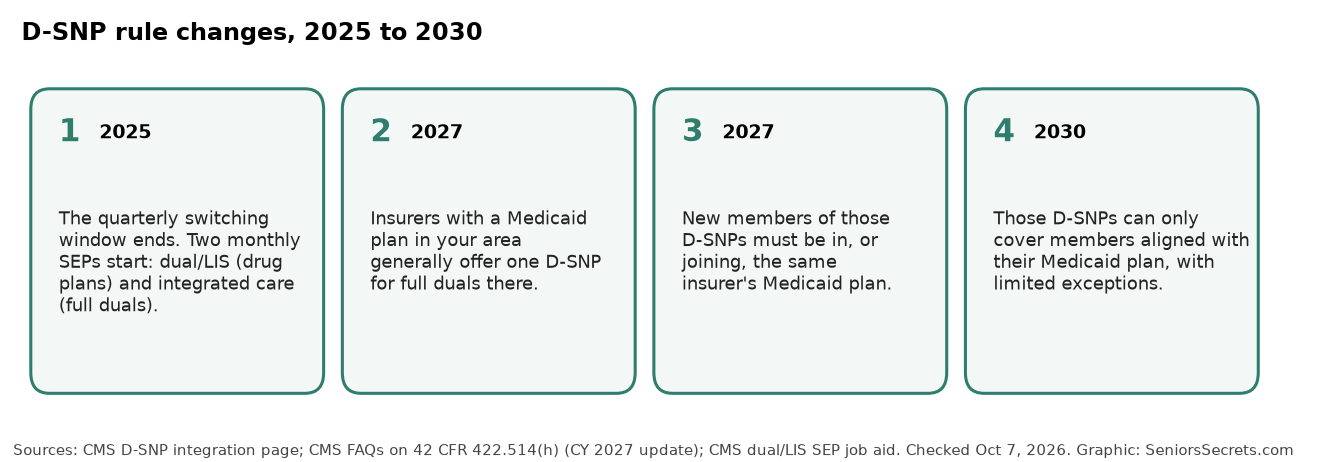
What this looks like in your mailbox: an insurer that ran several D-SNPs in one area may have to fold them into one for 2027, and CMS lets it move members into the surviving plan. If that’s happening to you, your Annual Notice of Change will say so. Read it, check that your doctors and drugs are still covered, and remember that you can pick a different plan during Open Enrollment if you don’t like the new one. CMS’s FAQ on these rules (updated for 2027) is technical, but it confirms the dates above.
Broader 2027 Medicare Advantage numbers apply to D-SNPs too: drug costs are capped at $2,400 a year (Extra Help covers most of that for duals), and CMS expects the average plan premium to fall. Our 2027 Medicare Advantage comparison guide walks through those numbers and how to read star ratings.
How to find D-SNPs in your area (the official way)
There’s no separate “D-SNP website.” The official place to see and compare every D-SNP in your county is Medicare Plan Finder on Medicare.gov. Insurers have their own D-SNP pages, but Plan Finder shows all of them side by side, and you don’t need to give anyone your Medicare number just to browse.

- Confirm your Medicaid level. Full or partial benefits? Your state Medicaid office can tell you.
- Search Plan Finder by ZIP code and look at the plans labeled as special needs plans for dual eligibles. Enter every prescription and your pharmacy.
- Check the network. Call your doctors and ask, “Will you take this plan in 2027?” Directories can be out of date.
- Ask how the plan works with your Medicaid. Is it integrated? If you get home care or other services through Medicaid, ask the plan and your state whether joining changes how you get them.
- Enroll through an official channel. Use Medicare.gov, call 1-800-MEDICARE (1-800-633-4227), or contact the plan directly. Hang up on anyone who calls you first asking for your Medicare number.
Who offers D-SNPs?
The insurers differ county by county. Large national insurers, regional plans and some hospital-run plans all sell D-SNPs, and the line-up in one county can look nothing like the next one over. Starting in 2027, if the company that runs your state Medicaid managed care plan also sells a D-SNP in your area, it will generally offer just one for full-benefit duals. That is often the most integrated option. I don’t rank D-SNP insurers, because a plan’s network in your county matters more than the brand name.
If you’re 55 or older and need a nursing-home level of care but want to stay at home, also look at PACE, a separate program that combines Medicare and Medicaid care through one local team.
Frequently asked questions
Is there an official D-SNP website?
No separate one. Medicare.gov’s Plan Finder is the official place to compare D-SNPs, and 1-800-MEDICARE can help by phone. Be careful with sites that ask for your Medicare number before showing any plans.
Can I switch D-SNPs every month?
Only in some cases. If you have full Medicaid, you can move into an integrated D-SNP that matches your Medicaid plan in any month. Anyone with Medicaid or Extra Help can leave a plan for Original Medicare and a stand-alone drug plan in any month. Other D-SNP changes usually wait for fall Open Enrollment or another Special Enrollment Period.
What happens if I lose Medicaid?
Your D-SNP may keep you for a grace period of one to six months while you requalify. The plan must tell you how long. If you don’t requalify, you’ll be disenrolled and get a Special Enrollment Period to choose new coverage.
Do D-SNPs charge a premium?
It varies. Medicare.gov says most costs are covered if you have Medicare and Medicaid, and many D-SNPs charge $0, but check each plan’s premium and copays on Plan Finder.
Does a D-SNP replace my Medicaid?
No. You keep Medicaid. An integrated D-SNP may deliver some or all of your Medicaid benefits through the same company, but you’re still enrolled in both programs.
The bottom line
A D-SNP can be a good deal if you have Medicare and Medicaid, but compare it like any other plan: doctors first, then drugs, then how it fits with your Medicaid, and the extras last. If anything about your Medicaid level or a plan change is unclear, a free SHIP counselor can go through your options with you before December 7.
Related guides