
GLP-1 Drugs and Medicare in 2026: The $50 GLP-1 Bridge, Who Qualifies, and What Part D Still Covers

Medicare now covers certain GLP-1 weight-loss drugs for a $50 monthly copay through a temporary program called the Medicare GLP-1 Bridge. It started July 1, 2026, and runs through December 31, 2027. It covers Foundayo (tablet), Wegovy (injection or tablet), and Zepbound (KwikPen only) for people with Medicare drug coverage who meet body mass index (BMI) and health requirements (Medicare.gov).
There is important fine print. The $50 copay doesn’t count toward your Part D deductible or the $2,100 yearly out-of-pocket cap, and Extra Help doesn’t lower it (CMS). And if you have type 2 diabetes, moderate-to-severe sleep apnea, or fatty liver disease, the Bridge isn’t for you, because your regular Part D plan may already cover a GLP-1.
Who qualifies for the GLP-1 Bridge
You need Medicare drug coverage: a stand-alone Part D plan, a Medicare Advantage plan with drug coverage, a Special Needs Plan, an employer or union group Part D plan, or the LI NET program. Then, when you start the drug, you must be 18 or older and meet one of these:
| BMI | Plus at least one of these conditions |
|---|---|
| 35 or higher | None needed |
| 30 or higher | Heart failure with preserved ejection fraction, uncontrolled high blood pressure, or chronic kidney disease stage 3a or higher |
| 27 or higher | Prediabetes, a previous heart attack or stroke, or peripheral artery disease with symptoms |
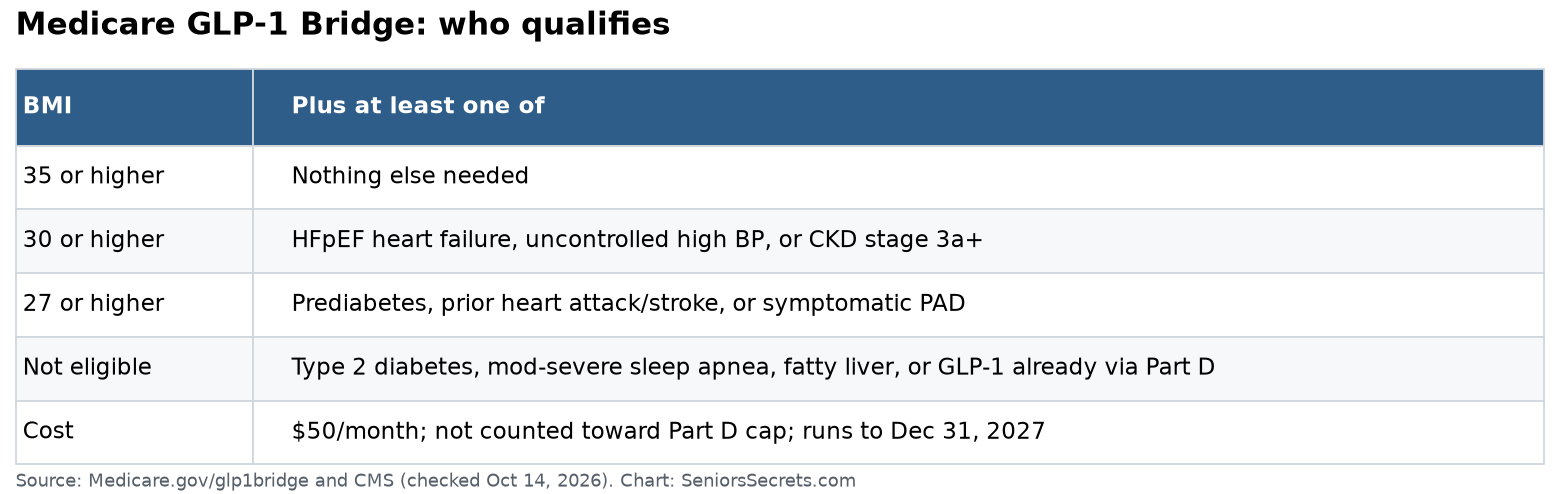
You aren’t eligible if you already get a GLP-1 through your Part D plan, or if you have type 2 diabetes, moderate-to-severe sleep apnea, or fatty liver disease. In those cases, keep using your plan’s coverage.
How to get it
- Talk with your doctor. Your doctor sends the prescription to your pharmacy and, when asked, completes a prior authorization. They must certify you’re using the drug as part of a lifestyle program focused on diet and exercise.
- Bring your Medicare information to the pharmacy. The pharmacy may ask for your Medicare Number or the last four digits of your Social Security number.
- Watch for a letter. Medicare mails a letter confirming your drug is covered under the Bridge.
- Refills are covered through 2027. The prior authorization stays valid, including for refills and dose changes, through December 31, 2027, unless you switch to a different GLP-1.
Questions or a status check: call 1-800-MEDICARE (1-800-633-4227), TTY 1-877-486-2048.

When your regular Part D plan pays instead
GLP-1 drugs approved for other conditions can be covered by Part D plans the usual way, with your plan’s copays counting toward the $2,100 cap in 2026 ($2,400 in 2027):
- Type 2 diabetes: drugs like Ozempic, Mounjaro and Rybelsus. See my diabetes management guide.
- Heart risk: Wegovy is approved to lower the risk of heart attack and stroke in adults with heart disease and overweight or obesity, and plans can cover it for that use.
- Sleep apnea: Zepbound is approved for moderate-to-severe obstructive sleep apnea in adults with obesity.
Coverage, prior authorization and copays vary by plan. During Open Enrollment (October 15 to December 7), check your plan’s 2027 formulary if you take one of these drugs.
What else Medicare covers for weight
Part B covers intensive behavioral therapy for obesity if your BMI is 30 or more, delivered in a primary care setting. You pay nothing if your provider accepts assignment (Medicare.gov). That counseling pairs well with the lifestyle requirement for the Bridge.
Side effects and cautions
GLP-1 drugs commonly cause nausea, vomiting, diarrhea and constipation, especially when the dose goes up. Weight loss can include muscle loss, which matters more as we age, so ask about protein and strength exercise. If you have kidney disease or heart failure, ask how the drug fits with your other medicines. My guides on kidney-friendly eating and exercise with heart failure may help.
Watch for scams. Medicare doesn’t call to sell GLP-1 drugs. Report suspected fraud to 1-800-MEDICARE.
What the $50 copay really costs you in a year
Here is the simple math. At $50 a month, a full year on the Bridge costs $600. Without the Bridge, these drugs often cost hundreds of dollars a month at list price.
But remember the catch. Bridge copays do not count toward your Part D out-of-pocket cap. So if you also take other costly drugs, you still have to reach the $2,100 cap (2026) with those drugs alone. Example:
| Your drugs | What you pay in 2026 |
|---|---|
| GLP-1 through the Bridge only | $50 x months used (up to $300 for July to December) |
| GLP-1 through the Bridge + other drugs that hit the cap | Up to $2,100 for other drugs + $50 a month for the GLP-1 |
| GLP-1 covered by your Part D plan (for diabetes, heart risk or sleep apnea) | Plan copay, which counts toward the $2,100 cap |
If you already pay a lot for other drugs, ask your doctor whether your GLP-1 could be covered under your Part D plan instead. Then its cost counts toward your cap.
Words you will hear, in plain terms
- BMI (body mass index): a number from your height and weight. Medicare’s online quiz has a BMI calculator.
- Prior authorization: your doctor sends a form asking Medicare to approve the drug before the pharmacy fills it.
- TrOOP (true out-of-pocket costs): the money you spend that counts toward your yearly Part D cap.
- Extra Help (LIS): a program that lowers drug costs for people with limited income. It does not lower Bridge copays.
Common reasons people get turned down
- Type 2 diabetes is on your record. The Bridge excludes people with type 2 diabetes. If you have it, ask your plan about diabetes GLP-1 coverage instead.
- No Part D coverage. If you have Original Medicare with no drug plan, you can’t use the Bridge. You can join a drug plan during Open Enrollment, October 15 to December 7, with coverage starting January 1.
- BMI too low for your conditions. A BMI of 31 with no listed condition does not qualify.
- The prior authorization form is incomplete. The doctor must confirm you are in a diet and exercise program. Ask the office to send it again if it bounced.
- Wrong Zepbound form. Only the KwikPen is covered. Single-dose vials and pens are not.
What to ask your doctor
- Do I qualify for the Bridge, or should my Part D plan cover this drug for another condition?
- Which drug fits me best: a tablet (Foundayo or Wegovy tablet) or a weekly shot?
- How will we protect my muscle while I lose weight? (Ask about protein and strength exercise.)
- What happens after December 31, 2027 if the program ends?
- How do these drugs fit with my other medicines, kidneys and heart?
Plan ahead for 2028
The Bridge is a test program. It is set to end on December 31, 2027. CMS has said it will use the data to help Part D plans prepare for a possible later model. Nothing is promised after 2027. If you start now, ask your doctor what your plan would be if coverage stops. Many people regain weight when they stop these drugs, so a long-term plan matters.
Common questions
Does Medicare cover Wegovy for weight loss in 2026?
Yes, through the temporary Medicare GLP-1 Bridge, for eligible people with Medicare drug coverage, at a $50 monthly copay. It runs through December 31, 2027.
Does the $50 GLP-1 copay count toward my Part D cap?
No. Bridge copays don’t count toward the Part D deductible or the out-of-pocket cap, and Extra Help doesn’t apply to them.
Can I use the GLP-1 Bridge if I have diabetes?
No. People with type 2 diabetes aren’t eligible, but your Part D plan may cover a GLP-1 for diabetes.
Which drugs are covered by the Medicare GLP-1 Bridge?
Foundayo (tablet), Wegovy (injection or tablet), and Zepbound KwikPen. Single-dose Zepbound vials and pens aren’t covered.
When does the Medicare GLP-1 Bridge end?
December 31, 2027. CMS extended it after a related model (BALANCE) didn’t launch in 2027.
Can I get the GLP-1 Bridge if I only have Original Medicare?
Only if you also have Medicare drug coverage (a Part D plan). You can join a drug plan during Open Enrollment, October 15 to December 7.
Does Extra Help lower the $50 GLP-1 copay?
No. CMS says the low-income subsidy does not apply to drugs filled through the Bridge.
Written by Khasim Basha Shaik. I research Medicare and senior health for readers and summarize official sources. I’m not a doctor, pharmacist or licensed insurance agent. Talk with your doctor and your plan before starting any medicine. Last reviewed October 14, 2026.
Related guides