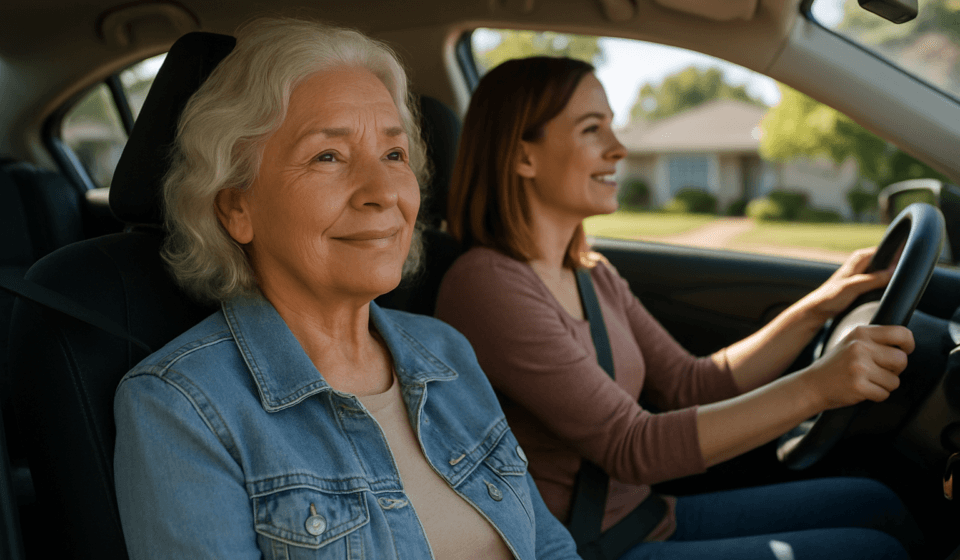

Few conversations are more difficult for families than discussing senior driving safety. The car represents freedom, independence, and identity — especially for older adults who built their lives around mobility. But driving is also the most dangerous activity most seniors engage in daily, and age-related changes in vision, reaction time, and cognition create real risks that deserve honest attention. This guide helps you recognize warning signs, understand when driving should stop, and navigate the alternatives that preserve independence.
Senior Driving Safety 2026: The Statistics Every Family Should Know
Older adults are not automatically dangerous drivers. In fact, seniors are among the most cautious drivers on the road — they wear seatbelts consistently, rarely speed, and avoid alcohol. But physical and cognitive changes that accumulate with age do increase crash risk per mile driven. According to the CDC, adults 65 and older account for about 20% of all traffic fatalities annually, even though they represent only 17% of the driving population.
The AAA Foundation for Traffic Safety reports that crash risk begins increasing around age 70 and rises sharply after 80. Adults 85 and older have crash rates comparable to teenage drivers. The key distinction: senior crashes are almost never caused by recklessness. They result from slower reaction times, narrowed visual field, increased medication effects, and cognitive changes — all of which can be evaluated and managed proactively.
10 Warning Signs of Unsafe Driving in Seniors
| Warning Sign | What It May Indicate |
|---|---|
| New dents or scrapes on car | Spatial awareness decline, delayed reactions |
| Running red lights or stop signs | Processing speed decline, visual field narrowing |
| Getting lost on familiar routes | Early cognitive or memory changes |
| Drifting between lanes | Attention lapses, neck mobility limits |
| Difficulty judging gaps in traffic | Visual processing or reaction time changes |
| Increased anxiety while driving | Awareness that something has changed |
| Driving well below the speed limit | Compensatory behavior for slowed reactions |
| Difficulty with night driving | Age-related vision changes, glare sensitivity |
| Confusing gas and brake pedals | Cognitive or fine motor changes — serious warning |
| Increasing near-misses or close calls | Multiple factors converging — needs evaluation |
Medical Conditions That Commonly Affect Senior Driving Safety
Certain medical conditions that are common in older adults can significantly affect driving ability and should trigger an honest conversation with your doctor: dementia (even mild cognitive impairment can double crash risk), Parkinson’s disease, macular degeneration or glaucoma, diabetic neuropathy (foot numbness may impair brake control), untreated sleep apnea (raises crash risk 2.5x), recent stroke, and sedating medications. The Beers Criteria lists dozens of medications that increase crash risk in seniors, including benzodiazepines, opioids, antihistamines, muscle relaxants, and certain blood pressure drugs.
Senior Driving Safety 2026: Professional Assessment Options
- Driver Rehabilitation Specialist (DRS): Occupational therapists with specialized training conduct the gold-standard assessment — both clinical tests and an on-road evaluation. Find a certified DRS at aded.net.
- AAA Driving Evaluation: AAA’s free “Roadwise Review” online self-assessment at seniordriving.aaa.com covers 8 key factors including reaction time and visual acuity.
- Physician Assessment: Ask your primary care doctor to complete a formal driving fitness assessment. Some states allow physicians to confidentially report unsafe drivers to the DMV.
- State DMV Programs: Many states offer senior driver programs with free or low-cost evaluations. Some require re-evaluation for drivers over 75 or 80.
- AARP Smart Driver Course: A refresher course (in-person or online) teaching updated techniques, with possible insurance discount at aarpdriversafety.org.
Having the Conversation: How Families Can Approach Driving Cessation
Research from the Hartford Center for Mature Market Excellence shows that seniors are more receptive when family members approach this topic from a place of concern rather than authority. Come with specific observations rather than generalizations, involve the doctor, focus on concrete transportation alternatives first, separate driving from identity, and be patient — this conversation may need to happen multiple times. The American Geriatrics Society recommends a collaborative approach over an authoritative one.
Transportation Alternatives That Preserve Senior Independence
| Transportation Option | Cost | Coverage |
|---|---|---|
| Uber / Lyft | 0-30/trip typical | Most urban/suburban areas |
| Medicare Advantage ride benefits | Often bash or low copay | Many MA plans include rides to medical appointments |
| Area Agency on Aging transportation | Free or sliding scale | Nationwide via eldercare.acl.gov |
| GoGoGrandparent senior rideshare | Small markup over Uber/Lyft | No smartphone needed |
| Public transit senior discount | Reduced fares for 65+ | Urban areas |
| Volunteer driver programs | Free | Faith communities, ITN America |
| Medicaid non-emergency medical transport | Covered for eligible seniors | Medical trips |
Steps to Extend Safe Driving Before Stopping
If warning signs are early and cognitive function remains intact, certain interventions can meaningfully extend safe driving: annual comprehensive eye exams to address cataracts or glaucoma, a pharmacist medication review for driving-impairing side effects, limiting driving to familiar routes and daylight hours, treating sleep apnea with CPAP therapy, taking the AARP Smart Driver refresher course, and considering adaptive equipment from a certified Driver Rehabilitation Specialist.
Sources
Related Articles You May Find Helpful