Does Medicare Cover Home Health Care in 2026? Who Qualifies, What’s Covered and What It Costs

Yes. Medicare pays the full cost of covered home health care if you’re homebound, you need part-time or intermittent skilled care, a doctor or other provider orders it after seeing you, and a Medicare-certified home health agency provides it. You pay nothing for the visits: no deductible, no copay. The only exception is medical equipment, where you pay 20% after the Part B deductible.
What Medicare doesn’t cover is round-the-clock care or help with daily living when that’s the only help you need. That gap catches a lot of families off guard, so this guide spells out both sides.
I’m a researcher who reads Medicare’s rules closely, not a nurse or licensed agent. The rules below come from Medicare.gov’s home health page and the CMS Medicare Benefit Policy Manual, chapter 7, checked October 1, 2026.
Who qualifies for Medicare home health care
You need to meet all four requirements:
1. You’re homebound. Medicare uses a two-part test. First, leaving home isn’t recommended because of your condition, or you need help to leave, such as a cane, walker or wheelchair, special transportation or another person. Second, you normally can’t leave home and leaving takes a lot of effort.
Homebound doesn’t mean bedbound. You can still go to medical appointments, adult day care, religious services, a family event or a short trip to the barber, as long as those outings are short and infrequent.
2. You need skilled care on a part-time or intermittent basis. That means skilled nursing, physical therapy, or speech-language therapy. Occupational therapy can continue on its own once it has started alongside one of the others.
3. A doctor or other provider orders it after seeing you. A doctor, nurse practitioner or similar provider must have a face-to-face visit with you, in person or by telehealth, within 90 days before or 30 days after care starts. The visit has to relate to the main reason you need home health. They then sign a plan of care.
4. A Medicare-certified agency provides it. Check an agency on Medicare Care Compare before you agree to services.
You don’t need a hospital stay first. Many people qualify because a chronic illness, a fall or a slow decline has made leaving home hard.
Improvement isn’t required
Medicare can’t deny home health just because you’re not getting better. Since the 2013 Jimmo v. Sebelius settlement, skilled care to maintain your condition or slow a decline is covered when you need a skilled professional to do it safely. If an agency tells you that you’ve “plateaued,” ask it to check that rule.
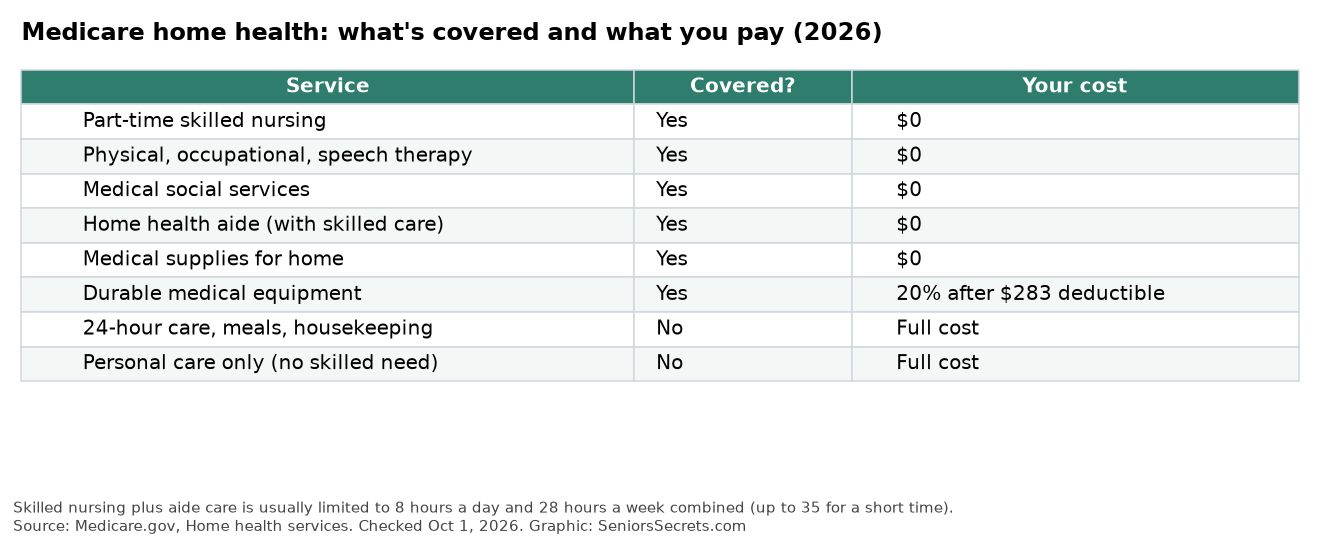
What Medicare home health covers and what you pay
| Service | Covered? | Your cost |
|---|---|---|
| Part-time skilled nursing | Yes | $0 |
| Physical, occupational and speech therapy | Yes | $0 |
| Medical social services | Yes | $0 |
| Home health aide (only with skilled care) | Yes | $0 |
| Medical supplies for use at home | Yes | $0 |
| Durable medical equipment | Yes | 20% after the $283 Part B deductible |
| 24-hour care at home | No | Full cost |
| Meal delivery, shopping, cleaning | No | Full cost |
| Personal care when it’s the only care you need | No | Full cost |
Skilled nursing includes wound care for pressure sores or surgical wounds, injections, IV or tube-feeding therapy, teaching you and your caregiver to manage a condition, and monitoring an unstable illness such as heart failure.
Home health aides can help with bathing, dressing, walking and changing linens, but only while you’re also getting skilled care. When the skilled care ends, the aide visits end too.
Equipment like a walker, hospital bed or wheelchair is billed under the durable medical equipment benefit. See Medicare coverage for walkers and wheelchairs.
How many hours and visits Medicare covers
There’s no limit on the number of visits as long as you keep qualifying. But each day’s care must stay part-time:
- Skilled nursing and aide care combined are usually limited to 8 hours a day and 28 hours a week.
- For a short period, your provider can order up to 35 hours a week, still under 8 hours a day.
Your plan of care is reviewed and recertified at least every 60 days. There’s no cap on how many times it can be renewed.
That’s the line between home health and long-term care. If someone needs supervision all day or overnight, Medicare won’t pay for it, and the family will need other options such as Medicaid, long-term care insurance, private pay or a facility.
Part A or Part B: which one pays?
Both pay home health at the same $0 cost to you. Part A pays for up to 100 visits that start within 14 days after a hospital stay of at least three days or a skilled nursing facility stay. Part B pays for everything else, including home health with no hospital stay at all. You don’t need to track which part is paying.
If you’re leaving the hospital, ask before discharge whether you qualify. Many people do and aren’t referred automatically. If you’ll need a short facility stay first, see Medicare skilled nursing coverage.
Common reasons people get home health
- Recovery from a hip or knee replacement or a broken hip
- Rehab after a stroke: physical, occupational and speech therapy at home
- Wound care for pressure ulcers, diabetic foot wounds or surgical incisions
- IV antibiotics or other infusions
- Managing a complicated new medication schedule
- Monitoring heart failure, COPD or diabetes after a flare
- Swallowing therapy after a stroke or with Parkinson’s disease
- Balance and strength therapy after a fall
If you can get to a clinic, outpatient therapy may be a better fit. See Medicare physical therapy coverage and occupational therapy coverage.
How to start home health care
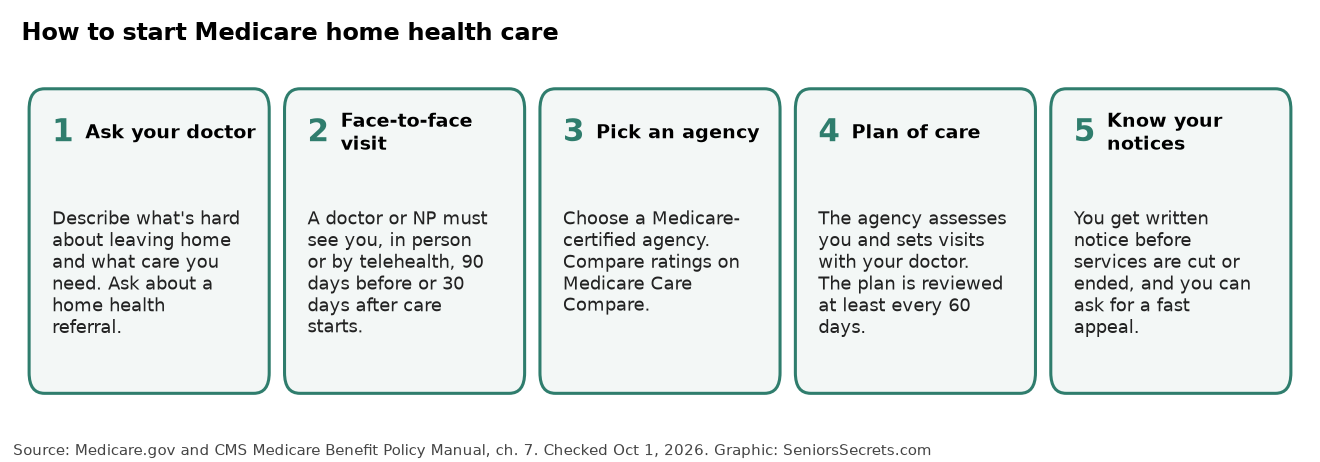
- Talk to your doctor. Be specific about what’s hard: getting to the car, stairs, breathlessness, a wound you can’t dress yourself. Downplaying problems is the most common reason people don’t get referred.
- Have the face-to-face visit. It can be in person or by telehealth, within the 90 days before or 30 days after care starts.
- Choose your agency. You have the right to pick. Your provider should give you a list and tell you if they have a financial interest in any agency on it.
- Agree on the plan of care. The agency visits to assess you, then works with your doctor on which services you’ll get and how often.
- Ask about costs in writing. The agency must tell you, before services start, about anything Medicare won’t pay for, using a notice called the Home Health Advance Beneficiary Notice.
If your agency is in a state taking part in Medicare’s Review Choice Demonstration (Florida, Illinois, North Carolina, Ohio and Texas, among others), the agency handles extra paperwork. It shouldn’t change your coverage or cost.
When services are cut or end: your appeal rights
Agencies must give you written notice before reducing or stopping your care:
- Notice of Medicare Non-Coverage: at least two days before all covered services end. It tells you how to ask for a fast appeal from your Beneficiary and Family Centered Care Quality Improvement Organization (BFCC-QIO). Call by noon of the day before services are due to end. Your services continue while the QIO reviews.
- Home Health Change of Care Notice: if the agency plans to reduce or stop some services, for example because your doctor changed the orders.
For step-by-step help, see my guide on how to win a Medicare appeal. Your State Health Insurance Assistance Program gives free counseling.
Medicare Advantage and home health
Medicare Advantage plans must cover home health that Original Medicare covers, but they can require you to use in-network agencies and get prior authorization. Some plans add extra in-home support, like a few hours a month of help with chores. Check your plan’s Evidence of Coverage, and compare during Open Enrollment, October 15 to December 7. See Medicare Advantage vs. Original Medicare.
If you have both Medicare and Medicaid, Medicaid may pay for personal care that Medicare doesn’t. See Medicare D-SNP plans for dual-eligible seniors.
Home health vs. hospice
Hospice is a different benefit for people with a terminal illness who choose comfort care. It can include more hands-on help at home than home health. If that’s your situation, see the Medicare hospice guide.

FAQ
Does Medicare pay 100% for home health care?
Yes, for covered visits: skilled nursing, therapy, medical social services and aide care cost $0. Equipment costs 20% after the Part B deductible.
Do I need to be in the hospital first?
No. Part B covers home health without a hospital stay if you meet the other requirements.
Can I leave the house and still be homebound?
Yes. Medical appointments, adult day care, religious services and short, infrequent outings are allowed.
Does Medicare pay for a home health aide by itself?
No. Aide visits are covered only while you’re also getting skilled nursing or therapy.
How long can I get home health care?
As long as you qualify. Your plan of care is recertified at least every 60 days, with no limit on renewals.
Does Medicare cover 24-hour home care?
No. Care must be part-time, usually up to 8 hours a day and 28 hours a week of nursing and aide care combined.
Related guides