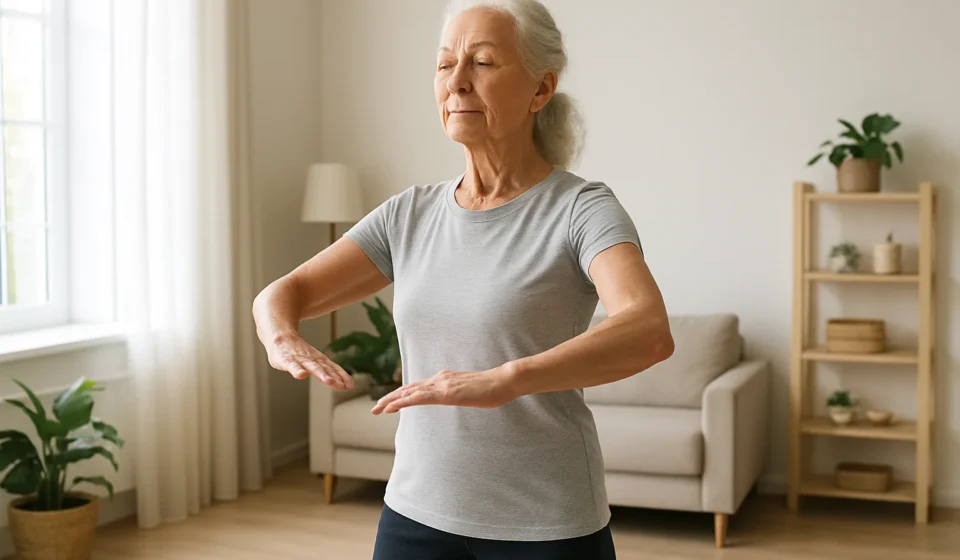

If your shoulders have started to round forward and your upper back is curving more than it used to, you are not stuck with it. The right posture exercises for seniors can measurably reduce age-related rounding, ease neck and back pain, improve breathing, and even lower fall risk—and research shows the spine responds to training well into our 80s. This guide gives you a safe, evidence-based routine to stand taller, plus the warning signs that mean you should see a doctor first.
I am Margaret Collins. Posture is not vanity—it is function. A forward-hunched spine shifts your center of gravity, strains muscles, and makes every step less stable. Let me show you how to fight back.
Table of Contents
- Why Posture Changes With Age
- Why It Matters More Than You Think
- The 6-Move Posture Routine
- Safety First: Osteoporosis Rules
- Daily Habits That Protect Your Spine
- Frequently Asked Questions
Why Posture Changes With Age
That forward curve of the upper back has a name: hyperkyphosis. It affects an estimated 20–40% of older adults and tends to worsen over time. Several things drive it. The muscles that hold you upright—the back extensors—weaken and lose mass with age. Years of sitting and looking down at screens and books shorten the chest muscles and lengthen the upper-back muscles. And in some people, small compression fractures in the vertebrae from osteoporosis wedge the spine forward.
The encouraging part: a large share of age-related kyphosis is postural—driven by muscle imbalance and habit, not by fixed bone change. That portion is trainable. Studies of targeted spine-strengthening programs show older adults can reduce their kyphosis angle and stand measurably taller within a few months.
Why It Matters More Than You Think
Posture is tied to outcomes that matter for independence. Greater hyperkyphosis is associated with slower walking speed, worse balance, a higher risk of falls, reduced lung capacity (a hunched chest cannot expand fully), difficulty swallowing, and even shortened survival in some studies. Correcting posture will not reverse every one of these, but improving back strength and alignment reliably improves balance and confidence—two of the strongest protectors against falls.
| Problem from poor posture | How posture work helps |
|---|---|
| Neck and upper-back pain | Strengthens extensors, unloads strained tissues |
| Poor balance, fall risk | Recenters gravity over the feet, improves stability |
| Shallow breathing | Opens the chest so lungs expand more fully |
| Low confidence / fatigue | Upright stance reduces muscular effort to stay vertical |
A 30-second self-check
Before you start, gauge where you are. Stand with your heels, buttocks, and upper back against a wall and let your head fall back naturally. If the back of your head cannot comfortably touch the wall without you straining your neck, that gap is a simple measure of forward-head and upper-back rounding. Note roughly how far it is, and re-check every few weeks—watching that gap shrink is one of the most motivating ways to track progress.
The 6-Move Posture Routine
Do these most days of the week. Move slowly, breathe normally (never hold your breath), and stop if anything sharpens into pain. All can be done at home with no equipment beyond a sturdy chair and a wall.
1. Wall angels
Stand with your back to a wall, heels a few inches out, lower back gently flattened. Raise your arms into a goal-post shape against the wall and slide them up and down. This trains the muscles that pull the shoulders back. Aim for 8–10 slow repetitions.
2. Chin tucks
Sitting tall, gently draw your chin straight back (making a “double chin”) to stack your head over your shoulders. Hold 5 seconds, repeat 10 times. This counteracts the forward-head posture that drives neck strain.
3. Scapular squeezes
Sit or stand tall and squeeze your shoulder blades together and slightly down, as if holding a pencil between them. Hold 5 seconds, repeat 10–15 times. A resistance band adds challenge as you progress—see our stretching guide for band basics.
4. Prone back extension (“floor cobra”)
Lie face down with arms at your sides and gently lift your head and chest a few inches off the floor, leading with the breastbone. Hold briefly and lower. This directly strengthens the back extensors that fight kyphosis. Skip if you have significant osteoporosis without clearance (see below).
5. Doorway chest stretch
Place your forearms on a doorframe and step gently through until you feel a stretch across the chest. Hold 20–30 seconds. Loosening tight chest muscles lets the shoulders sit back where they belong.
6. Seated thoracic extension
Sit in a firm chair, hands behind your head, and gently arch your upper back over the chair’s top edge, then return. Repeat 8–10 times to restore mobility to a stiff mid-back.
Safety First: Osteoporosis Rules
This is critical. If you have osteoporosis or have had a spinal compression fracture, avoid exercises that bend the spine forward (deep forward folds, crunches, toe-touches), which increase fracture risk. Favor the extension and alignment moves above instead—research on programs like physical therapy’s spinal-extension protocols shows they are both safer and more effective for this group. Always get clearance from your doctor or a physical therapist before starting if you have osteoporosis, a recent fracture, spinal stenosis, or any condition affecting balance. For more on protecting your bones, read our osteoporosis prevention guide.
Daily Habits That Protect Your Spine
Exercises work best alongside everyday awareness. Set up your chair and screen so you are not looking down for hours, take a posture break every 30 minutes, carry loads close to your body, and keep building overall strength and balance—our balance exercises for seniors over 70 pair naturally with posture work. Staying generally active with daily walking keeps the whole system strong. For the complete program, see our Senior Fitness & Exercise Guide.
Frequently Asked Questions
Can posture really be improved after 70?
Yes. Much age-related rounding is postural—caused by muscle weakness and habit rather than fixed bone change—and that portion responds to training. Studies show older adults can reduce their kyphosis angle and stand taller within a few months of consistent spine-strengthening exercise.
How long until I see results?
Most people notice less stiffness and easier upright sitting within two to four weeks, with measurable strength and alignment gains over two to three months of doing the routine most days.
Which exercises should I avoid with osteoporosis?
Avoid forward-bending and twisting movements such as crunches, toe-touches, and deep forward folds, which stress the front of the vertebrae. Stick to extension and alignment moves, and get clearance from your doctor or physical therapist first.
Does a posture brace fix bad posture?
A brace can be a short-term reminder, but it does not strengthen the muscles that hold you upright and can let them weaken further if relied on. Active exercise is what produces lasting change; a brace is at best a supplement.
Related Articles You May Find Helpful
- Senior Fitness & Exercise Guide 2026
- Balance Exercises for Seniors Over 70
- 10 Stretching Exercises for Seniors 2026
- Osteoporosis Prevention for Seniors 2026
- Wall Pilates for Seniors 2026
Sources
- NIH / NIA — Exercise and physical activity for older adults
- Katzman et al. — Hyperkyphosis in older adults: causes and exercise treatment
- Bone Health & Osteoporosis Foundation — Safe movement and exercise
This article is educational and not a substitute for professional medical advice. See our Medical Disclaimer and Editorial Guidelines.