Lifeline for Seniors 2026: The $9.25 Phone and Internet Discount, Who Qualifies, and How to Apply

Lifeline is a federal program that takes up to $9.25 a month off a phone, internet or bundled plan for low-income households, or up to $34.25 a month on Tribal lands. You qualify if you get Medicaid, SNAP, SSI, Federal Public Housing Assistance or a Veterans Pension, or if your household income is at or below 135% of the federal poverty guidelines, which for 2026 is $21,546 a year for one person and $29,214 for two in most states.
You apply through the FCC’s National Verifier at lifelinesupport.org, by mail, or through a participating phone company. Only one Lifeline benefit is allowed per household.
Program details below come from the FCC’s Lifeline consumer page and USAC’s Lifeline site, checked October 12, 2026.
Who qualifies
Through a benefit you already get
You (or someone in your household, including a dependent) participate in:
- Medicaid
- SNAP (food stamps)
- Supplemental Security Income (SSI)
- Federal Public Housing Assistance, including Section 8 vouchers, project-based rental assistance and public housing
- Veterans Pension or Survivors Benefit
- Certain Tribal programs, if you live on qualifying Tribal lands
Notice what’s not on the list: regular Social Security retirement benefits, Medicare, and Medicare Savings Programs. Getting those doesn’t qualify you by itself. Many seniors on SSI or Medicaid don’t realize they already qualify. If you think you might be eligible for those, my guides to SSI in 2026 and SNAP for seniors are a good next step.
Through income
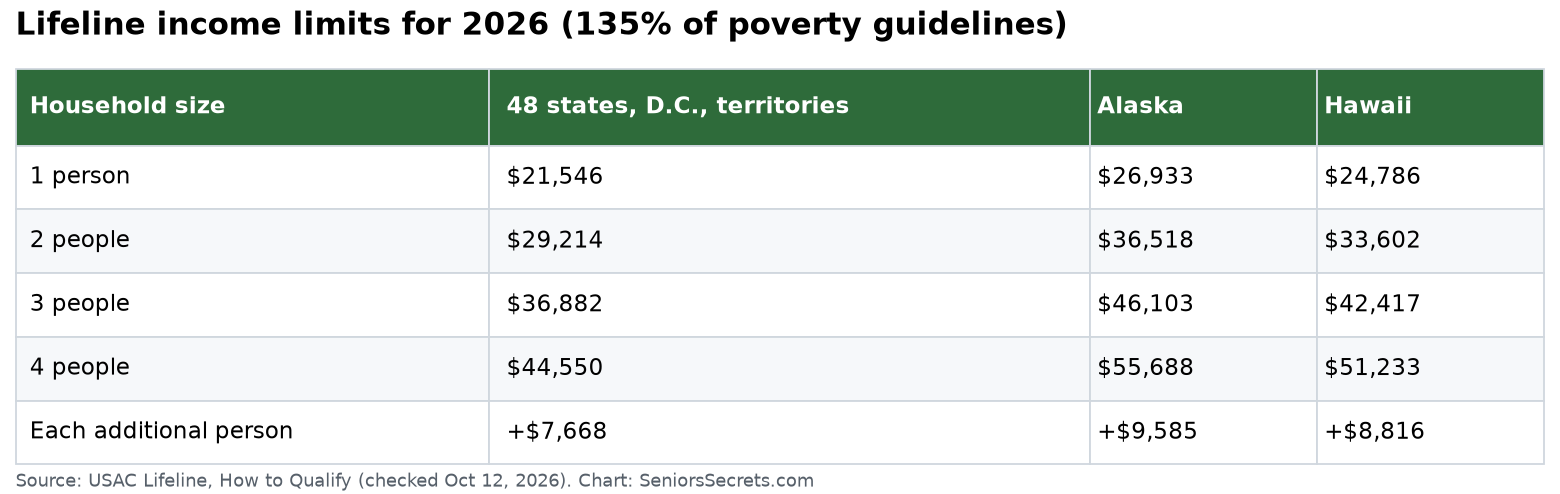
| Household size | 48 states, D.C. and territories | Alaska | Hawaii |
|---|---|---|---|
| 1 person | $21,546 | $26,933 | $24,786 |
| 2 people | $29,214 | $36,518 | $33,602 |
| 3 people | $36,882 | $46,103 | $42,417 |
| 4 people | $44,550 | $55,688 | $51,233 |
| Each additional person | +$7,668 | +$9,585 | +$8,816 |
Source: USAC, How to Qualify. If you qualify by income, you may need to show proof such as a tax return, a Social Security benefit letter, or three consecutive months of pay stubs. Documents must be dated within the past 12 months.
What counts as a household? The FCC defines it as people who live together and share income and expenses. If you live with an adult child but keep your finances separate, you can be a separate household. You may be asked to fill out a one-per-household worksheet. People in assisted living or other group facilities can qualify as their own households.
What the discount covers
| Service | Monthly discount |
|---|---|
| Broadband (home internet or mobile data) or a bundle | Up to $9.25 |
| Voice-only phone service | Up to $5.25 (the full $9.25 applies to qualifying broadband or bundles) |
| On Tribal lands | Up to $34.25, plus Link Up help with startup charges |
You can use the discount on a landline or a cell phone plan. With a wireless Lifeline provider, the discount often covers the whole bill, so service is “free.” The FCC doesn’t pay for phones themselves; a free handset is the provider’s offer, not part of the federal program.
The bigger internet discount, the Affordable Connectivity Program, ended in 2024 when its funding ran out. Lifeline is the federal discount that remains.
How to apply, step by step
- Gather proof. A Medicaid card, SNAP or SSI award letter, or income documents, plus a photo ID.
- Apply through the National Verifier at lifelinesupport.org, or call 1-800-234-9473 to get a mailed form. Residents of Texas and Oregon use their state’s own process.
- Choose a provider. Once you’re approved, sign up with a participating phone or internet company. USAC’s “Companies Near Me” tool lists the ones in your area.
- Use the service. If your provider doesn’t charge you anything, you must use it at least once every 30 days (a call, text or data use) or you can be de-enrolled.
- Recertify every year. USAC or your provider will contact you. Sometimes it’s automatic. If you miss it, you lose the benefit.
Avoid these mistakes
- Two Lifeline plans in one household. Only one is allowed. If you and your spouse both signed up, pick one and cancel the other.
- Not reporting a change. If your income rises or you leave the qualifying program, tell your provider. The FCC says you can face penalties for keeping a benefit you no longer qualify for.
- Giving your Social Security number to a street table or cold caller. Real Lifeline providers do enroll people in person, but if you’re unsure, apply directly through lifelinesupport.org instead. My guide to scams targeting seniors covers the warning signs.
- Thinking the “free phone” is government-issued. It’s the provider’s device; problems go to the provider.
To report suspected Lifeline fraud, the FCC runs a tip line at 1-855-455-8477.
If you’re working through other bills too, see my guides to LIHEAP energy assistance and the Weatherization Assistance Program.
Common questions
Can seniors on Social Security get Lifeline?
Social Security retirement alone doesn’t qualify you. You qualify if your total household income is at or below 135% of the poverty guidelines ($21,546 for one person in 2026) or you get Medicaid, SNAP, SSI, federal housing aid or a VA pension.
How much is the Lifeline discount in 2026?
Up to $9.25 a month for broadband or bundled service, up to $5.25 for voice-only service, and up to $34.25 on Tribal lands.
Is a Lifeline phone free?
The federal benefit is a monthly service discount, not a phone. Many wireless providers offer a free phone and plan to Lifeline customers, but the device comes from the provider.
Can I have Lifeline on a landline?
Yes. The discount can go on either a wireline or wireless service, but only one per household.
Do I have to reapply every year?
You must recertify your eligibility every year. Sometimes it happens automatically; otherwise USAC or your provider will contact you.
Written by Khasim Basha Shaik. I research benefit programs for seniors and compare official sources for readers. I’m not affiliated with any phone company or government agency. Figures come from the FCC and USAC. Last reviewed October 12, 2026.
Related guides

The $6,000 Senior Tax Deduction for 2025 to 2028: Who Qualifies and How to Claim It
2027 Social Security COLA Is 3.6%: What It Means for Your Check, SSI and Medicare

The $90 Medicare Part B Rebate: Who Gets It, When It Arrives, and What to Watch For