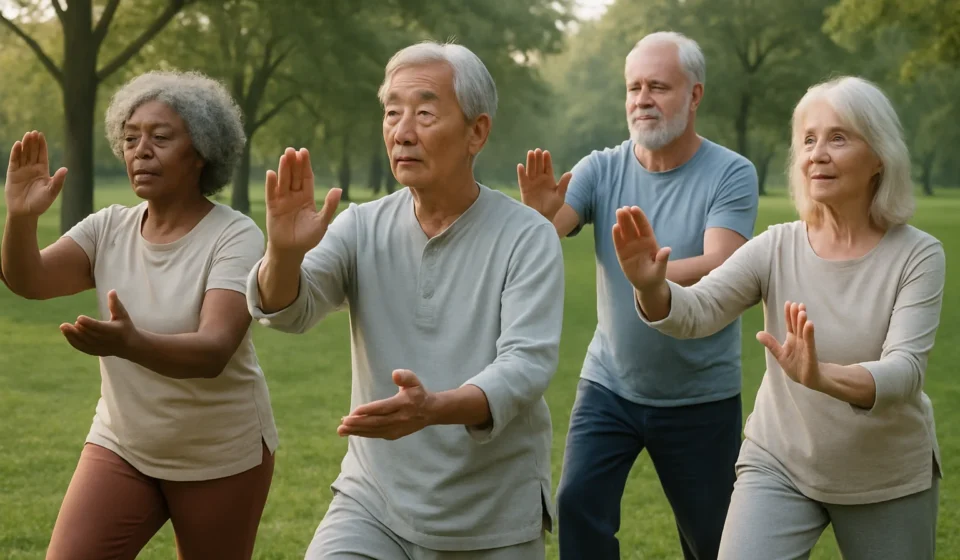

Few exercises have as much hard scientific backing for older adults as Tai Chi for seniors. This gentle, flowing practice — sometimes called “meditation in motion” — has been studied in dozens of randomized trials, and the results are striking: it measurably reduces the risk of falls, sharpens balance, and is easy on aging joints. For seniors worried about the falls that send 3 million older Americans to the emergency room each year, Tai Chi is one of the most evidence-backed, low-cost, low-impact tools available. This 2026 guide explains what the research actually shows, the specific benefits for older bodies, how to start safely, and whether Medicare can help cover it.
Table of Contents
- What Tai Chi Is
- The Evidence: Falls and Balance
- Other Health Benefits for Seniors
- How to Start Tai Chi Safely
- Cost and Medicare Coverage
- Frequently Asked Questions
What Tai Chi Is
Tai Chi is a centuries-old Chinese practice that combines slow, continuous, weight-shifting movements with controlled breathing and focused attention. For an older adult, what matters is the biomechanics: every form requires you to shift your center of gravity over one leg, control your trunk, and move through a wide range of motion — exactly the skills that decline with age and lead to falls. Because the movements are slow and never jarring, Tai Chi places minimal stress on joints, making it accessible even to seniors with arthritis or limited fitness. Several simplified styles exist; Yang-style and the Sun-style adapted for arthritis are the most common for beginners.
The Evidence: Falls and Balance
This is where Tai Chi separates itself from most “gentle exercise” recommendations. Multiple systematic reviews and meta-analyses of randomized controlled trials have found that Tai Chi significantly reduces falls in older adults — with pooled estimates showing roughly a 20–30% reduction in fall risk compared with control groups (relative risk around 0.76, and odds ratios near 0.70 in several analyses). The benefit grows with the duration and frequency of practice, and Yang-style has shown particularly strong results.
The balance improvements are measurable on the same clinical tests physical therapists use. Studies report gains on the Berg Balance Scale, the Timed Up-and-Go test, single-leg stance with eyes closed, and functional reach — the objective markers that predict who will and won’t fall. Tai Chi helps both healthy seniors and those already at high risk.
| Outcome | What the Research Shows |
|---|---|
| Fall risk | ~20–30% reduction vs. controls (RR ≈ 0.76) |
| Balance (Berg Balance Scale) | Significant improvement |
| Timed Up-and-Go | Faster, safer transitions |
| Single-leg stance | Improved static balance |
| Dose-response | Benefit increases with frequency and duration |
Other Health Benefits for Seniors
Beyond falls, the slow loading and weight-shifting build lower-body strength and joint stability, which is why arthritis-adapted Tai Chi programs are recommended for knee and hip osteoarthritis — they improve pain and function without high-impact stress. The breathing and meditative focus lower stress and improve sleep, and many seniors report reduced anxiety and a greater sense of confidence in moving through their day. Because it is a mind-body practice, it also engages attention and coordination, supporting cognitive engagement. And unlike high-intensity programs, it has an extremely low injury rate, so the risk-to-benefit ratio for older adults is excellent.
How to Start Tai Chi Safely
You need no equipment and no prior fitness — just flat shoes and room to take a few steps. To begin well:
- Look for a senior-specific class such as “Tai Chi for Arthritis” or “Tai Chi for Fall Prevention,” which are evidence-based programs designed for older adults and widely offered at senior centers, YMCAs, and Area Agencies on Aging.
- Start with a chair-supported or wall-near option if your balance is poor, so support is always within reach.
- Aim for consistency — even two to three sessions a week produces measurable gains, and benefits compound over months.
- Tell your instructor about any conditions such as recent surgery, severe arthritis, or low blood pressure so movements can be modified.
- Check with your doctor first if you have heart disease, severe balance problems, or are recovering from a fall or injury.
Cost and Medicare Coverage
Original Medicare (Parts A and B) does not pay for general fitness classes like Tai Chi as a standalone benefit. However, there are two real paths to low- or no-cost access. First, many Medicare Advantage plans include the SilverSneakers or Renew Active fitness benefits, which cover Tai Chi classes at participating gyms and senior centers at no extra charge — check your plan’s wellness benefits. Second, if Tai Chi-style balance training is delivered as part of a physician-ordered physical therapy plan for a diagnosed condition or fall risk, Part B may cover it under the therapy benefit (you pay 20% after the deductible). Beyond insurance, community senior centers and Area Agencies on Aging frequently offer free or donation-based classes.
Frequently Asked Questions
Is Tai Chi safe for seniors with arthritis?
Yes — in fact, Tai Chi for Arthritis is a recognized evidence-based program. The slow, low-impact movements improve joint function and reduce pain without the stress of high-impact exercise. Tell your instructor about affected joints so movements can be adapted.
How often should seniors do Tai Chi to prevent falls?
Research suggests benefits begin at two to three sessions per week, and the fall-reduction effect grows with longer, more frequent practice. Consistency over months matters more than intensity.
Can Tai Chi really reduce my risk of falling?
Yes. Multiple meta-analyses of randomized trials show roughly a 20–30% reduction in fall risk among older adults who practice Tai Chi, along with measurable improvements in balance tests that predict falls.
Do I need to be flexible or fit to start?
No. Tai Chi is designed to meet you where you are, with chair-supported and modified versions for those with limited mobility or balance. It is one of the most accessible exercises for older beginners.
What a Typical Tai Chi Class Looks Like
Knowing what to expect removes the intimidation factor. A senior Tai Chi class usually opens with a few minutes of gentle warm-up — loosening the ankles, knees, hips, and shoulders — followed by simple weight-shifting drills that train you to move your center of gravity with control. From there the instructor leads a short sequence of named forms performed slowly and repeated, with an emphasis on soft knees, an upright spine, and coordinated breathing. Sessions typically run 45 to 60 minutes and stay low-intensity throughout; you should be able to hold a conversation the entire time. A good instructor offers a chair-supported version of every movement, so no one is left behind. There is no special clothing required — just comfortable layers and flat, supportive shoes. Most beginners feel steadier within a few weeks and notice the largest gains after two to three months of consistent practice. If a movement causes joint pain, that is a signal to modify, not to push through; Tai Chi is meant to feel sustainable, which is exactly why seniors stick with it.
Related Articles You May Find Helpful
- Senior Fitness Guide 2026: Best Exercises for Healthy Aging
- Balance Exercises for Seniors Over 70: 8 Proven Moves
- Fall Prevention for Seniors 2026: 10 Proven Strategies
- Chair Yoga for Seniors 2026: 8 Seated Poses
- Resistance Band Exercises for Seniors 2026: 8 Moves
Sources
- Frontiers in Public Health (2023) — Tai Chi for fall prevention and balance improvement in older adults: systematic review and meta-analysis
- National Center for Complementary and Integrative Health (NIH) — Tai Chi
- Centers for Disease Control and Prevention (CDC) — STEADI: Older Adult Fall Prevention
This article is educational and not a substitute for medical advice. Check with your provider before starting a new exercise program, especially after a fall or surgery.