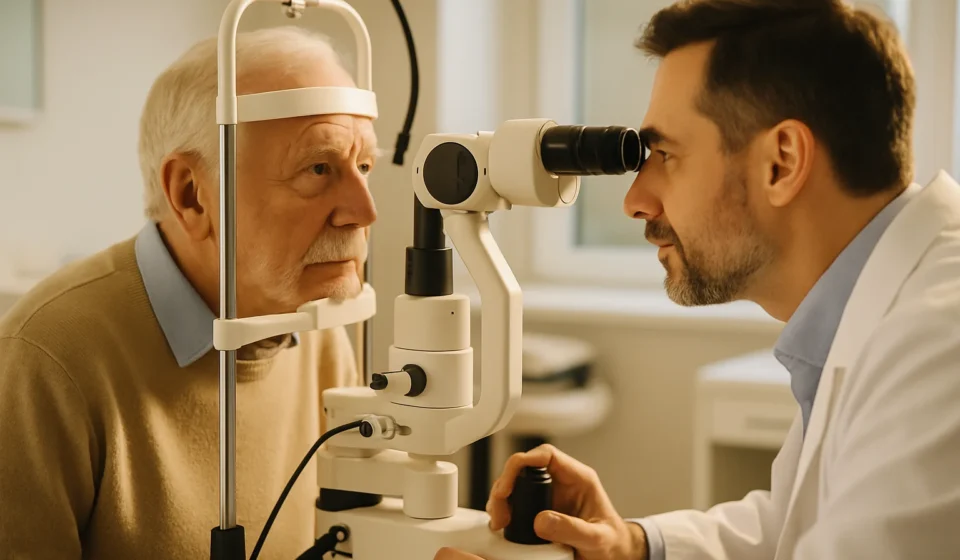

Glaucoma in seniors is often called the “silent thief of sight” for a reason: it destroys peripheral vision so gradually that most people do not notice until a substantial portion of their optic nerve fibers are already gone. By age 70, the risk climbs sharply, and glaucoma remains a leading cause of irreversible blindness in older adults. The encouraging news is that vision lost cannot be restored, but vision that remains can almost always be protected — if the disease is caught and treated early. This 2026 guide explains how glaucoma damages the eye, the warning signs that are easy to miss, the modern treatments that now rival or beat daily eye drops, and exactly what Medicare covers.
Table of Contents
- What Glaucoma Is and How It Damages Vision
- The Two Main Types Seniors Face
- Warning Signs and Risk Factors
- 2026 Treatment Options
- Medicare Coverage for Glaucoma
- Frequently Asked Questions
What Glaucoma Is and How It Damages Vision
Glaucoma is a group of diseases that damage the optic nerve, the bundle of roughly one million fibers that carries visual signals from the retina to the brain. In most cases the damage is driven by elevated intraocular pressure (IOP) — fluid called aqueous humor builds up faster than it drains, and the resulting pressure slowly strangles nerve fibers. Because the brain fills in the missing peripheral areas, the loss is invisible to the patient until it reaches the central field. This is why glaucoma is so dangerous in seniors: by the time symptoms appear, the damage is permanent.
The Two Main Types Seniors Face
Primary Open-Angle Glaucoma
This is the most common form, accounting for the large majority of cases. The eye’s drainage angle remains open, but the microscopic drainage meshwork becomes inefficient over years, raising pressure gradually and painlessly. There are no early symptoms — which is precisely why routine dilated eye exams are the only reliable way to catch it.
Angle-Closure Glaucoma
Less common but potentially an emergency. Here the drainage angle becomes physically blocked. An acute angle-closure attack causes sudden severe eye pain, headache, nausea, halos around lights, and blurred vision — and it can destroy sight within hours. This is a medical emergency requiring same-day care. A third pattern, normal-tension glaucoma, damages the nerve even when pressure readings look normal, underscoring that pressure is only part of the picture.
Warning Signs and Risk Factors
Open-angle glaucoma usually produces no symptoms until late, when patients notice gaps in side vision, difficulty navigating in dim light, or a sense of “tunnel vision.” Acute angle-closure, by contrast, announces itself loudly with pain and visual halos. Knowing your risk profile is the best substitute for symptoms you cannot feel.
| Risk Factor | Why It Matters |
|---|---|
| Age over 60 | Risk rises steadily; over 70 it climbs sharply |
| Family history | A first-degree relative substantially increases risk |
| African American or Hispanic heritage | Higher prevalence and earlier onset of open-angle disease |
| High eye pressure | The single most modifiable risk factor |
| Diabetes, high blood pressure | Vascular damage compounds optic nerve injury |
| Long-term steroid use | Can raise intraocular pressure |
2026 Treatment Options
Every glaucoma therapy works toward one goal: lowering intraocular pressure to slow or halt optic nerve damage. The treatment landscape has shifted meaningfully in recent years.
Eye Drops
Prostaglandin analogs (such as latanoprost) remain a first-line medical therapy, improving fluid outflow with once-daily dosing. Beta-blockers, alpha agonists, and carbonic anhydrase inhibitors are added when needed. The Achilles’ heel of drops is adherence — many seniors struggle with the daily regimen, arthritis-limited bottle handling, or burning side effects, and inconsistent use is a major cause of progression.
Selective Laser Trabeculoplasty (SLT)
SLT is an outpatient laser procedure that takes only minutes and lowers pressure by roughly 20–30%. The landmark LiGHT trial showed that SLT used as a first-line treatment controls pressure at least as well as drops while slowing progression — and it removes the daily-adherence problem entirely. A newer non-contact, image-guided version called Direct SLT (DSLT) was introduced in 2025, making the procedure faster and more accessible. For many seniors who dislike or forget drops, laser-first is now a legitimate, evidence-backed strategy worth discussing with an ophthalmologist.
Surgery and MIGS
When drops and laser are not enough, minimally invasive glaucoma surgery (MIGS) — tiny stents and microscopic drainage devices, often placed during cataract surgery — can lower pressure with a gentler recovery than traditional trabeculectomy. Conventional filtering surgery and drainage implants remain the option for advanced or aggressive disease.
Medicare Coverage for Glaucoma
Medicare Part B covers an annual glaucoma screening for people at high risk — including those with diabetes, a family history of glaucoma, and African Americans age 50 and older. After you meet the Part B deductible, Medicare pays 80% of the approved amount for medically necessary diagnostic testing, SLT, MIGS, and surgical treatment, leaving you responsible for the remaining 20% (which a Medigap plan can cover). Glaucoma eye-drop medications are generally covered under Part D prescription drug plans rather than Part B. Because cost-sharing and prior-authorization rules vary, confirm specifics with your plan before a procedure.
Frequently Asked Questions
Can glaucoma be cured?
No. Vision already lost to glaucoma cannot be restored, and there is no cure. But with consistent treatment to lower eye pressure, the disease can usually be controlled and remaining vision preserved for life.
How often should seniors get tested for glaucoma?
Most older adults should have a comprehensive dilated eye exam every one to two years, and annually if you have risk factors or an existing diagnosis. Medicare covers yearly screening for high-risk groups.
Is laser treatment better than eye drops?
For many patients, SLT works as well as drops as a first treatment and avoids the problem of forgetting daily doses, according to the LiGHT trial. It is not right for everyone, so the decision should be individualized with your ophthalmologist.
What does sudden eye pain with halos and nausea mean?
These are classic signs of acute angle-closure glaucoma, a medical emergency that can cause blindness within hours. Seek same-day emergency eye care immediately.
Protecting Your Vision Every Day
Because glaucoma damage is permanent, the daily habits that keep pressure controlled are as important as the treatment itself. If you use eye drops, take them at the same time every day and ask your ophthalmologist about the punctal-occlusion technique — gently pressing the inner corner of the eye for a minute after each drop — which improves absorption and reduces side effects. If arthritis makes squeezing the bottle hard, inexpensive drop-guide devices can help, and a missed-dose pattern is itself a reason to discuss laser therapy. Keep every follow-up appointment for visual field testing and optic nerve imaging (OCT); these track silent progression long before you would notice it. Moderate aerobic exercise can modestly lower eye pressure, while activities involving prolonged head-down positions may raise it, so mention your routine to your doctor. Finally, do not stop treatment because your vision “feels fine” — feeling fine is exactly how glaucoma progresses unchecked. Consistency, not symptoms, is what preserves sight.
Related Articles You May Find Helpful
- Senior Health Conditions 2026: Expert Guide to Prevention & Treatment
- Cataract Surgery for Seniors 2026: Medicare Coverage & Costs
- Macular Degeneration in Seniors 2026: Warning Signs & Medicare Guide
- Dry Eye Syndrome in Seniors 2026: Relief & Medicare
- Does Medicare Cover Eye Exams & Glasses in 2026?
Sources
- Glaucoma Research Foundation — Selective Laser Trabeculoplasty (SLT)
- National Eye Institute (NIH) — Glaucoma
- Medicare.gov — Glaucoma Tests Coverage
This article is educational and not a substitute for an examination by a licensed eye care professional. If you have vision changes, see an ophthalmologist promptly.