
Medicare Prescription Payment Plan for 2027: How It Works, Who It Helps, and When to Skip It

If you take an expensive drug, January can be brutal. Your Part D deductible resets, and a single trip to the pharmacy can cost hundreds of dollars. The Medicare Prescription Payment Plan exists for exactly that problem. It lets you pay your drug costs in monthly bills spread across the year instead of all at once at the counter.
It’s a useful tool for some people and a poor fit for others, and it’s widely misunderstood. One correction up front: an earlier version of this article said every Part D enrollee is enrolled automatically. That’s wrong. You have to ask your plan to join. Once you’re in, it renews each year only if you stay in the same plan.
About me: I’m a researcher who reads Medicare.gov and CMS documents and compares plans and programs for readers. I’m not a licensed insurance agent, I don’t sell plans, and no insurer pays this site. For free one-on-one help, contact your State Health Insurance Assistance Program (SHIP). Everything below was checked against official sources on October 8, 2026, a week before Open Enrollment (October 15 to December 7).

What the payment plan is (and isn’t)
According to Medicare.gov, the Medicare Prescription Payment Plan is a payment option that works with the drug coverage you already have. Here’s what that means in practice:
- Every Part D plan offers it, including Medicare Advantage plans with drug coverage.
- It’s voluntary and free. There’s no fee to join, and no interest is charged.
- You pay $0 at the pharmacy for covered Part D drugs, including mail-order and specialty pharmacies. Your plan bills you each month instead.
- It doesn’t lower your drug costs. You pay the same total for the year either way. It only changes when you pay.
- Your premium is separate. If your plan has a monthly premium, you keep paying it as usual, on its own bill.
It was created by the Inflation Reduction Act and started in 2025. The same law caps what you pay out of pocket for covered Part D drugs: $2,100 in 2026 and $2,400 in 2027. That cap applies to everyone with Medicare drug coverage, whether or not you use the payment plan. The payment plan just lets you spread whatever you owe under the cap across the months.
How your monthly bill is calculated
All plans use the same CMS formula. It has two parts:
- Your first month: the plan figures a “maximum possible payment,” which is the yearly cap minus anything you’ve already paid this year, divided by the months left. You pay that amount or your actual drug costs for the month, whichever is less.
- Every month after that: your unpaid balance plus any new drug costs, divided by the months left in the year.
The examples below come straight from Medicare’s own 2027 fact sheet on the payment plan.
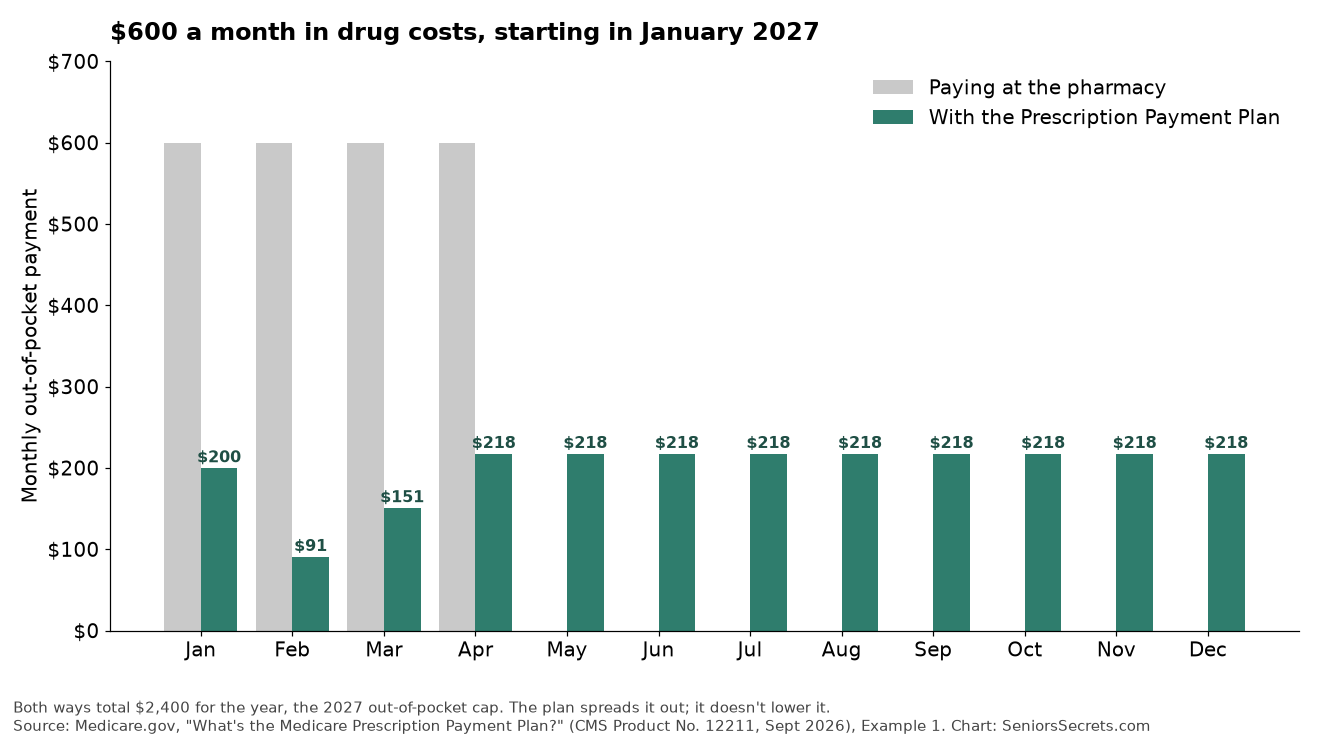
Example 1: high costs early in the year. Someone takes drugs with $600 a month in out-of-pocket costs and joins in January 2027. Paying at the pharmacy, they’d pay $600 in each of the first four months and hit the $2,400 cap in April. With the payment plan, they pay $200 in January, $90.91 in February, $150.91 in March, and $217.58 a month from April through December.
Example 2: steady, modest costs. Someone pays $80 a month for a regular prescription and joins in January. The bills start tiny ($7.27 in February) and then climb, ending at $241.59 in December. The total is still $960. They’ve simply moved most of the bill to the end of the year.
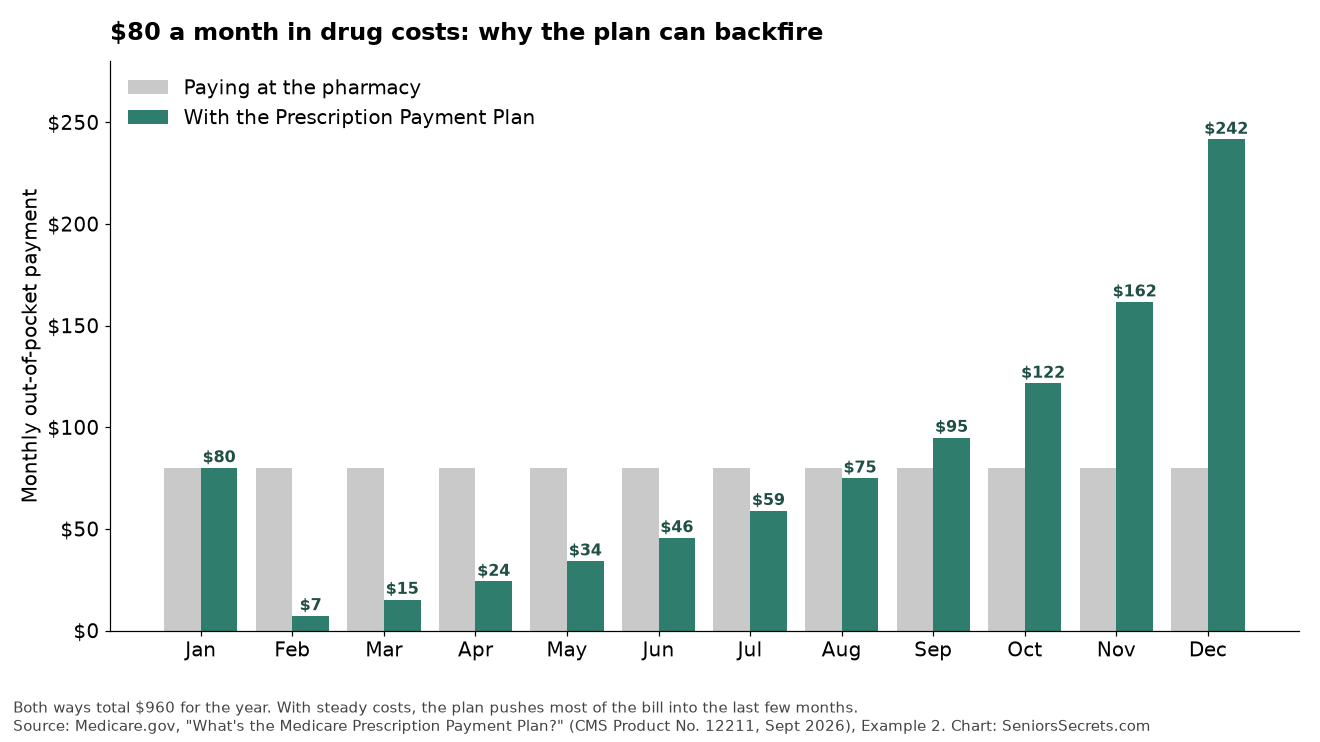
That second example is the part most explainers skip. The payment plan is built for a big cost early in the year, not for smoothing out a bill that’s already even.
Who it helps, and who should skip it
Medicare.gov says you’re most likely to benefit if you have high drug costs early in the year. My reading of the rules points to the same short list:
Good fit:
- You take a high-cost drug and would hit the $2,400 cap in the first few months of 2027.
- You’ve just been prescribed something expensive and can’t cover the first fills at once.
- You’d rather have a predictable monthly bill and can budget for it.
Probably not a good fit (Medicare.gov lists these):
- Your yearly drug costs are low, or they’re about the same every month.
- You’d be joining late in the year, after September. There are too few months left to spread the cost.
- You get or qualify for Extra Help or a Medicare Savings Program.
- You already get help from a State Pharmaceutical Assistance Program, a coupon program or other coverage.
If money is the real problem, a program that lowers your costs beats one that spreads them. Extra Help caps 2027 copays at $5.80 for generics and $14.40 for brand-name drugs. A Medicare Savings Program can pay your Part B premium and also qualifies you for Extra Help automatically. Drug makers’ patient assistance programs can help with specific medicines.
The Open Enrollment catch: switching plans ends it
This is the 2027 detail I’d flag for anyone shopping plans this fall.
Medicare’s fact sheet says your plan will automatically renew your participation every year, unless you change plans or contact your plan to opt out. So if you’re using the payment plan in 2026 and keep the same drug plan for 2027, you don’t need to do anything.
But if you switch to a different drug plan or Medicare Advantage plan during Open Enrollment, your participation ends when you leave the old plan. If you want it in 2027, contact your new plan and opt in again. The good news: under CMS’s program rules, you can opt in before the plan year starts, and a plan has 10 calendar days to process a request made before January. During the year, plans must process requests within 24 hours, so you’re not stuck waiting at the pharmacy for a week.
If you’re comparing 2027 drug plans, our Part D 2027 guide covers the new $700 maximum deductible, the premium changes and how to compare plans. Medicare’s Plan Finder can also estimate what your monthly payments would look like with the payment plan, once you enter your drugs.

How to sign up
- Contact your drug plan. Use its website, call the member services number on your card, or ask for a paper form. Joining doesn’t change your coverage, your pharmacy or your drug list.
- Watch for a confirmation letter. It explains how and when to pay your monthly bill.
- Fill prescriptions as usual. Your plan tells the pharmacy you’re in the program, and you pay $0 for covered Part D drugs at the counter.
- Pay the monthly bill from your plan. It shows what you owe and when.
You don’t always have to go looking for it. Plans have to tell members who look likely to benefit. When the program started, CMS set the trigger at a single prescription with $600 or more in cost-sharing; the pharmacy then gives you a standard “Likely to Benefit” notice.
What happens if you miss a payment or want out
- Missed payment: your plan sends a reminder. If you still don’t pay by the date in that reminder, you’re removed from the payment plan. You still owe the balance, but there’s no interest and no late fee, and you can pay it all at once or keep getting monthly bills.
- Your drug coverage stays. Being removed from the payment plan doesn’t drop you from your Part D or Medicare Advantage plan. Medicare’s advice is to always pay your plan premium first, so you don’t lose coverage.
- Leaving on purpose: you can opt out any time by contacting your plan. Any balance is still due, and you go back to paying the pharmacy directly for new prescriptions.
- Billing mistakes: call your plan. If that doesn’t fix it, you can file a grievance using the process in your plan’s Evidence of Coverage.
Frequently asked questions
Am I enrolled automatically?
No. You have to opt in with your plan. Once you’re in, it renews each year as long as you stay in the same plan and don’t opt out.
Does it save me money?
No. You pay the same total for the year. It only spreads payments out. Extra Help and Medicare Savings Programs are the programs that actually lower costs.
Does it cover Part B drugs, like infusions at my doctor’s office?
No. It applies only to drugs covered by your Part D plan.
What’s the most I could pay in 2027?
For covered Part D drugs, no more than the $2,400 out-of-pocket cap, and never more than you would have paid at the pharmacy anyway. Your premium is extra.
Can I join in the middle of the year?
Yes, any month. But joining late in the year leaves fewer months to spread the cost, which is why Medicare suggests it may not be worth it after September.
The bottom line
If you’re facing a big drug bill early in 2027, the Medicare Prescription Payment Plan can keep January from wrecking your budget, at no extra cost. If your costs are low or steady, skip it. And if you change plans during Open Enrollment, remember to opt in again with the new plan. For a free, unbiased second opinion on your drug plan options, talk to your SHIP counselor, and see our Medicare Advantage 2027 guide if you’re weighing a switch.
Related guides