Senior Housing Options Compared: Costs, Care Levels and Who Pays for Each
Assisted living now costs a national median of $6,200 a month, and a semi-private nursing home room costs $9,581 a month (CareScout Cost of Care Survey 2025). Medicare pays for neither when you need long-term help with daily living (Medicare.gov).
That’s why it pays to know your options before a crisis. This guide compares the main types of senior housing, what each costs, what care you get and who pays.
The quick comparison
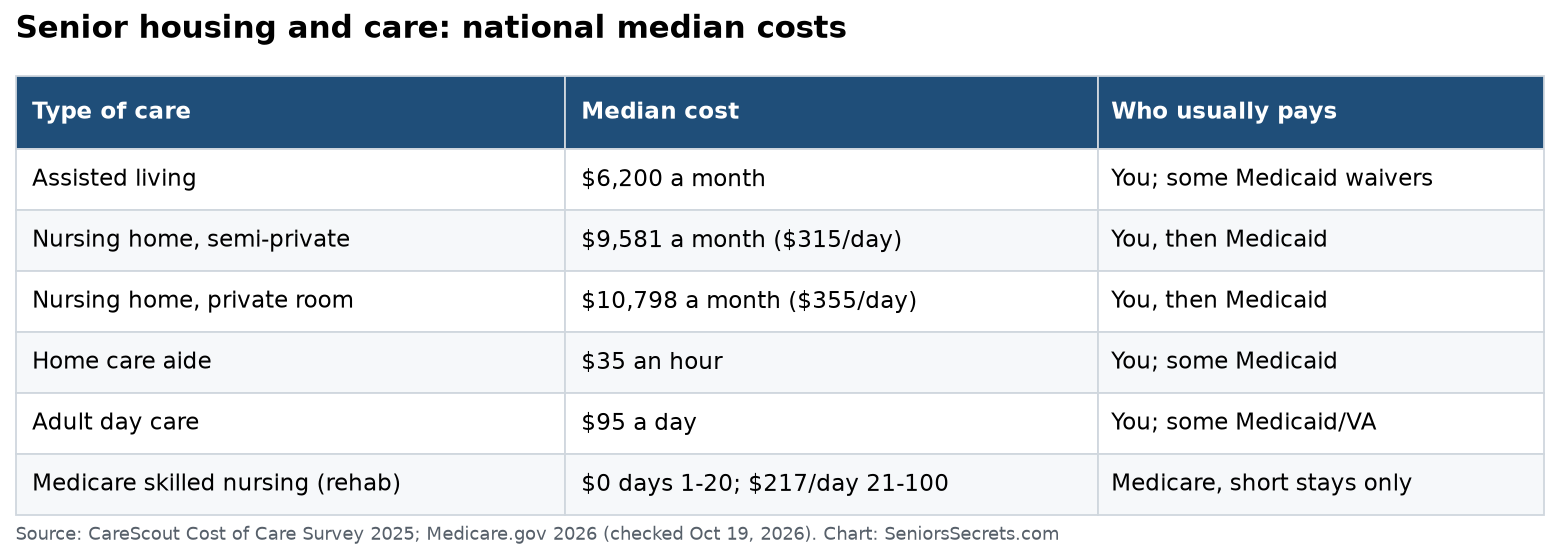
Costs vary a lot by state and city. Use these as a starting point and check local prices.
1. Staying at home with help
Most people want to stay home. You can, with the right support.
What it costs: A non-medical home care aide costs a median $35 an hour in 2025. At 44 hours a week, that’s about $80,080 a year. Skilled nursing at home costs a median $90 an hour when you pay privately.
What Medicare pays: Medicare covers home health care only if you’re homebound and need part-time or occasional skilled care, like nursing or therapy (Medicare.gov). It does not pay for:
- 24-hour care at home
- Meal delivery
- Homemaker services like shopping and cleaning, when not part of your care plan
- Help with bathing, dressing or using the bathroom, when that’s the only care you need
Who it fits: People who need a few hours of help a day, have family nearby or have a home that’s safe or can be made safe.
2. Adult day care
Adult day programs give older adults a safe place to spend the day with meals, activities and some health care. They also give family caregivers a break.
What it costs: A median $95 a day in 2025.
Who pays: Mostly you. Some state Medicaid programs and some VA benefits help pay.
3. Independent living and 55+ communities
These are apartments or homes for older adults with little or no hands-on care. Many offer meals, housekeeping, transportation and social activities.
What it costs: It varies widely, from market-rate rent to luxury. There’s no single national median for this type.
Who pays: You, from income or savings. Medicare and Medicaid don’t pay rent.
Low-income option: HUD’s Section 202 program offers subsidized apartments for very low-income adults aged 62 and older. Waitlists are often long. Our Section 202 guide explains how to apply.
4. Assisted living
Assisted living gives you a private apartment or room plus help with daily tasks like bathing, dressing and medicines. Staff are on site 24 hours a day. It’s not a nursing home. Medical care is limited.
What it costs: A median $6,200 a month, or $74,400 a year, in 2025. That’s up from $5,900 in 2024, a 5% rise.
Who pays: Mostly you. Medicare doesn’t pay for assisted living. In many states, Medicaid waiver programs can pay for the care part, but usually not room and board. See our guide to Medicaid waiver programs.
Memory care is a type of assisted living for people with dementia. It usually costs more because of extra staff and security.
5. Nursing homes
A nursing home gives 24-hour supervision, meals and help with daily living, plus nursing care.
What it costs in 2025:
- Semi-private room: a median $9,581 a month ($315 a day, or $114,975 a year)
- Private room: a median $10,798 a month ($355 a day, or $129,575 a year)
Who pays: At first, you. When your savings run low, Medicaid may pay if you meet your state’s rules (Medicare.gov). Each state sets its own income and asset limits. Our Medicaid spend-down guide explains how that works.
Medicare’s short-term nursing home rule
Medicare Part A does pay for a short stay in a skilled nursing facility after a hospital stay, for rehab or skilled care. In 2026 you pay (Medicare.gov):
- Days 1 to 20: $0 a day, after the $1,736 ($1,776 in 2027) Part A deductible
- Days 21 to 100: $217 a day
- Day 101 and later: all costs
You usually need a 3-day inpatient hospital stay first. Time spent “under observation” or in the ER doesn’t count, even overnight. Our skilled nursing guide covers the fine print.
6. Continuing care retirement communities (CCRCs)
A CCRC puts independent living, assisted living and nursing care on one campus. You move between levels as your needs change.
What it costs: Most charge an entry fee plus a monthly fee. Contracts differ a lot. Some cover future care at a set price. Others charge full price when you need more care.
Watch out for: Refund rules on the entry fee, how fees rise and the community’s finances. Have a lawyer review the contract before you sign.
7. PACE: nursing-home-level care while living at home
PACE (Program of All-inclusive Care for the Elderly) helps people who need nursing-home-level care stay in the community. You can join if you (Medicare.gov):
- Are 55 or older
- Live in a PACE service area
- Need nursing-home-level care, as certified by your state
- Can live safely in the community with PACE’s help
If you have Medicaid, you pay no monthly premium for PACE. It’s only in some areas. See our Medicaid waiver and PACE guide.

How to choose: 5 questions
- What help do you need now? Make a list: meals, bathing, medicines, getting around, memory.
- What will you likely need in 3 to 5 years? Moving twice is hard. A place that can add care may be worth more.
- What can you afford for how long? Multiply the monthly cost by the years you might need it.
- Will you qualify for Medicaid later? Ask each place if it accepts Medicaid, and what happens if your money runs out.
- Have you visited more than once? Go at mealtime. Talk to residents and families.
Where to get free help
Call the Eldercare Locator at 1-800-677-1116 or visit eldercare.acl.gov. It connects you to your local Area Agency on Aging, which can explain programs, home care options and benefits in your area.
Common questions
What is the cheapest senior housing option?
For people with very low income, HUD Section 202 apartments are usually the lowest-cost option, with rent based on income. Staying at home with family help and part-time aides can also cost less than assisted living.
Does Medicare pay for assisted living?
No. Medicare doesn’t pay for assisted living or other long-term custodial care. Medicaid waiver programs in many states can help pay for the care part.
How much does a nursing home cost per month in 2025?
The national median is $9,581 a month for a semi-private room and $10,798 for a private room, based on the CareScout 2025 survey.
Will Medicare pay for a nursing home?
Only for a short skilled nursing stay after a qualifying hospital stay, up to 100 days per benefit period. In 2026, days 21 to 100 cost $217 ($222 in 2027) a day. Medicare does not pay for long-term nursing home care.
What is the difference between assisted living and a nursing home?
Assisted living helps with daily tasks in a home-like setting with limited medical care. A nursing home gives 24-hour supervision plus nursing care for people with greater health needs.
2027 amounts added Nov 18, 2026 from the CMS 2027 Parts A and B fact sheet.
Written by Khasim Basha Shaik. I research and compare Medicare plans and senior care costs for readers. I am not a licensed insurance agent, elder law attorney or financial adviser. This article summarizes Medicare.gov, Administration for Community Living and CareScout data and is not legal or financial advice. Last reviewed October 19, 2026.