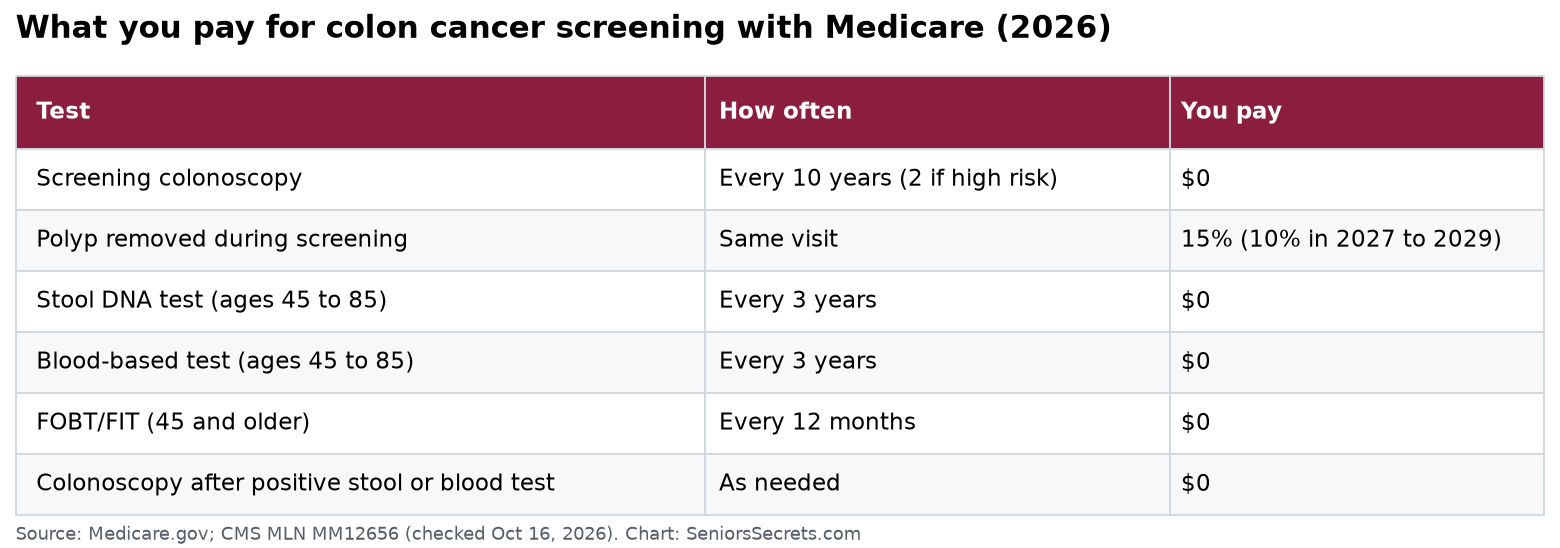
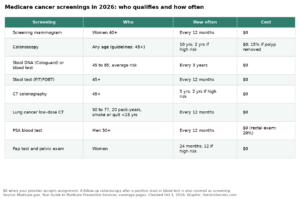
Yes. Medicare Part B covers screening colonoscopies, and you pay nothing if your doctor accepts assignment. There’s no minimum age. If you’re at average risk, it’s covered once every 10 years (120 months). If you’re at high risk, it’s every 2 years. One catch: if the doctor removes a polyp during the test, you pay 15% of the cost in 2026. That share drops to 10% in 2027 and to $0 in 2030. A follow-up colonoscopy after a positive stool or blood test is also free.
This guide uses Medicare.gov’s pages on screening colonoscopies, stool DNA tests, blood-based screening tests and fecal occult blood tests, plus the CMS notice on polyp-removal coinsurance. All were checked on October 16, 2026.
I research Medicare rules for older adults. I am not a doctor or licensed insurance agent.
How often Medicare covers a colonoscopy
| Your situation | How often Part B covers a screening colonoscopy |
|---|---|
| Average risk | Once every 120 months (10 years) |
| Average risk, after a flexible sigmoidoscopy | 48 months after the sigmoidoscopy |
| High risk | Once every 24 months (2 years) |
High risk usually means you or a close family member had colon cancer or certain polyps, or you have inflammatory bowel disease like Crohn’s or ulcerative colitis. Your doctor decides if you’re high risk.
What you pay in 2026
Screening with no polyps removed: $0
If your doctor accepts assignment, you pay nothing for the screening colonoscopy. The Part B deductible doesn’t apply.
If a polyp is removed: 15%
A screening can turn into a treatment if the doctor finds and removes a polyp or other tissue. In 2026, you pay:
- 15% of the Medicare-approved amount for the doctor’s services
- 15% to the facility, if done in a hospital outpatient department or surgery center
- No Part B deductible
This share is shrinking under a law passed by Congress, per CMS:
- 2023 to 2026: 15%
- 2027 to 2029: 10%
- 2030 and later: $0
Example
Here is a made-up round number to show the math. Say the Medicare-approved amount for the doctor and facility, with polyp removal, is $1,000. In 2026, you’d pay about $150. In 2027, the same visit would cost about $100. Real amounts vary by place.
A Medigap plan usually covers this coinsurance. See best Medigap plans for 2026.
At-home and blood test options
You don’t have to start with a colonoscopy. Medicare also covers these tests for people at average risk with no symptoms:
| Test | Ages | How often | Cost |
|---|---|---|---|
| Fecal occult blood test (FOBT or FIT) | 45 and older | Once every 12 months | $0 |
| Stool DNA test (like Cologuard) | 45 to 85 | Every 3 years | $0 |
| Blood-based screening test | 45 to 85 | Every 3 years | $0 |
The free follow-up rule
If your stool or blood test comes back positive, Medicare covers a follow-up colonoscopy as a screening test. That means you pay nothing for it, as long as your doctor accepts assignment. Before 2023, many people got a bill for this step. Not anymore.
If a polyp is removed during that follow-up, the 15% rule above still applies.
Which test should you pick?
Talk with your doctor. Here’s how they compare:
- Colonoscopy: finds and removes polyps in one visit. It needs bowel prep and sedation, and you’ll need a ride home. If normal, you may not need another for 10 years.
- Stool tests: easy and done at home. But a positive result means you’ll still need a colonoscopy.
- Blood test: just a blood draw. Also needs a colonoscopy if positive.
If you have symptoms, a stool or blood test isn’t the right choice. See a doctor for a diagnostic colonoscopy instead.
Getting ready for a colonoscopy
The prep is the hardest part for most people. Your doctor’s office will give you exact steps. Here’s what it usually looks like:
- A few days before: you may be told to skip seeds, nuts and high-fiber foods.
- The day before: clear liquids only, like broth, apple juice, tea and sports drinks without red or purple color.
- The evening before: you drink a bowel prep. Some plans split it, with half the night before and half early that morning.
- Medicines: ask about blood thinners, diabetes medicines and iron pills. Some may need to stop for a few days.
- The day of: bring an adult to drive you home. Sedation means you can’t drive for the rest of the day.
Good prep matters. If the colon isn’t clean, the doctor may miss polyps, and you may need to repeat the test sooner.
When a colonoscopy is “diagnostic”
If you go in because of symptoms, like bleeding, a change in bowel habits or belly pain, the colonoscopy is diagnostic, not screening. Different rules apply. You’ll likely pay 20% of the approved amount after the $283 Part B deductible, plus a facility copay in a hospital.
Tell the office the reason for your visit. Ask how it will be billed before the test.
Is there an age limit?
Medicare.gov says there’s no minimum age for a screening colonoscopy. There’s also no upper age limit on Medicare coverage. But screening after 75 isn’t right for everyone. The decision depends on your health and past results. Ask your doctor.
Tips to avoid surprise bills
- Confirm your doctor accepts assignment. That keeps your screening at $0.
- Ask about anesthesia. Medicare covers it with a screening colonoscopy. Ask how the anesthesia team bills.
- Check your high-risk status. It changes how often you’re covered.
- Keep your dates. Getting a screening too soon may not be covered.
- If you have Medicare Advantage, check network rules. Screening is still covered.
If a claim is denied, you can appeal. See how to win a Medicare appeal. For hospital billing traps, read about observation status.
Common questions
Is a colonoscopy free with Medicare?
A screening colonoscopy is $0 if your doctor accepts assignment. If a polyp is removed, you pay 15% in 2026.
How often will Medicare pay for a colonoscopy?
Every 10 years for average risk, every 2 years for high risk, or 48 months after a flexible sigmoidoscopy.
Does Medicare cover Cologuard?
Yes, every 3 years for people 45 to 85 at average risk with no symptoms. You pay nothing.
Do I pay for a colonoscopy after a positive Cologuard test?
No. Medicare covers the follow-up colonoscopy as a screening test. You pay 15% only if a polyp is removed.
Does Medicare cover colonoscopy after age 75?
Yes. There’s no upper age limit on Medicare coverage. Talk with your doctor about whether screening is right for you.
Written by Khasim Basha Shaik. I research Medicare rules for older adults. I am not a doctor or licensed insurance agent. This article summarizes Medicare.gov and CMS sources and is not medical or insurance advice. Last reviewed October 16, 2026.
Related guides
Skin Cancer in Seniors: Warning Signs, the ABCDEs, Prevention and What Medicare Covers
Pneumonia Vaccine for Seniors: Which Shot You Need After 50, and What Medicare Pays