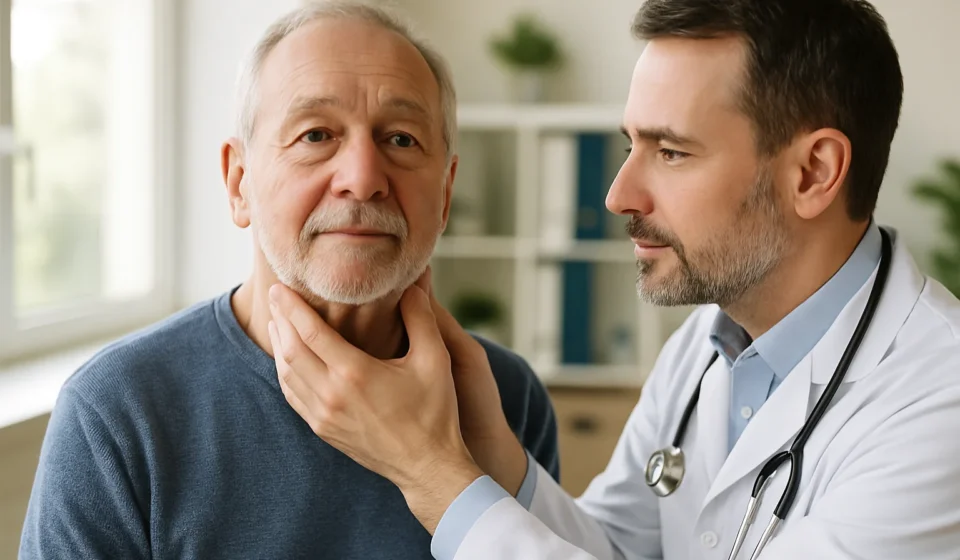

Hyperthyroidism in seniors is one of the most easily missed diagnoses in older adults — because it often looks nothing like the textbook picture. A younger person with an overactive thyroid is typically anxious, sweaty, and visibly revved up. An older adult may instead become quiet, withdrawn, and tired, losing weight for “no reason.” This atypical presentation is called apathetic thyrotoxicosis, and it is a major reason hyperthyroidism in seniors goes undiagnosed until a serious complication — most dangerously, atrial fibrillation — brings it to light. Here is what every older adult and caregiver should understand about the signs, the heart risk, and the treatment choices.
Table of Contents
- What Hyperthyroidism Is
- Why the Symptoms Look Different in Seniors
- The Atrial Fibrillation Connection
- Common Causes in Older Adults
- How It’s Diagnosed
- Treatment Options & Trade-Offs
- Bones, Brain, and Other Risks
- Frequently Asked Questions
What Hyperthyroidism Is
The thyroid is a small butterfly-shaped gland at the base of the neck that sets your metabolic “speed.” In hyperthyroidism, it produces too much thyroid hormone (T3 and T4), accelerating nearly every system in the body. The pituitary gland responds by shutting down thyroid-stimulating hormone (TSH), so a low or undetectable TSH is the hallmark blood-test finding. This is the mirror image of hypothyroidism, where the thyroid is underactive and TSH runs high.
Why the Symptoms Look Different in Seniors
In older adults, the classic hyperthyroid symptoms — racing heart, tremor, heat intolerance, jitteriness, bulging eyes — are frequently muted or absent. Instead, seniors often present with what doctors call apathetic thyrotoxicosis: fatigue, low mood or depression, apathy, cognitive slowing, and unexplained weight loss. Because these overlap with depression, dementia, and “just getting older,” the thyroid is the last thing anyone suspects.
| Feature | Typical (younger) | Often in seniors |
|---|---|---|
| Mood/energy | Anxious, restless, “wired” | Apathetic, depressed, fatigued |
| Weight | Loss despite big appetite | Loss, often with poor appetite |
| Heart | Palpitations, fast pulse | Atrial fibrillation, heart failure |
| Visible signs | Tremor, sweating, eye changes | Few or none |
| Muscles | Mild weakness | Marked weakness, frailty, falls |
The practical lesson: any older adult with new atrial fibrillation, unexplained weight loss, new-onset depression, or unexplained muscle weakness deserves a simple TSH blood test.
The Atrial Fibrillation Connection
This is the complication that makes hyperthyroidism in seniors genuinely dangerous. Excess thyroid hormone is directly toxic to the heart’s electrical and pumping systems. In one classic study, about 25% of hyperthyroid patients over age 60 had atrial fibrillation, compared with roughly 5% of those under 60. Research published in the New England Journal of Medicine found that a low serum TSH is an independent risk factor for developing atrial fibrillation in older people — even before full-blown hyperthyroidism develops (so-called subclinical hyperthyroidism).
Atrial fibrillation matters because it raises the risk of stroke and heart failure. The encouraging news: treating the hyperthyroidism restores a normal heart rhythm in up to two-thirds of patients, and beta-blockers can quickly control the racing pulse and protect the heart while definitive treatment takes effect.
Common Causes in Older Adults
The two leading causes of hyperthyroidism in seniors are:
- Toxic multinodular goiter — lumps (nodules) in a long-standing goiter begin overproducing hormone autonomously. This becomes more common with age.
- Graves’ disease — an autoimmune condition in which antibodies stimulate the thyroid. It is the most common cause overall and can occur in older adults too, confirmed by positive thyroid-stimulating immunoglobulin (TSI) or TSH-receptor antibodies (TRAb).
Less common triggers include excess thyroid hormone medication, certain iodine-containing drugs (such as the heart medication amiodarone), and thyroiditis (temporary inflammation).
How It’s Diagnosed
Diagnosis starts with blood tests: a suppressed TSH with elevated free T4 and/or T3 confirms overt hyperthyroidism. Antibody tests identify Graves’ disease. To distinguish Graves’ from a toxic nodular goiter, doctors may order a radioactive iodine uptake scan, which shows whether the whole gland or just nodules are overactive. Medicare Part B covers these diagnostic labs and imaging when medically necessary, generally subject to the deductible and 20% coinsurance.
Don’t Overlook Subclinical Hyperthyroidism
There is a milder, sneakier version called subclinical hyperthyroidism, in which TSH is low but the free thyroid hormones are still in the normal range. Many seniors feel fine, so it is easy to dismiss. Yet research links even this mild state to a higher risk of atrial fibrillation, bone loss, and possibly cognitive decline in older adults. Whether to treat it depends on how low the TSH is, your age, and your heart and bone health — a conversation worth having with your doctor rather than ignoring. If your TSH comes back low on a routine test, ask whether it should be rechecked in a few weeks and whether a cardiology or endocrinology opinion makes sense.
Treatment Options & Trade-Offs
There are three definitive treatments, plus beta-blockers for fast symptom control. The right choice depends on the cause, your heart, and your overall health.
| Treatment | How it works | Senior considerations |
|---|---|---|
| Antithyroid drugs (methimazole) | Block hormone production | Often first choice; monitor liver and blood counts |
| Radioactive iodine | Shrinks/destroys overactive tissue | Common, effective; usually leads to lifelong hypothyroidism needing levothyroxine |
| Surgery (thyroidectomy) | Removes the gland | Reserved for large goiters or specific cases; surgical risk weighed carefully |
| Beta-blockers | Slow the heart, ease tremor | Bridge therapy; reduce arrhythmia risk while other treatment works |
Because older adults tolerate uncontrolled hyperthyroidism poorly, doctors generally treat it more aggressively and aim to normalize thyroid levels promptly — while watching for the opposite problem, because overshooting into hypothyroidism is common after radioactive iodine.
Bones, Brain, and Other Risks
Beyond the heart, chronic excess thyroid hormone accelerates bone loss and raises the risk of osteoporosis and fractures — a serious concern for post-menopausal women, who are already at risk. It also drives muscle wasting that contributes to weakness and falls, and can worsen confusion or low mood. Treating the thyroid often improves all of these. That is why catching and correcting hyperthyroidism is about far more than the gland itself — it protects the heart, the skeleton, and the mind.
Frequently Asked Questions
What is the most common symptom of hyperthyroidism in older adults?
Unlike younger people, seniors often have few classic symptoms. The most common clues are unexplained weight loss, fatigue or apathy, new depression, muscle weakness, and a heart rhythm problem — especially atrial fibrillation. Any of these should prompt a TSH blood test.
Can hyperthyroidism cause atrial fibrillation in seniors?
Yes. About 25% of hyperthyroid patients over 60 develop atrial fibrillation, and even mild (subclinical) hyperthyroidism with a low TSH independently raises that risk. Treating the thyroid restores normal rhythm in up to two-thirds of cases.
Is hyperthyroidism in seniors curable?
It is highly treatable and often effectively cured with antithyroid drugs, radioactive iodine, or surgery. Many patients end up needing thyroid hormone replacement afterward because treatment commonly leads to an underactive thyroid, which is easily managed with a daily pill.
Does Medicare cover hyperthyroidism testing and treatment?
Yes. Medicare Part B covers medically necessary thyroid blood tests, imaging, and physician visits, and Part D covers antithyroid medications and beta-blockers. Standard deductibles and coinsurance apply.
Related Articles You May Find Helpful