
You do not need 10,000 steps a day after 65. That round number came from a Japanese pedometer marketing campaign decades ago, not from a medical guideline. For older adults, studies that track health outcomes tend to show benefits starting around 4,000 steps a day, with more benefit as you move toward 6,000–8,000, as long as you build up gradually and can walk safely.
Think of steps as one way to hit the broader federal recommendation for older adults: at least 150 minutes a week of moderate activity (brisk walking counts) plus muscle-strengthening work on 2 or more days, and activities that help with balance. The CDC’s guidelines for older adults add one line I wish more people heard: if you can’t meet the recommendations, be as active as your abilities and conditions allow. Some activity is better than none.
I’m a researcher comparing official guidance for readers, not a doctor or physical therapist. Match any new walking plan to your own health history.
A practical step target
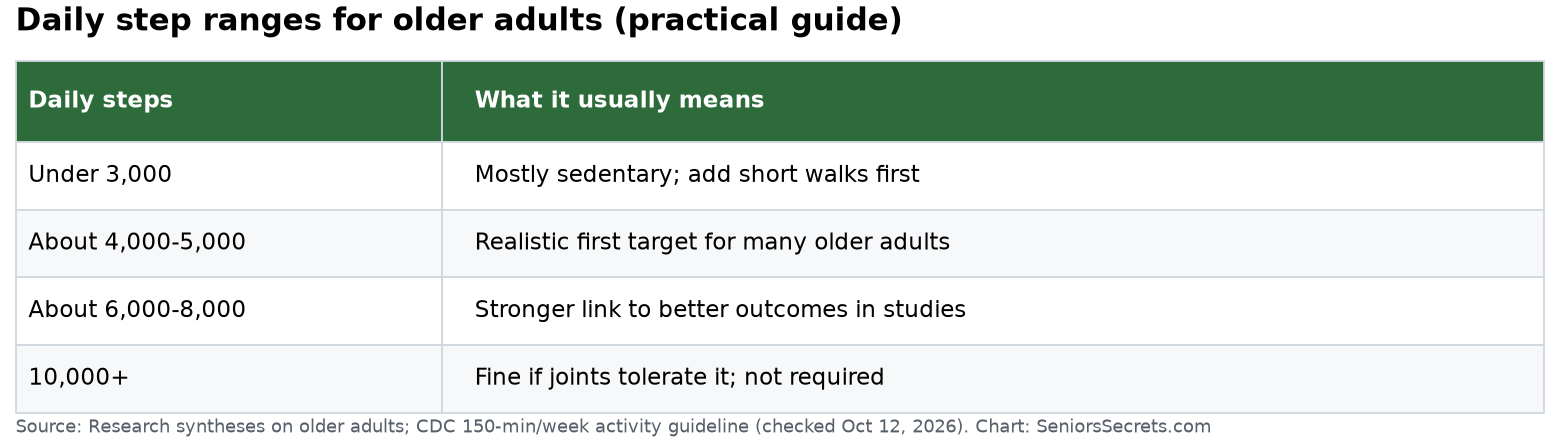
| Daily steps (rough guide) | What it usually means |
|---|---|
| Under 3,000 | Mostly sedentary; aim to add short walks first |
| About 4,000–5,000 | A realistic first target for many older adults |
| About 6,000–8,000 | Stronger association with better health outcomes in studies of older adults |
| 10,000+ | Fine if you enjoy it and your joints tolerate it; not a requirement |
If you currently walk 2,000 steps a day, jumping to 8,000 next week is a recipe for sore knees. Add 500–1,000 steps a day each week until you settle on a number you can keep.
How do steps map to the 150-minute guideline? A brisk 30-minute walk is often roughly 3,000–4,000 steps, depending on height and pace. Five of those across the week get you near both targets without obsessing over a single daily number.
How to make walking stick
- Break it up. Three 10-minute walks count. Short bouts after meals are easier to keep than one long session.
- Use what you already do. Park farther away, walk while on phone calls, or take a short loop after meals.
- Check your footwear and route. Smooth sidewalks, good lighting and supportive shoes cut fall risk. CDC’s STEADI resources emphasize home and outdoor safety for walkers.
- Add strength and balance. Steps alone don’t cover everything. Pair walking with chair exercises, balance work, or the routines in my exercises over 75 guide.
- Track simply. A phone, watch or $15 pedometer is enough. The number matters less than the habit.
- Have a weather plan. Mall walking, indoor tracks and covered parking garages keep you moving when ice or heat make outdoor walks unsafe.

Steps vs. intensity: which matters more?
Step counts are easy to understand, but intensity still matters. A slow shuffle around the house adds steps; a brisk walk that makes conversation slightly harder counts as moderate activity toward the 150-minute weekly goal. If arthritis limits speed, longer easy walks still help with endurance and mood — just don’t assume every step is equal.
Pace cues that work without a heart-rate monitor:
- You can talk in full sentences but not sing comfortably → roughly moderate.
- You need to stop to finish a sentence → too hard; slow down.
- You could easily chat and laugh for minutes → pick up the pace a little if your joints allow.
When to get clearance first
Talk to your doctor before raising your walking goal if you have unstable heart disease, recent surgery, dizziness, chest pain with activity, or a history of falls. If you have diabetes, neuropathy or joint replacements, start with shorter walks and supportive shoes; my guides on exercise with diabetes and exercises after knee replacement cover the adjustments.
If you can’t walk much at all, chair-based movement, water exercise and physical therapy still count. See my chair exercises and water aerobics guides rather than forcing a step target that isn’t safe.
A sample week that builds steps without burning out
| Day | Walking | Extra |
|---|---|---|
| Mon | Two 15-minute neighborhood loops | 5 minutes of balance near a counter |
| Tue | One 20-minute mall walk | Chair strength (sit-to-stand, wall push-ups) |
| Wed | Three 10-minute after-meal walks | Easy stretch |
| Thu | Rest or a short stroll | Strength again |
| Fri | 25–30 minutes outdoors or indoors | Balance |
| Sat | Walk with a friend or family member | Whatever pace you can talk through |
| Sun | Optional easy 10 minutes | So you never go two full days without moving |
Adjust the minutes down if you’re recovering from illness or joint pain. Consistency beats a heroic Saturday.
Common questions
Is 10,000 steps a day necessary for seniors?
No. It’s a popular target, not a medical requirement. Many older adults get meaningful benefit from fewer daily steps, built up gradually.
How many steps should a 70-year-old walk?
A common research-backed range is roughly 4,000 to 8,000 steps a day, adjusted for your fitness and health. Start from your current average and add slowly.
Does walking count as moderate exercise?
Brisk walking that raises your breathing and heart rate counts toward the 150 minutes a week of moderate activity recommended for older adults.
Can I break my steps into short walks?
Yes. Several short walks add up and are often easier to stick with than one long session.
What if I can’t walk much?
Chair-based movement, water exercise and physical therapy still count. See my chair exercises and water aerobics guides.
Written by Khasim Basha Shaik. I research senior health topics and compare official sources for readers. I’m not a doctor or physical therapist. This article summarizes federal activity guidance and published research and isn’t medical advice. Last reviewed October 12, 2026.
Related guides