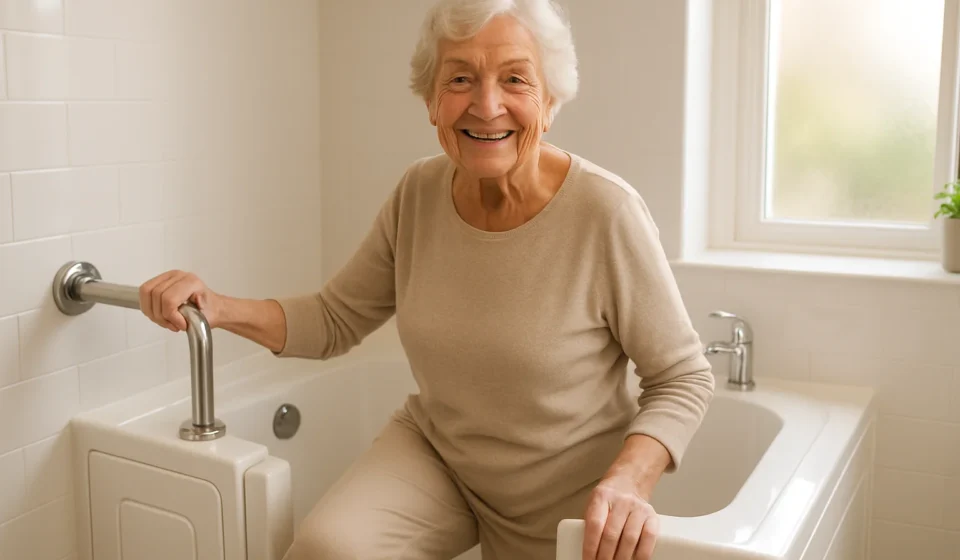

No — Original Medicare does not cover walk-in tubs in 2026. If you have been searching “does Medicare cover walk-in tubs,” that blunt answer saves you from one of the most common sales pitches aimed at older adults. Medicare classifies a walk-in tub as a home modification, not durable medical equipment (DME) — the category that covers hospital beds, wheelchairs, and oxygen. But the full story is more hopeful: some Medicare Advantage plans, Medicaid waivers, VA grants, and free home-repair programs genuinely help pay for bathroom safety. As someone who has walked hundreds of readers through DME rules, I’ll show you exactly which doors are open and which are marketing mirages.
Table of Contents
- Why Original Medicare Says No
- When Medicare Advantage Says Yes
- Grab Bars, Shower Chairs & What IS Covered
- 5 Programs That Actually Help Pay
- The “Free Walk-In Tub” Trap
- Frequently Asked Questions
Why Original Medicare Says No
Medicare Part B covers durable medical equipment: items that are medically necessary, used repeatedly, primarily medical in nature, and appropriate for home use. A walk-in tub fails the “primarily medical” test in the eyes of the Centers for Medicare & Medicaid Services (CMS). Like a stair lift or a widened doorway, it is considered a structural convenience — even though every geriatrician knows the bathroom is where a huge share of senior falls happen. The CDC counts the bathroom among the most hazardous rooms in the home for adults over 65, with wet transfers in and out of a standard tub being a classic fall mechanism.
So does Medicare cover walk-in tubs under any exception? In practice, no. Original Medicare will not reimburse the tub, the installation, or the plumbing work — even with a doctor’s prescription. A physician’s letter of medical necessity can, however, matter enormously for the alternative programs below, so get one anyway if falls, arthritis, neuropathy, or balance problems make bathing unsafe. This is the same mechanism-versus-furniture logic Medicare applies to lift chairs, where only the lifting mechanism is covered.
When Medicare Advantage Says Yes
Since 2019, Medicare Advantage (Part C) plans have been allowed to offer supplemental benefits that address daily living — and in 2026 a meaningful minority do. These typically appear as “bathroom safety devices,” “home safety modifications,” or a spending allowance on a flex card. Coverage is plan-specific and usually capped well below a full walk-in tub installation, which runs roughly $2,000 to $10,000+ installed. Plans in 2026 most likely to include bathroom-safety benefits include certain Humana Gold Plus, UnitedHealthcare Dual Complete, Aetna Medicare Eagle, WellCare, and Kaiser Senior Advantage plans — with dual-eligible special needs plans (D-SNPs) among the most generous. If you qualify for both Medicare and Medicaid, a D-SNP plan is often the single best route to real bathroom-modification dollars.
Three questions to ask your plan before buying anything: Is a walk-in tub or bathroom modification an explicit covered benefit or only a general allowance? Is prior authorization required? Must I use a contracted installer? Get the answers in writing.
Grab Bars, Shower Chairs & What IS Covered
Here is where readers are often surprised in both directions. Original Medicare does not cover grab bars or standard shower chairs either — they are labeled “self-help” or convenience items. Yet several closely related items are covered as DME when prescribed. The table below sorts it out.
| Item | Original Medicare (Part B) | Medicare Advantage (2026) |
|---|---|---|
| Walk-in tub | Not covered | Some plans, capped allowance |
| Grab bars | Not covered | Many plans cover as safety devices |
| Standard shower chair | Not covered | Often covered / OTC allowance |
| Commode chair | Covered (80% after $283 deductible) | Covered |
| Patient lift | Covered as DME | Covered |
| Hospital bed | Covered as DME | Covered |
For covered DME, you pay 20% coinsurance after the 2026 Part B deductible of $283, and both your doctor and the supplier must be enrolled in Medicare.
5 Programs That Actually Help Pay
1. Medicaid HCBS waivers. If you qualify for Medicaid, Home and Community-Based Services waivers in most states pay for environmental modifications — including tub cuts, roll-in showers, and sometimes walk-in tubs — when they keep you out of a nursing home. Waiting lists exist; apply early through your state Medicaid office.
2. VA grants. Veterans may use the HISA grant (Home Improvements and Structural Alterations) — up to $6,800 for service-connected conditions and $2,000 for non-service-connected — specifically for bathroom accessibility. HISA sits on top of any Medicare coverage.
3. USDA Section 504. Rural homeowners 62+ with very low income can receive grants up to $10,000 (and 1% loans up to $40,000) for home health and safety repairs, bathroom modifications included. Our guide to free home repair programs for seniors walks through the application.
4. Area Agencies on Aging. Many AAAs run minor home-modification programs that install grab bars, transfer benches, and handheld showers free or at low cost. Call the Eldercare Locator at 1-800-677-1116. While you are improving the home, ask about the Weatherization Assistance Program too — the same call often screens for both.
5. State assistive-technology programs and nonprofits. Every state has a federally funded AT program with device loans and sometimes low-interest financing; Rebuilding Together and Habitat for Humanity chapters do free safety modifications in many counties.
The “Free Walk-In Tub” Trap
Ads promising a “free walk-in tub through Medicare” are lead-generation funnels, not benefits. The Federal Trade Commission has repeatedly warned about high-pressure in-home tub sales targeting older adults — inflated list prices, same-day-signing discounts, and financing that quietly costs more than the tub. Red flags: anyone who says Medicare will reimburse you later (it won’t), refuses a written itemized quote, or demands a decision today. A legitimate accessibility contractor will happily wait a week while you check with your plan, your AAA, and a second bidder. If bathing safety is urgent this month, a $40 transfer bench, a $25 handheld shower, and professionally installed grab bars remove most of the danger for under $200 while you arrange bigger funding. Planning documents matter here too — our guide to advance directives covers the other paperwork every household should have on file.
Frequently Asked Questions
Does Medicare ever reimburse a walk-in tub after purchase?
No. Original Medicare has no reimbursement pathway for walk-in tubs before or after purchase, even with a prescription. Any salesperson claiming otherwise is misinformed or misleading you. Only a Medicare Advantage plan with an explicit modification benefit can contribute.
Will Medicare pay for grab bars in 2026?
Original Medicare does not. Many 2026 Medicare Advantage plans do cover grab bars as a supplemental safety benefit or through an over-the-counter allowance — check your plan’s Evidence of Coverage document, then get installation done professionally.
How much does a walk-in tub really cost?
Expect roughly $2,000–$5,000 for the tub itself and $5,000–$10,000+ installed, depending on plumbing and electrical work. Hydrotherapy jets, heated seats, and fast-drain systems push prices higher. Always collect at least two itemized quotes.
Is a walk-in tub tax deductible?
Possibly. If installed for a specific medical condition with a doctor’s recommendation, the cost may count as a medical expense to the extent your total medical expenses exceed 7.5% of adjusted gross income. Keep the prescription and receipts, and confirm with a tax professional.
What should I install first if I can’t afford a tub?
In fall-prevention order: two professionally anchored grab bars (entry and control wall), a non-slip mat inside and outside the tub, a transfer bench or shower chair, and a handheld showerhead. Together they cost under $250 and eliminate the highest-risk movements.
Related Articles You May Find Helpful
- Medicare Lift Chair Coverage 2026: Full Guide
- Medicare Flex Card 2026: What It Really Is & Who Qualifies
- Free Home Repair Programs for Seniors 2026
- Medicare D-SNP Plans 2026: Dual Eligible Benefits
- Weatherization Assistance Program 2026: Free for Seniors
For the bigger coverage picture, see our complete Medicare guide for 2026.
Sources
- Medicare.gov — Durable Medical Equipment (DME) Coverage
- CDC — Older Adult Falls Data
- AARP — Does Medicare Cover Home Safety Equipment?
This article is for educational purposes and is not medical or financial advice. See our medical disclaimer.