
What if the most powerful thing you could do for your longevity took less time than brushing your teeth? Exercise snacks — brief bursts of vigorous movement woven into ordinary daily life — are exactly that. A landmark study in Nature Medicine found that just three to four minutes a day of these short, intense efforts was linked to a 26–30% lower risk of dying from any cause. For seniors who find hour-long gym sessions daunting or impossible, exercise snacks may be the single most practical fitness strategy of 2026. As a senior health writer, I want to show you what the science says and exactly how to do them safely.
Table of Contents
- What Are Exercise Snacks?
- The Science: VILPA and the Nature Medicine Study
- Why Short Bursts Work So Well
- 15 Exercise Snacks for Seniors
- How to Build Them Into Your Day
- Safety First: Who Should Be Careful
- Frequently Asked Questions
What Are Exercise Snacks?
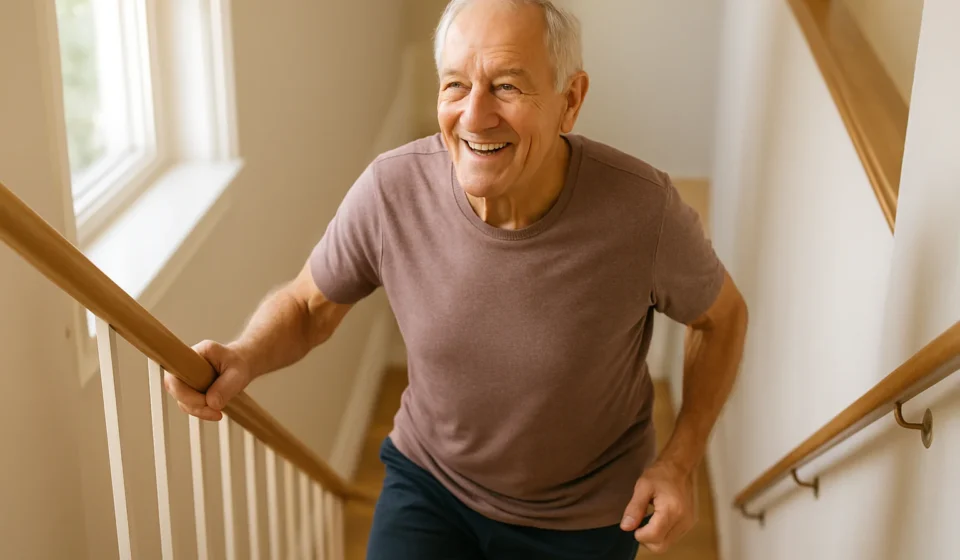
An exercise snack is a short bout of movement — usually 20 seconds to a few minutes — done at a higher intensity than a leisurely stroll, and repeated a few times across the day. Think of climbing a flight of stairs briskly, carrying groceries the long way to the car, or doing ten sit-to-stands from your kitchen chair. Researchers call the everyday version of this VILPA: Vigorous Intermittent Lifestyle Physical Activity. The key word is “lifestyle” — you are not changing into gym clothes; you are simply turning routine movements into brief, purposeful efforts.
The Science: VILPA and the Nature Medicine Study
In 2022, Emmanuel Stamatakis and colleagues published a wearables-based cohort study in Nature Medicine tracking more than 25,000 adults who did no formal exercise. Using wrist accelerometers, they measured tiny bouts of vigorous activity scattered through daily life. The results were striking: a median of just 4.4 minutes of VILPA per day was associated with a 26–30% reduction in all-cause and cancer mortality and a 32–34% reduction in cardiovascular death.
Perhaps most encouraging for seniors, bouts as short as one to two minutes carried measurable benefit, and the steepest gains came at the very bottom of the dose — meaning people who currently do almost nothing have the most to gain. A related analysis found that three such bouts a day was associated with roughly 40% lower all-cause and cancer mortality compared with none.
| Daily VILPA (median) | All-Cause Mortality | Cardiovascular Mortality |
|---|---|---|
| ~1–2 minutes | Measurable reduction | Measurable reduction |
| ~4.4 minutes | 26–30% lower | 32–34% lower |
| 3 short bouts/day | ~40% lower | Substantially lower |
These are observational associations, not proof of cause and effect, and the original study looked at adults who were middle-aged and older rather than the very old. But the biological rationale is strong and consistent with decades of exercise research.
Why Short Bursts Work So Well
Brief vigorous efforts rapidly recruit large muscle groups and push your cardiovascular system to adapt. Each bout improves VO2 max (your body’s ability to use oxygen), enhances insulin sensitivity for hours afterward, and stimulates the mitochondria — the energy factories inside your cells — to become more efficient. Because the efforts are short, they generate a strong training signal without the joint strain and fatigue of prolonged exercise, which is precisely why they suit older bodies. Repeated across the day, exercise snacks also break up long stretches of sitting, itself an independent risk factor for poor health.
15 Exercise Snacks for Seniors
Lower-Body Power
Try brisk stair climbing (one to two flights), ten to fifteen sit-to-stands from a sturdy chair, calf raises while holding the counter, a set of mini wall squats, or marching in place with high knees for 30 seconds. These build the leg strength that keeps you independent.
Whole-Body and Cardio
Walk briskly to the mailbox and back, carry a laden laundry basket up the stairs, do a fast lap around the garden, briskly push a shopping cart on an incline, or “power walk” the grocery aisles for a minute. The goal is to feel your breathing quicken and be slightly unable to sing.
Strength and Balance
Do standing push-ups against the kitchen counter, heel-to-toe walk the length of the hallway, stand on one foot while the kettle boils, lift and lower a gallon jug in each hand, or do seated leg extensions during television commercials. Pairing strength with balance directly lowers fall risk.
How to Build Them Into Your Day
The beauty of exercise snacks is that they attach to things you already do — a technique behavioral scientists call “habit stacking.” Anchor a snack to a routine: every time the kettle boils, do calf raises; every trip to the bathroom, add ten sit-to-stands; every commercial break, march in place. Aim for three to five snacks spread across the day, each lasting one to three minutes, and let the intensity — not the clock — be your guide. You should feel warmer, breathe harder, and be glad to stop, but never in pain.
Safety First: Who Should Be Careful
“Vigorous” is relative to your fitness — for a deconditioned senior, brisk walking may already qualify. Still, if you have heart disease, uncontrolled high blood pressure, unstable angina, severe arthritis, or you have had a recent fall or surgery, talk with your doctor before adding intense bursts. Always hold a rail on stairs, keep a chair or counter nearby for balance work, warm up with a few easy movements, and stop immediately for chest pain, severe breathlessness, dizziness, or palpitations. Start with one snack a day and build gradually.
Frequently Asked Questions
How many minutes of exercise snacks do I need?
The Nature Medicine data linked as little as 4.4 minutes of vigorous daily movement to meaningfully lower mortality, with benefit starting at one to two minutes. Aim for three to five short bouts across the day and build from there.
Are exercise snacks as good as a full workout?
They are not a complete replacement — structured strength and endurance training still offer broader benefits — but for people who do no formal exercise, snacks deliver a remarkable return for the time invested and are far better than nothing.
What counts as “vigorous” for a senior?
Intensity is personal. A useful rule is the “talk test”: during a vigorous bout you can speak a few words but not comfortably sing. If brisk walking or stair climbing leaves you breathing hard, that is vigorous for you.
Can I do exercise snacks if I have arthritis?
Often yes, using low-impact movements like sit-to-stands, counter push-ups, or brisk flat walking rather than jumping. Choose joint-friendly options and check with your doctor or physical therapist about which movements suit your joints.
Do I need any equipment?
None. Stairs, a sturdy chair, a kitchen counter, and everyday objects like laundry baskets or water jugs are all you need. That is what makes exercise snacks so accessible.
Related Articles You May Find Helpful
- Senior Fitness & Exercise Guide 2026
- Grip Strength for Seniors 2026: The Longevity Test
- Best Exercises for Seniors Over 75
- Tai Chi for Seniors 2026: Better Balance
- Balance Exercises for Seniors Over 70
Sources
- Stamatakis E. et al., “Association of wearable device-measured vigorous intermittent lifestyle physical activity with mortality,” Nature Medicine, 2022
- National Institute on Aging (NIA) — Exercise & Physical Activity for Older Adults
- CDC — Physical Activity Guidelines for Older Adults
This article is educational and not a substitute for medical advice. See our Medical Disclaimer. Check with your physician before starting vigorous activity, especially if you have heart or joint conditions.