
Medicare OTC Card for 2027: Who Gets One, What It Buys, and How Not to Lose the Money

A Medicare OTC card is an allowance a Medicare Advantage plan loads for over-the-counter health items like pain relievers, bandages and denture supplies. Original Medicare (Parts A and B) doesn’t give you one, and neither does a Medigap policy. If your plan offers it, the money is real, but it usually resets every month or quarter, so whatever you don’t spend is gone.
Open Enrollment runs October 15 to December 7, 2026. If an OTC allowance matters to you, this is the window to check whether your 2027 plan still has one and how big it is. Fewer plans offer it than a couple of years ago.
Who actually gets an OTC allowance
KFF’s review of 2026 Medicare Advantage plans found that 66% of individual plans offered an allowance for over-the-counter items, down from 73% in 2025. Among Special Needs Plans (SNPs), including the D-SNPs for people with both Medicare and Medicaid, it was 94% (KFF, Medicare Advantage 2026 Spotlight).
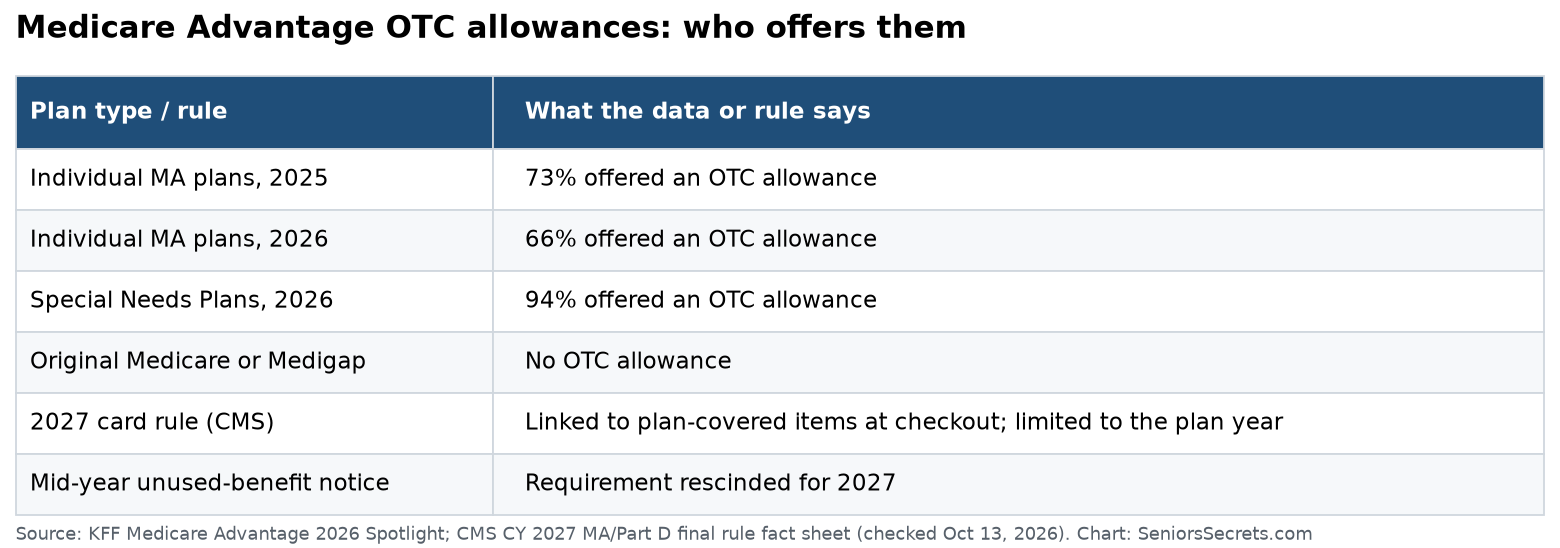
| Plan type | Offered an OTC allowance |
|---|---|
| Individual Medicare Advantage plans, 2025 | 73% |
| Individual Medicare Advantage plans, 2026 | 66% |
| Special Needs Plans (SNPs), 2026 | 94% |
| Original Medicare, with or without Medigap | Never |
So the honest answer to “do I get a Medicare OTC card?” is: only if you’re in a Medicare Advantage plan that includes the benefit. Plans set the dollar amount, the reload schedule and the product list themselves. I don’t quote “typical” allowance ranges here because they vary too much by plan and county to be useful. Your plan’s Summary of Benefits or Evidence of Coverage lists the exact amount.
How the allowance works
- The plan loads a set amount on a schedule: monthly, quarterly or yearly. Quarterly is common.
- You buy from an approved list. Plans publish a catalog. Many let you shop at partner pharmacies and big-box stores, by phone, or through the plan’s website with home delivery.
- Only listed items go through. If an item isn’t on the plan’s list, the card declines it at checkout. The rest of your purchase goes through normally if you pay for it another way.
- Unused money usually expires at the end of each period. A $50 quarterly allowance is worth $200 a year only if you use it every quarter.
- It isn’t cash. You can’t withdraw it, transfer it, or use it for things the plan doesn’t cover.
What it usually buys, and what it doesn’t
Medicare’s rules require supplemental benefits like this to be primarily health-related, so catalogs stick to health and personal-care items. Common categories:
| Usually on the list | Usually not covered |
|---|---|
| Pain relievers (acetaminophen, ibuprofen, aspirin) | Prescription drugs (those go through Part D) |
| Cold, allergy and cough medicine | Groceries, unless you have a separate food benefit |
| Antacids, fiber, laxatives | Cosmetics and beauty products |
| First-aid supplies, thermometers | Alcohol and tobacco |
| Denture adhesive and cleaners, toothpaste | Cash back or gift cards |
| Incontinence supplies | Anything not in your plan’s catalog |
| Some plans: blood pressure monitors, compression socks, reading glasses |
Some catalogs include vitamins and supplements. Just because a product is “free” on the card doesn’t make it a good idea. High-dose supplements can interact with prescriptions. Spend the allowance on things you already use or that your doctor has suggested.
OTC card vs. “flex card”
TV ads blur these together. An OTC allowance covers over-the-counter items. Some plans put other benefits on the same card, like a healthy-food allowance, utility help or a dental/vision allowance, and many of those extras are offered only to members with certain chronic conditions. They often come from separate pots of money with separate rules. I explain the difference in detail in my Medicare flex card guide.
What changes for OTC cards in 2027
CMS’s final rule for contract year 2027, issued April 2, 2026, makes two changes that affect how these cards work (CMS fact sheet):
- Tighter card rules. Debit cards used for supplemental benefits must be electronically linked to the specific items the plan covers, checked in real time at the point of sale, and limited to the specific plan year. In practice, expect the card to decline anything not on your plan’s list, and don’t expect a leftover balance to carry into the next year.
- No more mid-year reminder. Plans had been required to mail a mid-year notice listing supplemental benefits you hadn’t used yet. CMS rescinded that requirement. Plans can still send reminders, but you shouldn’t count on one.
The second change is the reason I’d set your own calendar reminder (see the tips below).
How to check your card and balance
- Call member services (the number is on your plan ID card) and ask: “Does my plan include an over-the-counter allowance? How much, how often does it reload, and what’s my balance?”
- Look up the 2027 version. Your plan’s Annual Notice of Change, mailed by September 30, shows whether the OTC benefit changes next year. Here’s what to look for in your Annual Notice of Change.
- Compare plans in Medicare Plan Finder during Open Enrollment. Plan details list extra benefits, but confirm the dollar amount in the plan’s own Summary of Benefits before you switch.
If you have Medicare and Medicaid, ask about D-SNPs in your area. They’re the plans most likely to include an OTC allowance. My D-SNP guide covers who qualifies.
Don’t switch plans just for the card
An OTC allowance is a nice extra, but it’s small next to the big costs. A plan with a $50 quarterly allowance and a doctor network that drops your cardiologist is a bad trade. Check these first:
- Are your doctors and hospitals in the network?
- Are your prescriptions on the formulary, and at what tier?
- What’s the maximum out-of-pocket limit? For 2027 it can be as high as $9,850 in-network.
- Does the plan need prior authorization for services you use?
My 2027 Medicare Advantage comparison guide walks through those checks in order.
Tips to use every dollar
- Set a reminder a week before each reset date. Plans no longer have to remind you, so put it in your phone or on the kitchen calendar.
- Keep a running list of health staples you buy anyway, and buy them with the card instead of cash.
- Order online or by phone if getting to the store is hard. Many plans deliver free.
- Keep receipts. If a covered item gets declined, member services can usually fix it.
Watch for “free benefits card” scams
Robocalls and ads promising a large “Medicare benefits card” to anyone who gives their Medicare number are a common scam. Medicare doesn’t mail OTC cards. Only a plan you’ve joined can issue one. Don’t give your Medicare number, Social Security number or bank details to an unsolicited caller. You can report suspected fraud to 1-800-MEDICARE or to your state’s Senior Medicare Patrol. I cover other schemes in my senior scam alert.
Common questions
Does Original Medicare give you an OTC card?
No. Original Medicare and Medigap don’t include an over-the-counter allowance. It’s an extra benefit some Medicare Advantage plans and most Special Needs Plans offer.
Can I get cash from a Medicare OTC card?
No. The card only works for approved items in your plan’s catalog. Anyone offering to “cash out” your card is running a scam.
Does unused OTC money roll over?
Usually not. Most allowances reset monthly or quarterly. Under CMS’s 2027 rule, supplemental-benefit debit cards are also limited to the plan year.
How do I find a plan with an OTC allowance for 2027?
Compare plans in Medicare Plan Finder during Open Enrollment (October 15 to December 7), then confirm the amount and reload schedule in each plan’s Summary of Benefits.
Will my plan remind me to use my OTC allowance?
It might, but it no longer has to. CMS rescinded the mid-year unused-benefits notice in its 2027 rule, so set your own reminder.
Written by Khasim Basha Shaik. I research and compare Medicare plans and rules for readers. I’m not a licensed insurance agent. This article summarizes KFF and CMS materials and isn’t financial or legal advice. For free one-on-one help, contact your State Health Insurance Assistance Program (SHIP). Last reviewed October 13, 2026.
Related guides