
Calf raises are one of the simplest, safest, and most underrated exercises a senior can do — and they deliver benefits far beyond shapely lower legs. This single movement strengthens the muscles that power every step, sharpens your balance, and helps push blood back up from your legs toward your heart. Best of all, calf raises for seniors require no equipment, can be done while holding a kitchen counter, and take just a few minutes a day. Here is why this small exercise punches so far above its weight.
If I could get every older adult to add one movement to their day, calf raises would be near the top of the list. Let me show you why — and how to do them right.
Table of Contents
- The Calf: Your Second Heart
- 5 Benefits for Seniors
- How to Do a Calf Raise Safely
- Progressions and Variations
- Safety and When to Check With Your Doctor
- Frequently Asked Questions
The Calf: Your Second Heart
Your calf is made of two main muscles — the gastrocnemius and the deeper soleus. Together they do something remarkable: every time they contract, they squeeze the deep veins of the lower leg and pump blood upward against gravity, back toward the heart. Physiologists actually call the calf the “second heart” or the calf-muscle pump. When these muscles are weak or inactive, blood pools in the legs, contributing to swelling, fatigue, and that heavy-legged feeling many seniors know well.
The calf muscles are also among the first to weaken with age and inactivity, yet they are essential for walking, climbing stairs, rising onto your toes, and catching your balance when you stumble. Strengthening them pays dividends across daily life.
5 Benefits for Seniors
| Benefit | Why It Matters |
|---|---|
| Better circulation | The calf pump helps return blood from the legs, easing swelling and that heavy feeling |
| Improved balance | Strong calves and ankles help you recover from stumbles and stay steady |
| Stronger walking & stairs | Calves provide the push-off that propels each step and stair |
| Ankle & bone support | Loading the lower leg supports ankle stability and weight-bearing bone health |
| Fall prevention | Quick ankle strength is part of how the body braces against falls |
There is a circulation payoff worth highlighting, too. Many seniors who sit for long stretches notice swollen ankles and tired, heavy legs by evening. Because the calf pump is what moves that pooled blood and fluid back upward, regularly working these muscles can ease the swelling and discomfort that come from prolonged sitting — a small daily habit with an outsized effect on how your legs feel at the end of the day.
Falls are the leading cause of injury in older adults, and lower-leg weakness is a known contributor. Because calf raises train the very muscles and joints involved in staying upright, they belong in any well-rounded senior fitness routine alongside walking and broader strength work.
How to Do a Calf Raise Safely
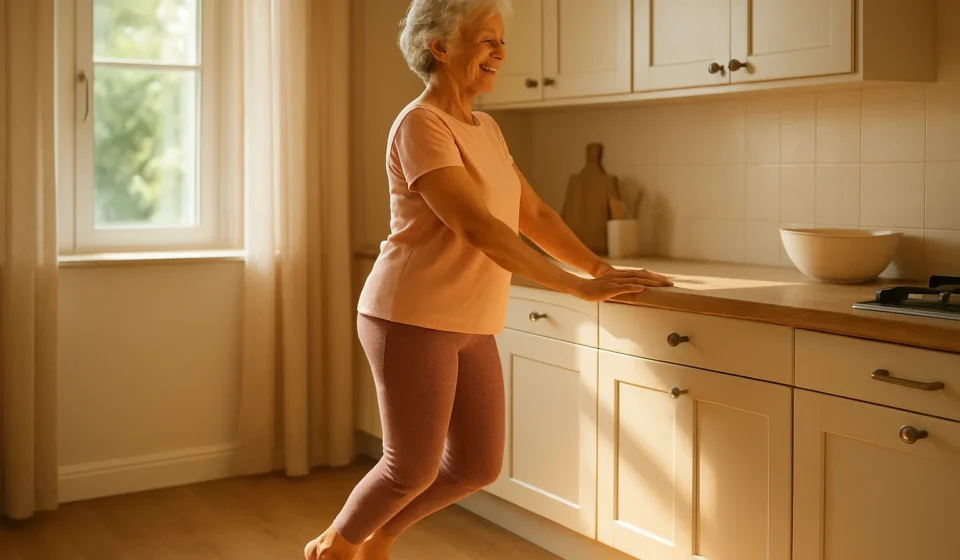
Start with the supported standing version:
- Stand tall behind a sturdy kitchen counter or the back of a heavy chair, feet hip-width apart.
- Rest your hands lightly on the support for balance — not to pull yourself up.
- Slowly rise onto the balls of your feet, lifting your heels as high as is comfortable.
- Pause for a second at the top and squeeze your calves.
- Lower your heels slowly and with control, all the way back down.
Aim for 10 to 15 repetitions, rest, and repeat for 2 to 3 sets. The slow, controlled lowering phase is where much of the strength is built, so resist the urge to drop quickly. Two or three sessions a week is a sensible starting point; many people do a set or two daily while brushing their teeth or waiting for the kettle.
Progressions and Variations
As the move gets easier, increase the challenge gradually:
- Lighter touch. Use just one or two fingertips on the support instead of your whole hand, which trains balance more.
- Single-leg raises. Once strong and steady, rise on one foot at a time — a big jump in difficulty, so keep the support close.
- Seated calf raises. If standing is hard, press the balls of your feet down while seated, ideally with a light weight on your knees. This is gentler and great for circulation.
- Hold at the top. Pause for several seconds at the peak to build endurance.
Consistency matters more than intensity. A modest set done most days beats an ambitious routine you abandon after a week.
To make the habit stick, anchor it to something you already do. Calf raises while the coffee brews, during television commercials, or each time you wait at the kitchen sink turn idle minutes into strength work without carving out a separate “workout.” This idea of breaking activity into short, frequent bouts — sometimes called exercise “snacks” — is well suited to older adults and fits easily around the rest of your day. Pairing calf raises with a few other simple moves, such as sit-to-stands from a sturdy chair and gentle marching in place, builds a quick lower-body routine that supports walking, stair-climbing, and steady balance all at once.
Safety and When to Check With Your Doctor
Calf raises are very safe for most seniors, but a few common-sense rules apply. Always have a stable support within reach, wear supportive non-slip shoes (or go barefoot on a non-slip surface), and never rush the movement. Stop if you feel sharp ankle, knee, or calf pain, dizziness, or chest discomfort. Check with your doctor before starting if you have a recent ankle or foot injury, severe arthritis, balance disorders, peripheral artery disease, or a history of blood clots. A sudden painful, swollen, warm calf in one leg is not a reason to exercise — it can signal a clot and needs prompt medical attention.
Frequently Asked Questions
How many calf raises should a senior do per day?
A good starting point is 2 to 3 sets of 10 to 15 repetitions, two or three times a week, progressing as it gets easier. Many seniors safely do a set or two daily. Quality and control matter more than high numbers.
Do calf raises really help circulation?
Yes. The calf muscles act as a pump that pushes blood from the legs back toward the heart. Contracting them through calf raises supports venous return and can ease swelling and that heavy-legged feeling.
Are calf raises safe if I have poor balance?
They can be, if you hold a sturdy support like a counter and keep both feet down at first. If balance is a serious concern, start with the seated version and ask a physical therapist for guidance.
Can calf raises help prevent falls?
They contribute to fall prevention by strengthening the ankle and lower-leg muscles you use to stay balanced and brace against stumbles. They work best as part of a broader routine that includes balance and overall strength training.
Can I do calf raises sitting down?
Yes. Seated calf raises — pressing the balls of your feet down while seated, ideally with a light weight resting on your knees — are a gentler option that still works the calf-muscle pump. They are ideal if standing is difficult or your balance is limited, and a good way to build up before trying the standing version.
Related Articles You May Find Helpful
- Senior Fitness & Exercise Guide 2026
- Balance Exercises for Seniors Over 70: 8 Proven Moves
- Stair Climbing for Seniors 2026: Heart & Leg Strength
- Grip Strength for Seniors 2026: The Longevity Test
- Sarcopenia Warning: Why Every Senior Needs Strength Training
This article is for educational purposes and is not medical advice. Please review our Medical Disclaimer and consult your doctor before beginning a new exercise routine.
Sources
- National Institute on Aging — Exercise & Physical Activity for Older Adults
- Centers for Disease Control and Prevention — Older Adult Falls Prevention
- American Heart Association — Staying Active as You Age
Related guides