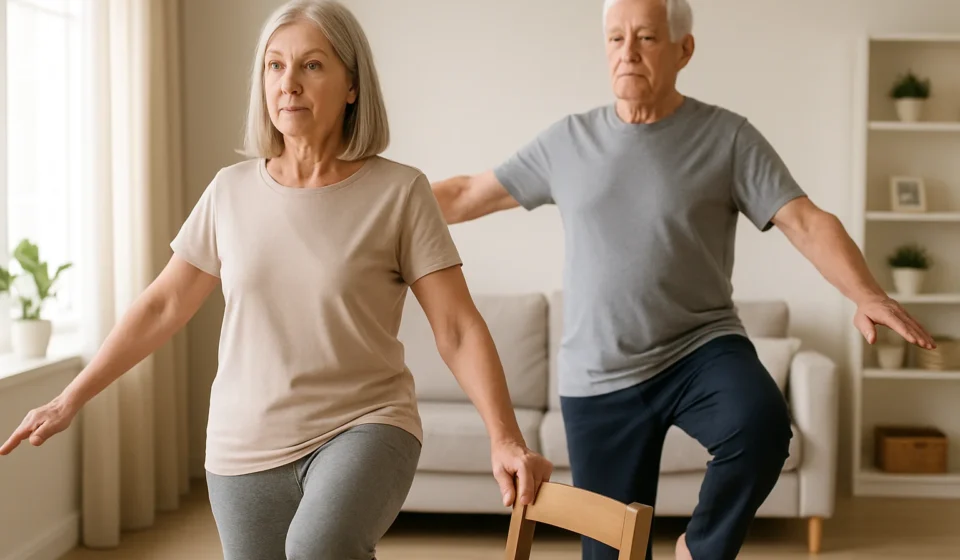

Balance deteriorates faster after age 70 than at any other time in adult life — and the consequences are serious. Approximately 30 percent of adults over 70 fall at least once per year, rising to 50 percent by age 80. Falls are the leading cause of injury-related death in adults over 65. But the research is unambiguous: targeted balance training significantly reduces fall risk, even when started in your 70s, 80s, or beyond. The 8 exercises in this guide are specifically chosen for adults over 70, taking into account the unique sensory and neuromuscular changes that occur in this age group. Consistent practice, three times per week, can cut your fall risk by 23 to 47 percent according to multiple controlled trials.
Table of Contents
- Why Balance Declines After 70
- Quick Home Balance Assessment
- 8 Balance Exercises for Seniors Over 70
- Weekly Balance Training Program
- The Tai Chi Advantage for 70+ Adults
- Safety Rules and Medication Considerations
- Medicare Coverage for Balance Training
- Frequently Asked Questions
Why Balance Declines Faster After Age 70
Balance is maintained through the integration of three sensory systems: the vestibular system (inner ear), the visual system, and proprioception (position-sensing nerve endings in muscles, joints, and tendons). After age 70, all three systems undergo accelerated deterioration that distinguishes this age group from adults in their 50s and 60s:
- Vestibular decline: By ages 70 to 80, vestibular sensitivity in the semicircular canals and otolith organs is reduced by 35 to 50 percent. This impairs the ability to sense head movement and maintain orientation during turning, bending, and uneven surfaces.
- Visual changes: Depth perception, contrast sensitivity, and peripheral vision decline accelerate after 70. Nearly 35% of adults 70+ have moderate-to-severe visual impairment contributing to balance problems.
- Proprioceptive loss: Mechanoreceptors in the ankles and knees — critical for detecting ground surface changes — decline by 35 to 45 percent after age 70. Peripheral neuropathy (affecting 30-50% of seniors over 70) further compromises this system.
- Central processing slows: The cerebellum, which coordinates balance signals, shows measurable atrophy after age 70. Reaction time to a balance disturbance slows by 10 to 20 percent compared to adults in their 50s.
- Sarcopenia and hip/ankle weakness: The hip abductors, tibialis anterior, and ankle plantar/dorsiflexors — the muscles most critical for lateral stability and gait control — lose disproportionately more strength after 70 than after 65.
The good news: the neuromuscular system retains remarkable plasticity even at 70, 80, and beyond. Balance training creates new neural connections, strengthens proprioceptive pathways, and rebuilds the muscle strength needed for postural control — at any age.
Quick Home Balance Assessment
Before starting any balance program, assess your current baseline with the validated clinical tool used in physical therapy settings — the Single-Leg Stance Test. Stand near a wall or sturdy chair with arms folded across your chest. Lift one foot off the floor and time how long you can stand on one leg without touching anything or moving your standing foot. Results interpretation:
| Age Group | Low Fall Risk (Normal) | Moderate Fall Risk | High Fall Risk |
|---|---|---|---|
| Ages 60–69 | >22 seconds | 10–22 seconds | <10 seconds |
| Ages 70–79 | >15 seconds | 5–15 seconds | <5 seconds |
| Ages 80+ | >6 seconds | 3–6 seconds | <3 seconds |
If you cannot hold for 3 seconds unsupported, begin all exercises with both hands lightly resting on the back of a sturdy chair. Re-test every 4 weeks to track progress. The Berg Balance Scale (56-point clinical test) is the gold standard used by physical therapists — a score below 45 indicates significant fall risk and warrants a formal PT evaluation.
8 Balance Exercises for Seniors Over 70
Perform these exercises near a sturdy chair, wall, or kitchen counter. Always have support within arm’s reach. Wear non-slip socks or shoes with good ankle support. Start with supported versions; progress to unsupported as your balance improves.
1. Single-Leg Stance (Supported → Unsupported)
Stand next to a chair with one hand on the back. Lift one foot just off the floor (1–2 inches). Hold for 10 seconds, then switch feet. Work toward holding 20 to 30 seconds per leg without hand support. Clinical basis: This exercise directly trains the vestibulospinal reflex pathway and strengthens the hip abductors and ankle stabilizers on the stance leg. A 6-week program of 3 sets × 30-second holds per leg reduced single-leg stance sway by 32% in adults aged 70–85 in a 2022 Journal of Aging and Physical Activity RCT.
2. Tandem Standing and Tandem Walk
Tandem standing: Place one foot directly in front of the other, heel to toe, for 30 seconds. If too difficult, use a modified semi-tandem (feet close but not fully aligned). Tandem walk: Walk heel to toe in a straight line for 10 steps, as if on a balance beam. Use the wall alongside for safety. Clinical basis: The Tandem Walk Test is a validated clinical fall-risk screen — taking more than 10 seconds for 10 tandem steps identifies elevated fall risk. Tandem training improves the cerebellum-mediated fine-tuning of gait stability.
3. Lateral Weight Shifts
Stand with feet hip-width apart, hands on a chair. Slowly shift your weight to the right foot until the left heel just lifts off the floor, hold 3 seconds, return to center, then shift to the left. Progress to doing this without chair support. Perform 10 repetitions per side. Clinical basis: Lateral instability is the primary mechanism of hip fracture falls in older adults. Lateral weight training specifically activates the gluteus medius — the key hip stabilizer most weakened in adults over 70.
4. Heel-to-Toe Rocking
Stand with feet shoulder-width apart, holding a chair lightly. Slowly rise up on your toes (heel raises), hold 2 seconds, then rock back onto your heels, lifting your toes off the floor, hold 2 seconds. Repeat 10–15 times. Clinical basis: Strengthens the ankle plantar and dorsiflexors — the muscles most responsible for preventing forward stumble-falls. Older adults with weak ankle dorsiflexion have a 2.3-fold higher fall risk in prospective cohort studies.
5. Side Steps (Crab Walk)
Stand with feet together. Take 10 slow sideways steps to the right, then 10 to the left. Keep your weight low, as if slightly sitting. Progress by crossing one foot over the other (braiding/grapevine step). Clinical basis: Directly strengthens the hip abductors and challenges the lateral balance system, which is under-trained in most daily activities (which primarily involve forward movement).
6. Chair Sit-to-Stand (Slow and Controlled)
From seated, cross your arms over your chest (or extend them for balance). Lean slightly forward from the hips, then stand slowly without pushing off the chair. Lower back down in 3–5 seconds. Repeat 8–12 times. This is the 30-Second Chair Stand Test used clinically — fewer than 11 repetitions in 30 seconds indicates fall risk for adults 70–79. Clinical basis: Strengthens the quadriceps and gluteus maximus — the primary muscles preventing “buckling” falls when stumbling.
7. Backward Walking
Walk backward slowly for 10 to 20 steps along a hallway, keeping the wall within arm’s reach. SAFETY NOTE: Clear the path completely before this exercise. Clinical basis: Backward walking challenges proprioceptive systems in ways forward walking does not — it requires greater hip extension, activates different muscle groups, and challenges the cerebellum’s predictive balance models. A 2021 Physical Therapy study found 8 weeks of backward walking training improved forward gait stability by 19% in older adults.
8. Clock Reach Exercise
Stand on one foot next to a chair (lightly holding if needed). With your free leg, reach forward as if pointing to 12 o’clock, then to the side (3 o’clock), then diagonally back (5 o’clock), then return to starting position. Perform 3 to 5 reaches per direction per leg. Clinical basis: The Star Excursion Balance Test (SEBT) is the gold standard clinical tool for measuring dynamic balance — this exercise is a home-adapted version. Studies in adults aged 65+ show the star excursion exercise reduces postural sway and improves dynamic balance scores by 25–35% over 8 weeks.
Weekly Balance Training Program for 70+
| Day | Session Focus | Exercises | Duration |
|---|---|---|---|
| Monday | Stability foundation | Single-leg stance, lateral weight shifts, heel-toe rocking | 20–25 min |
| Tuesday | Rest or light walking | 10–15 min neighborhood walk | 15 min |
| Wednesday | Dynamic balance | Tandem walk, crab walk, clock reach | 20–25 min |
| Thursday | Rest or chair yoga | Gentle seated stretching | 15 min |
| Friday | Strength + control | Chair sit-to-stand, backward walking, single-leg stance | 20–25 min |
| Weekend | Active rest | Gardening, gentle walking, social activities | As desired |
The American College of Sports Medicine (ACSM) 2023 guidelines for older adults recommend balance training a minimum of 3 days per week. Combining balance training with resistance training (which can be done on the same days or alternating days) produces superior results compared to balance training alone — a Cochrane 2021 meta-analysis of 108 trials confirmed combined exercise programs reduced falls by 34% compared to 23% for balance training alone.
The Tai Chi Advantage for Adults Over 70
Tai Chi deserves special mention as the single most evidence-based balance intervention for adults over 70. A landmark Cochrane meta-analysis of 59 trials (2021) found that Tai Chi practice reduced the rate of falls by 19% and the number of fallers by 20%, with the evidence graded as “moderate to high certainty.” A separate analysis specific to adults aged 70 to 85 found a 47% reduction in injurious falls with twice-weekly Tai Chi practice over 6 months.
Tai Chi works through multiple mechanisms simultaneously: weight shifting trains lateral stability, slow movements build proprioceptive precision, the mind-body focus improves central processing speed, and the meditative component reduces fall-related fear (which itself is an independent fall risk factor). The Yang-style 24-form is the most studied sequence and is widely available in community senior centers. Medicare Advantage plans with the SilverSneakers benefit often cover Tai Chi classes at no cost.
Safety Rules and Medication Considerations
Before beginning this program, discuss any dizziness, recent falls, or joint pain with your physician. Several specific safety rules are essential for adults over 70:
- Check blood pressure before each session if you take antihypertensive medications. Orthostatic hypotension (blood pressure drop upon standing) affects 30% of adults over 70 and is a leading fall cause during exercise transitions.
- Review your medications with your pharmacist. The most fall-risky medications in seniors include benzodiazepines (Ativan, Valium, Xanax), sleep aids (Ambien, Benadryl), alpha-blockers (Flomax), tricyclic antidepressants, antiepileptics, and first-generation antihistamines. If you take any of these, ask about safer alternatives.
- Avoid hot environments. Heat causes peripheral vasodilation and can trigger dizziness during balance exercises.
- Skip floor exercises. Floor-based balance work (mat yoga, Pilates) creates fall risk during transitions for adults over 70. All exercises in this program are designed to be performed standing next to support.
- Wear non-slip footwear during all exercises. Socks alone on hardwood or tile floors are a fall hazard.
Medicare Coverage for Balance Training
Medicare Part B covers physical therapy services for balance impairment and documented fall risk. A physician referral to a licensed physical therapist allows a comprehensive falls risk assessment (including Berg Balance Scale and STEADI protocol evaluation), individualized balance training, and gait analysis — all covered at 80% of the Medicare-approved amount after the $283 Part B deductible. Medigap Plan G covers the 20% coinsurance. For seniors with Medicare Advantage, many plans include a SilverSneakers gym membership that covers supervised balance and fitness classes at no additional cost. Contact your plan to confirm SilverSneakers or ActiveFit+ enrollment.
How quickly will balance exercises show results for adults over 70?
Clinical studies show measurable improvements in static balance (single-leg stance) within 4 to 6 weeks of consistent 3x/week training. Reductions in fall rate require 8 to 12 weeks of consistent practice to achieve, as the nervous system needs time to reorganize proprioceptive and cerebellar pathways. Do not judge effectiveness before 8 weeks. The 2022 JAMA Internal Medicine trial of balance training in adults aged 70–85 found 30–40% improvement in tandem walk performance at 12 weeks.
Should I see a physical therapist before starting balance exercises?
If you have fallen in the past year, have a neurological condition (Parkinson’s disease, stroke, vestibular disorder, peripheral neuropathy), have significant joint replacements, or scored in the “high fall risk” range on the Single-Leg Stance Test, a formal PT evaluation is strongly recommended before exercising independently. Medicare covers this evaluation under Part B. A physical therapist can identify your specific balance deficits, address the root cause (vestibular vs. proprioceptive vs. muscular), and design a targeted program.
Is balance training safe if I have osteoporosis?
Balance training is actually critically important for seniors with osteoporosis — fall prevention directly reduces fracture risk. All exercises in this program avoid high-impact movements, trunk flexion (which can cause vertebral compression fractures), and floor work. Discuss your exercise program with your physician if you have severe osteoporosis (T-score below -2.5) or a history of vertebral fractures. Weight-bearing balance exercises like standing and slow weight shifts are generally safe and beneficial even in osteoporosis.
Can I combine balance exercises with my existing walking routine?
Yes, and this combination is ideal. Walking provides cardiovascular benefit and general leg strengthening, while targeted balance exercises train the specific sensory-motor systems that prevent falls. The Cochrane 2021 analysis confirmed that combining walking with balance-specific exercises produces significantly greater fall risk reduction than either intervention alone. Walk first (when energy is highest), then complete your balance exercises while still warm.
Sources
- Cochrane Review: Exercise for Preventing Falls in Older People (2021)
- CDC STEADI Falls Prevention Initiative
- ACSM Physical Activity Guidelines for Older Adults 2023
Related Articles You May Find Helpful