
Spinal stenosis is a narrowing of the spaces in your spine that puts pressure on the nerves. In the lower back, it often causes burning pain, numbness or cramping in the buttocks and legs that gets worse when you stand or walk and better when you sit or lean forward (NIAMS). It is very common after 60, usually from arthritis. Most people improve with physical therapy, activity and pain care. Surgery is an option when symptoms limit daily life.
The classic clue: you can walk farther in a grocery store leaning on a shopping cart than you can standing upright. This guide explains the signs, tests, treatment choices and what Medicare pays for in 2026.
What causes spinal stenosis
Your spinal canal is like a tunnel for the nerves. With age, several things can narrow it:
- Arthritis with bone spurs
- Thickened ligaments along the back of the spine
- Bulging or worn disks
- One vertebra slipping forward over another (spondylolisthesis)
It can happen in the lower back (lumbar stenosis, the most common) or the neck (cervical stenosis).
Symptoms to watch for
Lower back (lumbar):
- Low back pain
- Pain, burning or cramping down the buttocks and legs
- Numbness or tingling in the legs or feet
- Leg weakness
- Symptoms that worsen with standing or walking and ease with sitting or bending forward
Neck (cervical):
- Neck pain
- Numbness or tingling in the arms and hands
- Weakness or clumsiness in the hands
- Balance problems
Get emergency care for: loss of bladder or bowel control, numbness in the groin or inner thighs, or sudden severe leg weakness. These can mean serious nerve pressure.
How it is diagnosed
- History and exam: your doctor checks reflexes, strength and walking.
- X-rays show arthritis and slipping bones.
- MRI shows the nerves and how narrow the canal is.
- CT myelogram if you cannot have an MRI.
Many older adults have narrowing on an MRI without symptoms. Treatment is based on how you feel and function, not on the picture alone.
Treatment options
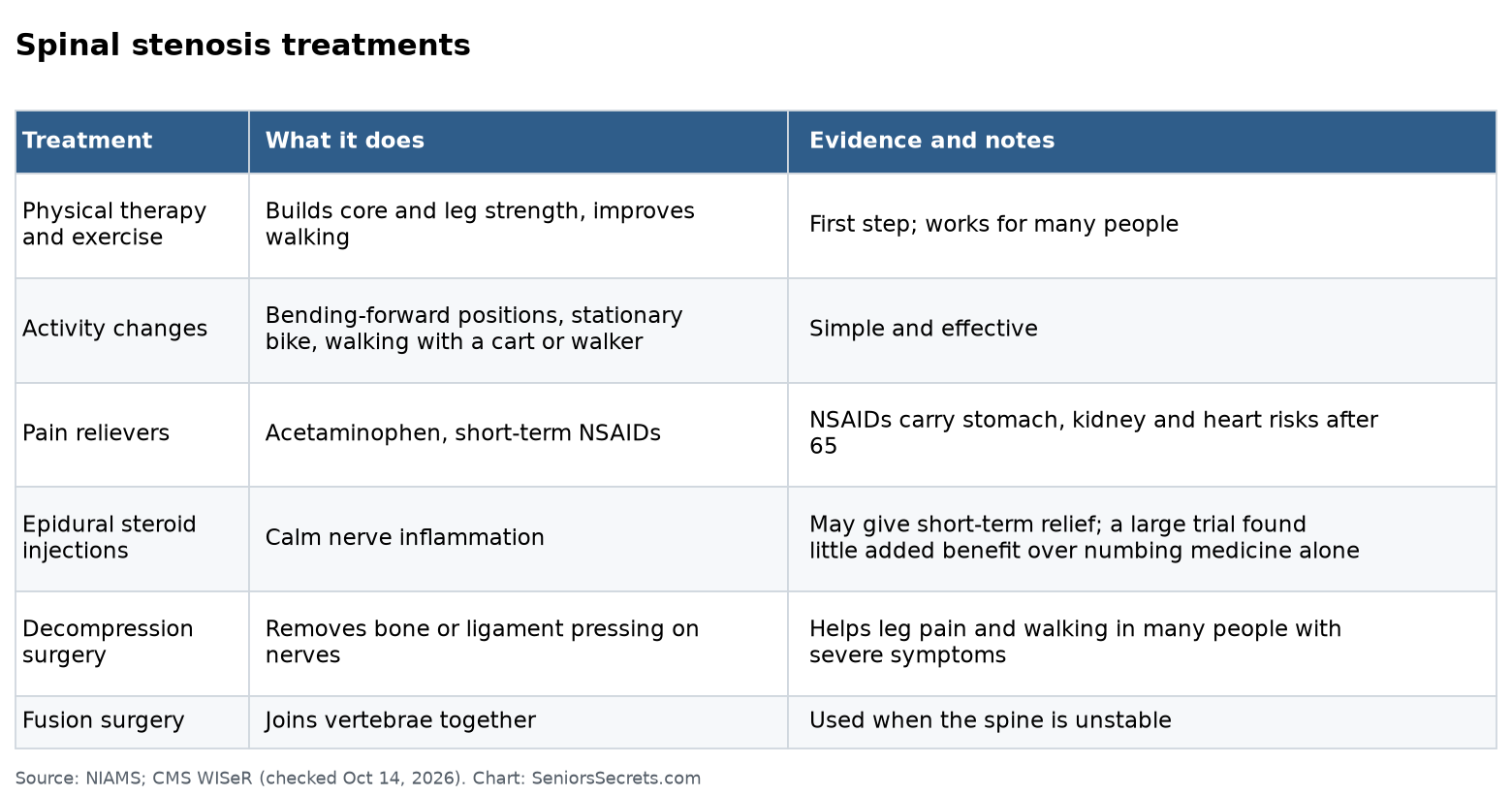
| Treatment | What it does | Evidence and notes |
|---|---|---|
| Physical therapy and exercise | Builds core and leg strength, improves walking | First step; works for many people |
| Activity changes | Bending-forward positions, stationary bike, walking with a cart or walker | Simple and effective |
| Pain relievers | Acetaminophen, short-term NSAIDs | NSAIDs carry stomach, kidney and heart risks after 65 |
| Epidural steroid injections | Calm nerve inflammation | May give short-term relief; a large trial found little added benefit over numbing medicine alone |
| Decompression surgery | Removes bone or ligament pressing on nerves | Helps leg pain and walking in many people with severe symptoms |
| Fusion surgery | Joins vertebrae together | Used when the spine is unstable |
Physical therapy and exercise
A physical therapist can teach:
- Flexion exercises like knee-to-chest stretches
- Core strengthening to support the spine
- Hip and leg strengthening for walking
- Stationary cycling, which many people tolerate well because you lean forward
- Balance work to prevent falls
Give therapy 6 to 12 weeks before judging results.
Injections
Epidural steroid injections may ease pain for weeks to months. A well-known trial in the New England Journal of Medicine (2014) found adding steroid to a numbing injection gave little extra benefit at 6 weeks for lumbar stenosis. Injections may still help some people get through a flare or start therapy.
Surgery
Surgery is worth discussing when:
- Leg pain limits walking or daily life despite therapy
- Weakness is getting worse
- Bladder or bowel control is affected (urgent)
Decompression (laminectomy) relieves pressure on the nerves. Fusion may be added if the spine is unstable. Ask your surgeon how much your walking and leg pain are likely to improve, and about recovery time. Age alone is not a reason to avoid surgery, but your overall health matters.

Simple home exercises to ask your therapist about
- Knee-to-chest stretch lying on your back, 20 to 30 seconds per side
- Pelvic tilts to gently flatten your low back against the floor
- Seated forward bend in a sturdy chair
- Sit-to-stand from a chair to build leg strength
Living with spinal stenosis
- Use a walker or cart for longer walks. Leaning forward opens the canal.
- Take sitting breaks when shopping or walking.
- Stay active. Rest makes muscles weaker and pain worse over time.
- Keep a healthy weight to ease load on the spine.
- Make your home safe to prevent falls, especially if your legs feel numb.
What Medicare covers in 2026
- Doctor visits, imaging and physical therapy: Part B, after the $283 deductible, usually 20% coinsurance. There is no hard cap on therapy if it is medically needed.
- Epidural steroid injections: Part B, when they meet Medicare’s coverage rules.
- Surgery: Part A if you are admitted ($1,736 deductible per benefit period) or Part B for outpatient surgery.
- Walkers and canes: Part B as durable medical equipment with a doctor’s order.
New in 2026: prior approval pilot. Under Medicare’s WISeR model, Original Medicare in Arizona, New Jersey, Ohio, Oklahoma, Texas and Washington now reviews certain services before or after they are done, including epidural steroid injections and cervical fusion (CMS). If you live in one of these states, ask your doctor whether prior authorization is needed.
Medicare Advantage plans often need prior authorization for injections, imaging and surgery. Check before you schedule.
Questions to ask your doctor
- Is my pain from stenosis or something else, like hip arthritis or poor leg circulation?
- What can I expect from physical therapy?
- Are injections likely to help me, and how often can I have them?
- If I have surgery, how much will my walking improve?
- What are the risks for someone with my health?
Common questions
What is the main symptom of spinal stenosis?
Leg pain, numbness or cramping that gets worse with standing or walking and better with sitting or leaning forward.
Can spinal stenosis get better without surgery?
Many people improve with physical therapy, exercise and pain care. Symptoms may stay stable for years.
Are epidural injections worth it for spinal stenosis?
They may give short-term relief for some people. A major trial found little added benefit from the steroid itself.
Does Medicare cover spinal stenosis surgery?
Yes, when medically needed. In some states, the WISeR pilot adds review for certain procedures.
What exercises help spinal stenosis?
Forward-bending stretches, core strengthening, stationary cycling and walking with support.
When is spinal stenosis an emergency?
Loss of bladder or bowel control, groin numbness or sudden leg weakness need emergency care.
Written by Khasim Basha Shaik. I research senior health and Medicare for readers and summarize official sources. I’m not a doctor or licensed health professional. Talk with your doctor about your symptoms and treatment. Last reviewed October 14, 2026.