Does Medicare Cover Blood Tests? What Part B Pays, Screening Limits, and When You Get a Bill

Yes. Medicare Part B covers medically necessary blood tests and other lab work when your doctor or other provider orders them, and you usually pay nothing, not even the Part B deductible, per Medicare.gov’s diagnostic lab test page. Screening blood tests (cholesterol, diabetes, PSA, hepatitis C and a few others) are also free, but only at the frequency Medicare allows.
Most surprise lab bills come from one of three things: a test done more often than Medicare allows, “routine” blood work with no medical reason on the order, or a lab that doesn’t take Medicare. All three are avoidable.
Diagnostic vs. screening: why the label matters
Diagnostic tests check something your doctor suspects or is already treating, like an A1C for diabetes you’ve been diagnosed with, a kidney panel because you take a blood pressure drug, or a blood count because you’re tired and short of breath. Medicare covers these whenever they’re medically necessary, with no set yearly limit.
Screening tests look for a problem when you have no symptoms. Medicare covers a specific list of them as preventive services, each with its own eligibility and schedule.
The same blood draw can be either one. What matters is the reason your doctor puts on the order.
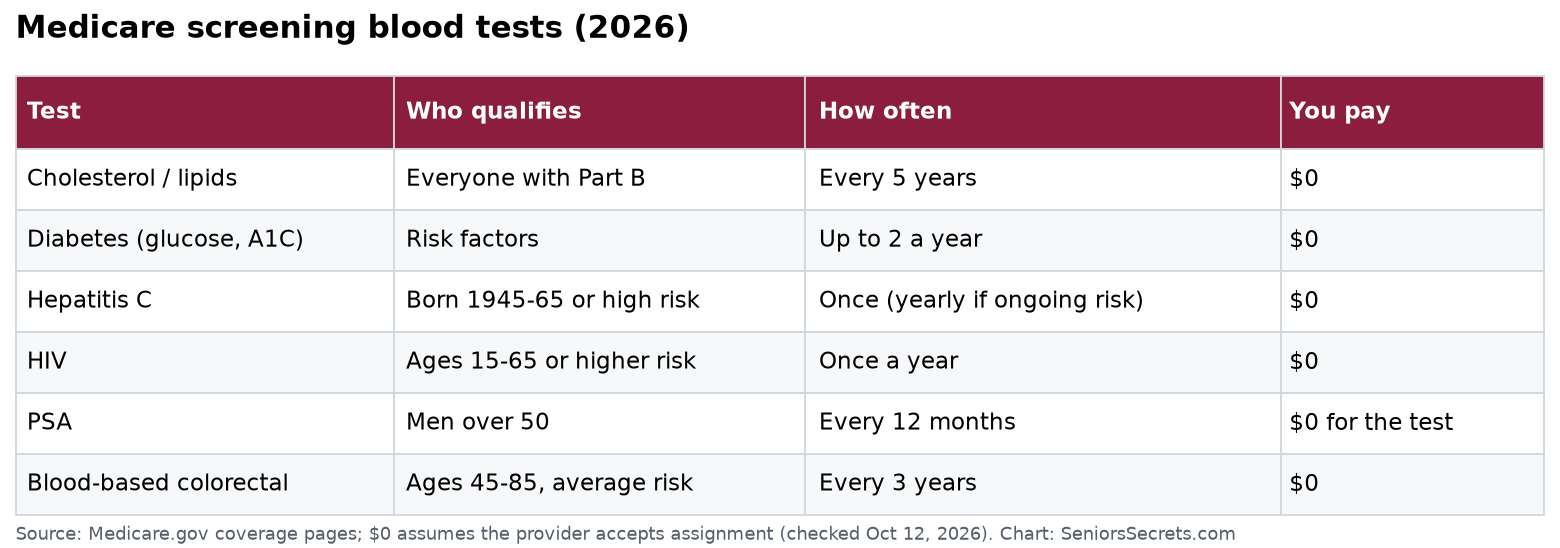
Screening blood tests Medicare covers (2026)
| Screening test | Who qualifies | How often | You pay |
|---|---|---|---|
| Cholesterol, lipids, triglycerides | Everyone with Part B | Once every 5 years | $0 with assignment |
| Diabetes (fasting glucose, A1C) | Risk factors such as high blood pressure, abnormal cholesterol, obesity or past high blood sugar; or 2+ of: age 65+, overweight, family history | Up to 2 a year | $0 with assignment |
| Hepatitis C | Born 1945–1965, transfusion before 1992, or injection drug use; ordered by your primary care provider | Once in a lifetime (yearly if ongoing high risk) | $0 with assignment |
| HIV | Ages 15–65, or older with increased risk | Once a year | $0 with assignment |
| PSA (prostate) | Men over 50 | Once every 12 months | $0 for the blood test |
| Blood-based colorectal test | Ages 45–85, no symptoms, average risk | Once every 3 years | $0 with assignment |
A few details people miss:
- The cholesterol screening is every 5 years. If your doctor checks your lipids every year because you have heart disease or take a statin, that’s diagnostic monitoring, which is covered when it’s medically necessary.
- For PSA, the blood test itself is free, but the digital rectal exam that’s often done with it costs 20% after the deductible.
- A positive blood-based colorectal test means Medicare also covers a follow-up colonoscopy as a screening.
For the full list of free preventive services, including the non-blood ones, see my Medicare free preventive screenings guide.
What you’ll pay
| Situation | Typical cost with Original Medicare |
|---|---|
| Diagnostic lab test ordered by your doctor, Medicare lab | $0 (no deductible, no coinsurance) |
| Covered screening within the frequency limit | $0 if the provider accepts assignment |
| Doctor visit where the test is ordered | Usually 20% after the $283 Part B deductible |
| Blood drawn in a hospital outpatient department | The test is usually $0; other hospital services can carry a copay |
| Test done too often, or with no medical reason | You may pay the full lab charge |
If you have a Medicare Advantage plan, it must cover everything Original Medicare does, but you may need an in-network lab, and some plans charge a lab copay. Check your plan’s Summary of Benefits. A Medigap policy doesn’t change much here, since covered lab tests are already $0.
When a bill shows up, and how to avoid it

The “annual physical” trap. Medicare doesn’t cover a routine yearly physical. It covers a Welcome to Medicare visit and a yearly Annual Wellness Visit, and neither one automatically includes blood work. If a lab panel is drawn “just to check,” it may be denied. I explain the difference in my wellness visit vs. physical guide.
Too often. Two diabetes screenings in a year are covered; a third, without a diagnosis, isn’t.
The ABN. If the lab or doctor thinks Medicare may not pay, they should ask you to sign an Advance Beneficiary Notice of Noncoverage (ABN) before the test. It lists the test and an estimated cost. You can choose to skip the test, or have it and accept you might pay. If you never got an ABN and Medicare denies the claim, you usually can’t be billed for it.
Labs that don’t take Medicare. Most hospital labs and large national chains do. Ask the lab directly, or use Medicare’s Care Compare to find one.
Practical steps I’d take:
- Ask your doctor, “Is this test diagnostic or screening, and will Medicare cover it this often?”
- Make sure the order lists a diagnosis or reason, not just “routine.”
- Read any ABN before you sign it.
- Check your Medicare Summary Notice or plan statement afterward. If a lab test was denied and you think it shouldn’t have been, my Medicare appeal guide shows how to challenge it.
Common questions
Does Medicare cover routine blood work?
Not by itself. Medicare covers blood tests that are medically necessary or that are on its list of covered screenings, within their limits. Blood work done only as part of a routine physical may not be covered.
Do I have to meet the Part B deductible before lab tests are covered?
No. Medicare-covered clinical lab tests usually cost $0, with no deductible or coinsurance.
How often does Medicare pay for a cholesterol test?
As a screening, once every 5 years. If you have a condition that needs monitoring, your doctor can order lipid tests more often as diagnostic tests.
Does Medicare cover an A1C test?
Yes. As a screening, up to twice a year if you have risk factors. If you have diabetes, A1C tests to monitor it are covered when medically necessary.
What is an ABN for lab work?
An Advance Beneficiary Notice of Noncoverage. Labs give it when they expect Medicare may not pay, so you can decide before the test if you’re willing to pay.
Written by Khasim Basha Shaik. I research Medicare coverage and compare official sources for readers. I’m not a licensed insurance agent or medical professional. This article summarizes Medicare.gov guidance and isn’t medical advice. Last reviewed October 12, 2026.
Related guides