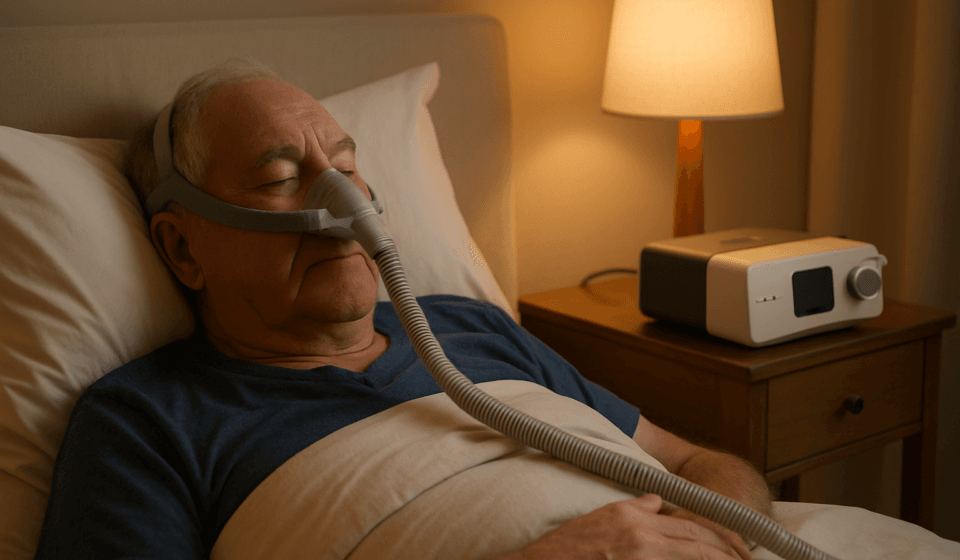

More than half of all Medicare beneficiaries are at high risk for obstructive sleep apnea — yet the vast majority are never diagnosed or treated. Sleep apnea in seniors is far more than a snoring problem. Untreated sleep apnea in older adults is strongly linked to Alzheimer’s disease, heart failure, stroke, and depression. In 2026, Medicare covers CPAP therapy as durable medical equipment, making effective treatment accessible at low cost. If you or a loved one snores loudly, wakes frequently at night, or feels exhausted despite a full night’s rest, sleep apnea may be the hidden culprit — and this guide gives you everything you need to act.
Sleep Apnea in Seniors 2026: How Common Is It Really?
Obstructive sleep apnea (OSA) occurs when throat muscles relax during sleep and partially or completely block the airway, causing repeated breathing pauses. These pauses can last 10 seconds to over a minute and happen hundreds of times per night, disrupting sleep quality even when the person does not fully awaken. Research using Medicare claims data found that 56% of Medicare beneficiaries are at high risk for OSA — and nearly 94% of those tested were diagnosed with sleep apnea. Studies estimate 15-20% of adults 65 and older have clinically significant OSA. The condition affects men more than women, though the gender gap narrows significantly after menopause. Despite its prevalence, sleep apnea is dramatically underdiagnosed in older adults, with symptoms like fatigue and memory fog often attributed to "normal aging."
Warning Signs of Sleep Apnea in Seniors
| Nighttime Symptoms | Daytime Symptoms |
|---|---|
| Loud, chronic snoring | Excessive daytime sleepiness |
| Witnessed breathing pauses (reported by partner) | Memory problems and brain fog |
| Gasping or choking during sleep | Morning headaches |
| Frequent nighttime urination (nocturia) | Irritability or mood changes |
| Waking with dry mouth or sore throat | Difficulty concentrating |
| Restless, fragmented sleep | Depression or anxiety |
Many seniors experience silent sleep apnea — minimal snoring but significant breathing disruptions. If you wake tired despite 7-8 hours in bed, experience daytime fatigue interfering with daily life, or have a partner who reports you stop breathing during sleep, discuss OSA with your doctor.
The Dementia and Alzheimer’s Connection: Critical Evidence
Perhaps the most alarming finding in sleep apnea research is its strong link to cognitive decline. Every apnea event temporarily deprives the brain of oxygen (intermittent hypoxia). Repeated oxygen drops disrupt the glymphatic system — the brain’s waste-clearance mechanism operating during deep sleep — impairing clearance of amyloid-beta plaques central to Alzheimer’s disease. Published research in the journal SLEEP using Medicare claims data found that PAP treatment was associated with significantly lower odds of incident Alzheimer’s disease during a 3-year follow-up. Adherent users (those using CPAP consistently) had even lower dementia risk. University of Michigan Medicine research confirmed that treating sleep apnea may meaningfully reduce dementia risk in older adults. Beyond dementia, untreated sleep apnea is associated with 2-3x higher risk of cardiovascular events, worsening of heart failure and atrial fibrillation, and poorly controlled blood pressure.
How Sleep Apnea Is Diagnosed
- Home Sleep Apnea Test (HSAT): A monitoring device worn overnight at home measuring breathing, oxygen, and heart rate. Medicare Part B covers this for most seniors suspected of OSA. You pay 20% of the approved amount after your $283 Part B deductible.
- In-Lab Polysomnography (PSG): Comprehensive overnight monitoring at a sleep center. Medicare covers when clinically indicated for complex cases.
Sleep apnea severity is measured by the Apnea-Hypopnea Index (AHI): 5-14 is mild, 15-29 is moderate, 30+ is severe. Medicare requires an AHI of 15 or above (or 5+ with symptoms like excessive daytime sleepiness or cardiovascular disease) to cover CPAP therapy.
Medicare CPAP Coverage in 2026: Exact Costs and Rules
- Covered under: Medicare Part B as Durable Medical Equipment (DME/DMEPOS)
- Your cost: After the $283 Part B deductible, Medicare pays 80%; you pay 20%. Medigap Plan G covers the 20% coinsurance.
- Trial period: Medicare covers an initial 3-month trial. You must use the device at least 4 hours per night, 70% of nights during the trial for continued coverage.
- Ownership: After 13 consecutive months of qualifying rental (Medicare paying 80%), the CPAP becomes yours to keep at no additional cost.
- Supplies covered: Masks, filters, tubing, and replacement supplies covered at 80% under Part B as needed.
- Supplier requirement: Must use a Medicare-enrolled DME supplier — find one at medicare.gov/care-compare.
Alternative Sleep Apnea Treatments Medicare Covers
- BiPAP: Covered under Part B for cases not responding to standard CPAP. Uses separate pressures for inhalation and exhalation — often more comfortable for seniors.
- Auto-APAP: Covered for qualifying seniors; automatically adjusts pressure throughout the night.
- Inspire Upper Airway Stimulation: An implantable neurostimulator for moderate-to-severe OSA patients who cannot tolerate CPAP. Medicare Part A covers the inpatient implant procedure. Eligibility: BMI 32 or below, confirmed OSA severity.
5 Action Steps if You Suspect Sleep Apnea
- Talk to your primary care doctor about your symptoms and request a sleep evaluation at your next visit
- Ask about a home sleep apnea test — Medicare Part B covers it for appropriate candidates
- Request referral to a sleep specialist if symptoms are severe or initial testing is inconclusive
- Get a CPAP from a Medicare-certified DME supplier once diagnosed; confirm they bill Medicare correctly
- Build CPAP habits gradually — use the ramp feature (slow pressure start), try a full-face mask if nasal congestion is an issue, and use a heated humidifier to reduce dryness
Related Articles You May Find Helpful
- Memory Loss vs. Dementia in Seniors 2026: How to Tell the Difference
- Alzheimer’s New Treatments 2026: Leqembi & Donanemab Explained
- Depression in Seniors 2026: Warning Signs, Treatment & Medicare Resources
- Best Exercises for Seniors Over 75: Doctor-Approved 2026 Guide
- Vertigo in Seniors 2026: Causes, Treatment & Fall Prevention Guide
Sources: SLEEP Journal: OSA Treatment and Dementia Risk | The Senior List: Medicare CPAP Coverage 2026 | University of Michigan Medicine