
After a knee replacement, the surgery is only half the job. The other half is the exercise you do in the weeks that follow: straightening the knee, getting it to bend, and rebuilding the thigh muscles that weakened during years of knee pain. The American Academy of Orthopaedic Surgeons (AAOS) says surgeons and therapists often recommend 20 to 30 minutes of exercise two or three times a day, plus walking for 30 minutes two or three times a day in early recovery, according to its knee replacement exercise guide.
This article walks through what that looks like week by week. Your own surgeon and physical therapist set your plan, and theirs comes first if it differs from what’s here.
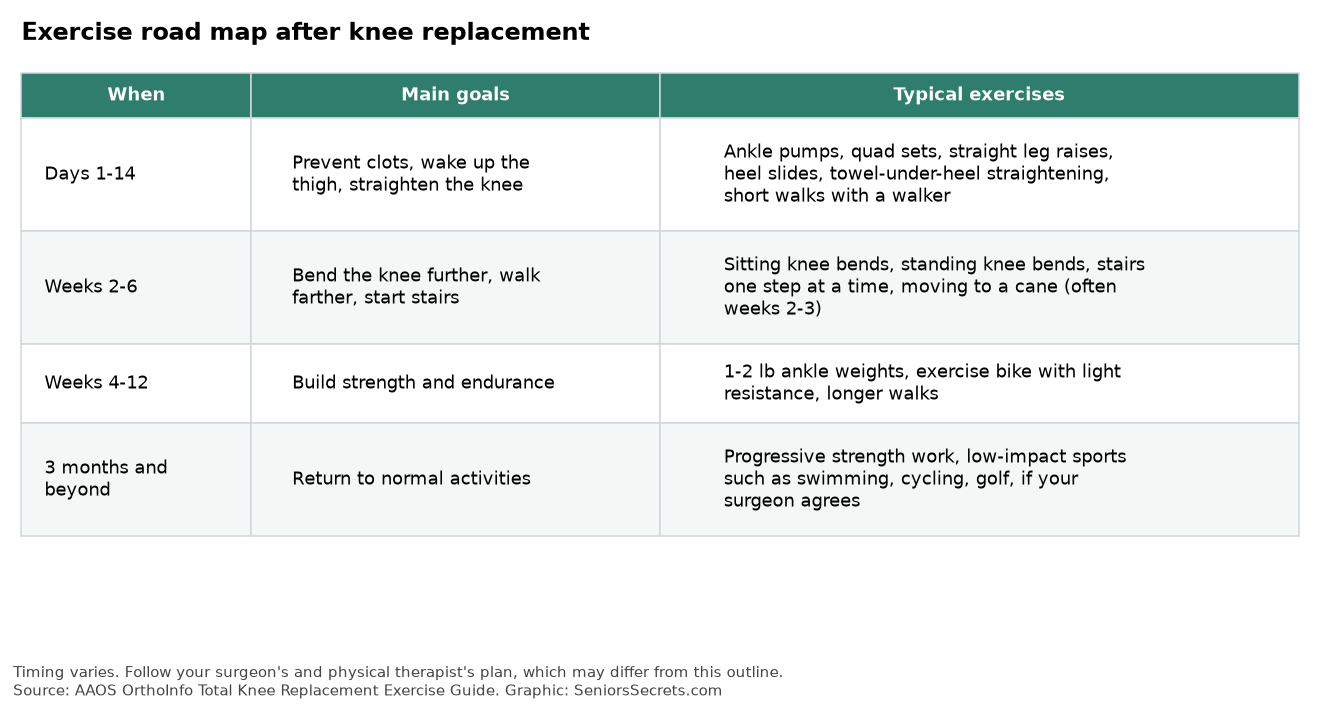
Days 1 to 14: straighten, activate, walk
You’ll usually start exercises in the hospital or surgery center, sometimes the same day. They feel uncomfortable at first, but AAOS notes they actually reduce pain after surgery and help prevent blood clots.
- Ankle pumps. Move your foot up and down at the ankle for 2 to 3 minutes, several times an hour while awake. This keeps blood moving in your legs and lowers clot risk.
- Quad sets. Lying or sitting with your leg straight, tighten the muscle on the front of your thigh and press the back of your knee down. Hold 5 to 10 seconds. Repeat about 10 times, rest a minute, and repeat until the thigh tires.
- Straight leg raises. Tighten your thigh with the knee fully straight, lift the leg a few inches off the bed, hold 5 to 10 seconds, and lower slowly.
- Knee straightening. Put a small rolled towel under your heel so the knee is unsupported. Tighten your thigh and try to press the back of the knee toward the bed. Hold 5 to 10 seconds.
- Heel slides (bed-supported knee bends). Slide your heel toward your buttocks, bending the knee as far as you can. Hold 5 to 10 seconds, then straighten.
- Walking. Start with short walks using a walker or crutches, as often as your team suggests. Step heel first, then flatten the foot, then push off with the toes.
Straightening matters as much as bending. A knee that can’t fully straighten makes you limp and tires you out. Don’t rest with a pillow under the knee; put it under the calf or ankle instead.
Weeks 2 to 6: more bend, more walking, stairs
As pain settles, the focus moves to bending the knee further and walking with less support.
- Sitting knee bends. Sit in a chair with your thigh supported. Bend the knee as far as you can, then slide your body forward in the chair to bend it a little more. Hold 5 to 10 seconds, then straighten fully.
- Standing knee bends. Holding a walker or counter, lift your thigh and bend the knee as far as you can. Hold 5 to 10 seconds and lower.
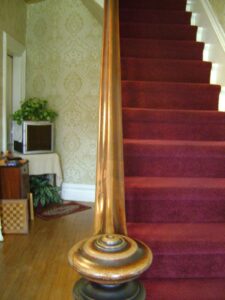
- Stairs. Use a handrail and take one step at a time. Remember “up with the good, down with the bad”: lead up with your good leg and down with your operated leg.
- Moving to a cane. AAOS says many people can switch to a single cane or crutch about 2 to 3 weeks after surgery, once they can walk and stand for more than 10 minutes without leaning on the walker. Hold it in the hand opposite your new knee.
Weeks 4 to 12: build strength
From about four to six weeks, your therapist may add resistance.
- Ankle weights. Start with 1 to 2 pounds on the exercises above and increase slowly as you get stronger.
- Exercise bike. Set the seat high enough that your knee is almost straight at the bottom of the pedal stroke. Pedal backward first, then forward when it’s comfortable. Build from 10 to 15 minutes twice a day to 20 to 30 minutes three or four times a week, adding light resistance around weeks 4 to 6. My stationary bike guide covers setup in more detail.
- Longer walks at a steady pace, on even ground at first.
Once your therapist releases you, the exercises in my knee strengthening guide are a good way to keep building strength. If standing exercise is still hard, a seated chair routine works the same muscles.
3 months and beyond
AAOS says a full recovery takes several months. Swelling and stiffness can linger, especially after a long day. Many people return to low-impact activities such as swimming, cycling, walking and golf. Ask your surgeon before high-impact activities like running or jumping sports.

Pain and swelling: what’s normal
Some pain during and after exercise is expected, and it should get a little better each week. Plan your exercises for 30 to 60 minutes after a dose of pain medicine if your doctor has prescribed one.
For pain or swelling after exercise, AAOS suggests raising your leg and using ice wrapped in a towel: 20 minutes on, 20 minutes off, for about two hours. Pain that is steadily getting worse rather than better, or that keeps you from doing your exercises, is worth a call to your surgeon or therapist.
Warning signs: when to call
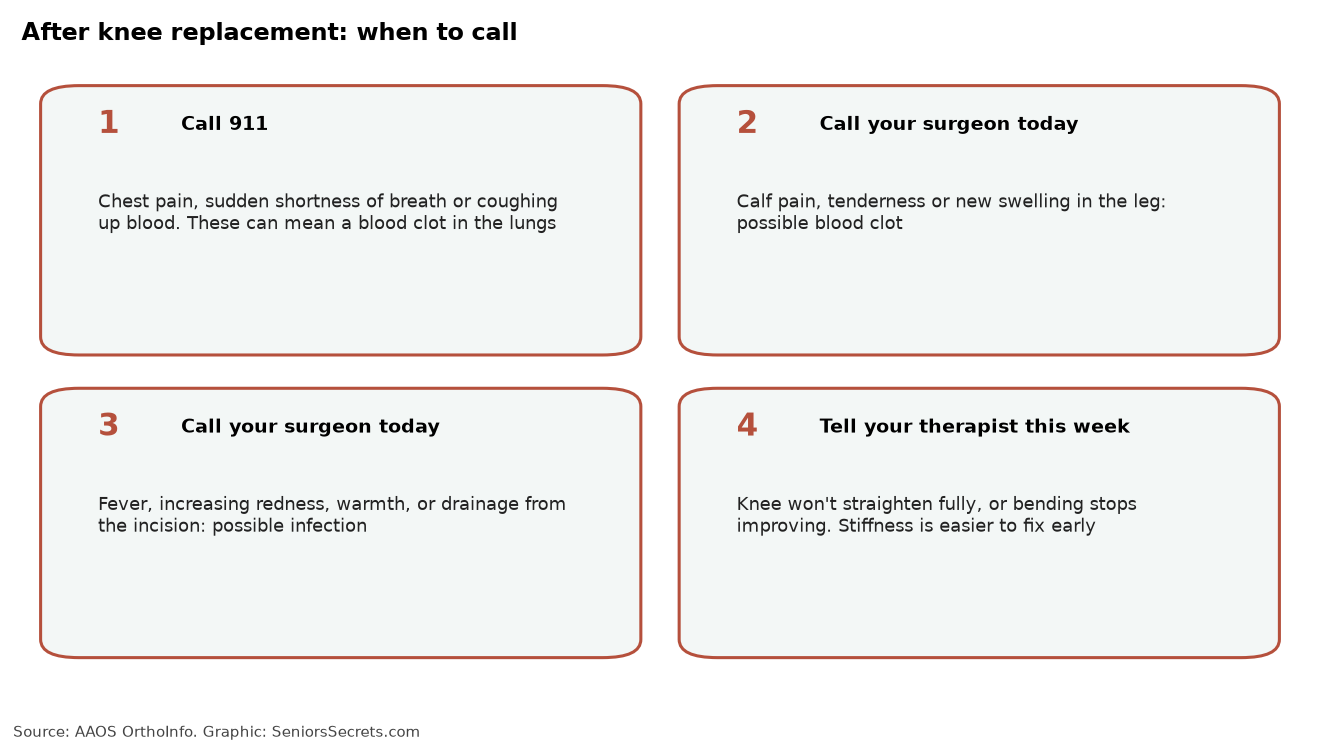
- Call 911 for chest pain, sudden shortness of breath or coughing up blood. These can be signs of a blood clot that has traveled to the lungs.
- Call your surgeon the same day for pain, tenderness or new swelling in your calf, or for fever, spreading redness, warmth or drainage from the incision.
- Tell your therapist promptly if your knee won’t straighten fully or your bending has stopped improving. Stiffness is much easier to treat early.
Safety at home
- Clear walkways, remove loose rugs and put night-lights between the bedroom and bathroom.
- Use a chair with arms and a firm seat, and consider a raised toilet seat and shower chair for the first weeks.
- Keep using your walker or cane until your therapist says you’re ready to stop. A fall in the early weeks can damage the new joint.
If you’re also working on steadiness, my balance exercises guide has safe moves to add once your therapist agrees.
What Medicare covers for rehab
Medicare covers medically necessary knee replacement and the rehab that follows. Inpatient stays fall under Part A; outpatient surgery, physical therapy and follow-up visits fall under Part B, where you usually pay 20% of the approved amount after the deductible. If you’re homebound after surgery, home health physical therapy may be covered at no cost. Walkers and canes are covered as durable medical equipment under Part B.
For costs in detail, see my guides to Medicare coverage for knee replacement and walkers and wheelchairs.
FAQ
How soon can I start exercising after knee replacement?
Usually the same day or the day after surgery, beginning with ankle pumps, quad sets and short walks with a walker.
How long should I do knee replacement exercises?
AAOS describes 20 to 30 minutes, two or three times a day, in early recovery. Keep doing strengthening exercises for months after formal therapy ends, because thigh strength keeps improving.
When can I stop using a walker?
Many people move to a cane about 2 to 3 weeks after surgery, once they can stand and walk for more than 10 minutes without leaning on the walker. Your therapist will tell you when.
Is it normal for my knee to swell months later?
Some swelling after activity is common for several months. Swelling with redness, warmth or fever, or new calf swelling, needs a call to your surgeon.
This article is for general information and doesn’t replace instructions from your surgeon or physical therapist.
Related guides