Exercises for Osteoporosis After 60: 9 Safe Moves for Stronger Bones and Fewer Falls (and What to Avoid)

If you have osteoporosis, exercise does two jobs. It gives your bones a reason to stay strong, and it builds the muscle and balance that keep you from falling in the first place. The second job matters most: most fractures happen in a fall.
An international expert panel, in the Too Fit To Fracture recommendations for people with osteoporosis, strongly recommended a program that combines strength training and balance training, and warned against relying on aerobic exercise such as walking alone (Giangregorio et al., Osteoporosis International).
Below are nine safe moves, the movements to avoid, and a weekly plan. If you’ve already had a spine fracture, or your bone density is very low, ask your doctor for a referral to a physical therapist before you start.
What kind of exercise helps bones
The Bone Health & Osteoporosis Foundation highlights two kinds:
- Weight-bearing exercise, where you’re upright and working against gravity. Brisk walking, stair climbing and dancing count. High-impact versions like jogging or jumping build bone more, but aren’t safe for everyone with osteoporosis.
- Muscle-strengthening exercise: weights, bands, machines or your own body weight, including sit-to-stands and rising up on your toes.
Bone responds to loads that are challenging. In the LIFTMOR trial, women around 65 with low bone mass did supervised, heavy strength and impact training twice a week for eight months. Their spine bone density rose about 2.9% while the low-intensity group lost 1.2%, and only one minor back spasm was reported (Watson et al., 2018). That was carefully supervised and progressed slowly, so don’t try heavy lifting on your own, but it shows that people with osteoporosis can build real strength safely with the right coaching.
9 safe exercises for osteoporosis
Do the strength moves two or three days a week and the balance moves most days. Start with 1 set of 8 to 10 reps and build to 2 or 3 sets. The last few reps should feel hard but your form should stay good.
1. Sit-to-stand
Sit near the front of a sturdy chair, feet hip-width apart. Lean forward from the hips with a straight back and stand up, then sit down slowly. This trains the thighs and hips that protect you from falls. My chair exercise routine shows how to make it easier or harder.
2. Wall push-up
Stand an arm’s length from a wall, hands on the wall at shoulder height. Bend your elbows to bring your chest toward the wall, keeping your body straight, then push back. Move closer to a counter, and later a sturdy table, to make it harder.
3. Band row
Anchor a resistance band at chest height (or loop it around a sturdy post). Pull your elbows back and squeeze your shoulder blades together. Strong upper-back muscles support an upright posture and help counter the forward rounding that comes with spine fractures. My resistance band guide covers bands and anchors.
4. Back extension
Lie face down with a pillow under your hips and your arms by your sides. Squeeze your shoulder blades together and lift your head and chest an inch or two, keeping your neck in line. Hold 3 seconds and lower. If lying on the floor is hard, stand with your back to a wall and press your shoulders and the back of your head gently toward it.
5. Standing side leg raise
Hold the back of a chair. Keeping your body upright and toes pointing forward, lift one leg out to the side, then lower slowly. These hip muscles help you catch yourself when you lose balance sideways.
6. Heel raises
Holding a counter, rise up onto your toes, pause, and lower slowly. Do 10 to 15. When this is easy, try one leg at a time.
7. Heel drops (only if your doctor agrees)
Rise up on your toes, then let your heels drop to the floor with a light thump. It’s a small, controlled impact that loads the hips and spine. Skip it if you’ve had a spine or hip fracture, unless your doctor or therapist has cleared you.
8. Single-leg stand and heel-to-toe walk
Holding a counter, stand on one foot for up to 30 seconds, then switch. Then walk along the counter placing one heel directly in front of the other toes. Use the counter less as you get steadier. My balance exercises guide has more options and a home balance test.
9. Brisk walking
Aim for about 150 minutes a week of brisk walking or similar activity, the CDC’s guideline for adults 65 and older. Walking on gentle hills or climbing stairs adds a bit more load for bones.
Movements to avoid with osteoporosis
The biggest risk for a fragile spine is bending forward with a rounded back, especially while lifting or twisting. That position squeezes the front of the vertebrae and can cause compression fractures.
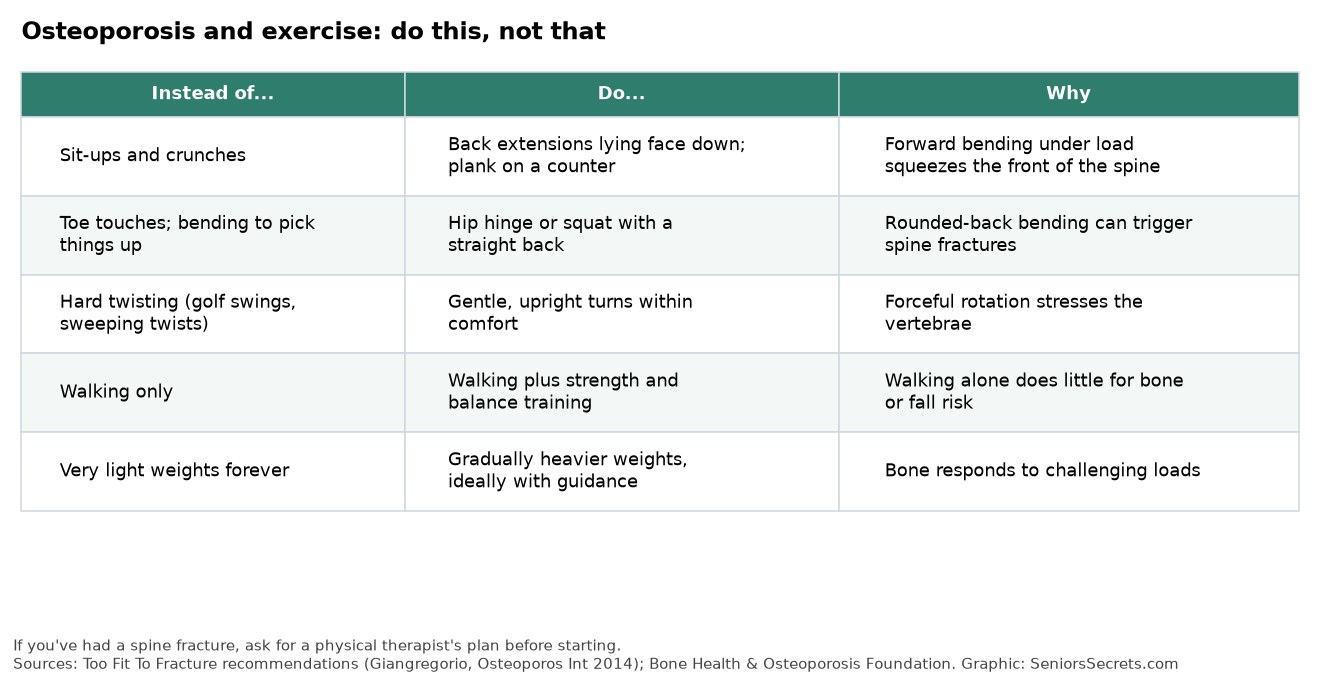
- Skip sit-ups, crunches and toe touches. Strengthen your core with back extensions and a plank against a counter instead.
- Bend at the hips and knees, not your back, when you pick something up, load the dishwasher or garden.
- Avoid forceful twisting, such as a hard golf swing or twisting yoga poses. BHOF has safe yoga and Pilates guides if you enjoy those classes.
- Ask before high-impact exercise like jogging or jumping if you’ve had a fracture or your bone density is very low.
A weekly plan
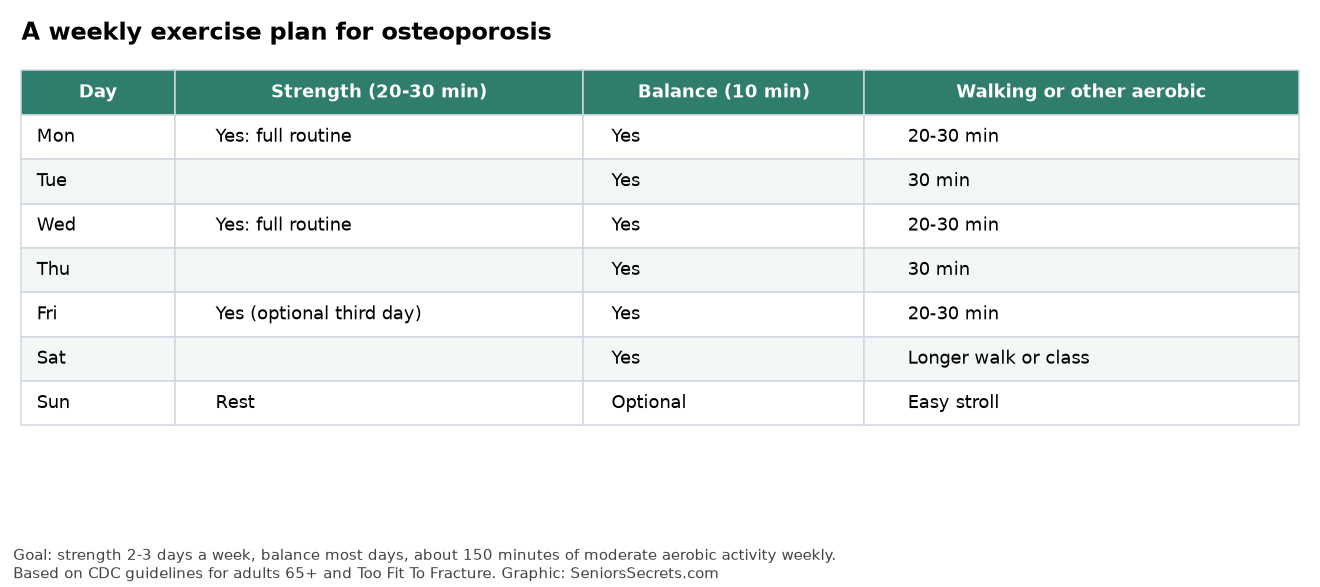
Strength sessions take 20 to 30 minutes and balance practice about 10 minutes, so this fits into most routines. Give your muscles a day off between strength sessions.
Exercise works best with the rest of your plan
Exercise doesn’t replace osteoporosis medication when you need it. It works alongside it. If you haven’t had a bone density scan, Medicare Part B covers one every 24 months for people at risk, and more often when medically necessary. See my guides to the bone density test, osteoporosis medications and osteoporosis prevention, which covers calcium, vitamin D and protein.
Getting supervised help
A physical therapist can design a safe program, check your form and progress it. That’s especially worth doing if you’ve had a spine fracture, have a stooped posture or have fallen. Medicare Part B covers outpatient physical therapy when your doctor says it’s medically necessary; you usually pay 20% of the approved amount after the deductible.
FAQ
What is the best exercise for osteoporosis?
There isn’t a single best one. Experts recommend a mix of strength training and balance training, plus weight-bearing activity like brisk walking.
Can exercise reverse osteoporosis?
Exercise can modestly increase bone density in some people and slow loss in others, but it rarely reverses osteoporosis on its own. Its biggest benefit is fewer falls and fractures. Medication may still be needed.
Is walking enough for osteoporosis?
No. Walking is good for your heart and helps bones a little, but the Too Fit To Fracture panel advised against relying on aerobic exercise alone. Add strength and balance training.
Is yoga safe with osteoporosis?
Some poses are, but avoid deep forward bends and strong twists. Look for a teacher trained in osteoporosis-safe yoga, or use BHOF’s safe yoga guide.
Should I lift weights if I have osteoporosis?
Yes, with good technique and gradual progression. Start light, avoid rounding your back, and get guidance from a physical therapist if you’ve had a fracture.
This article is for general information. Ask your doctor or a physical therapist which exercises are safe for you, especially if you’ve had a fracture.
Related guides