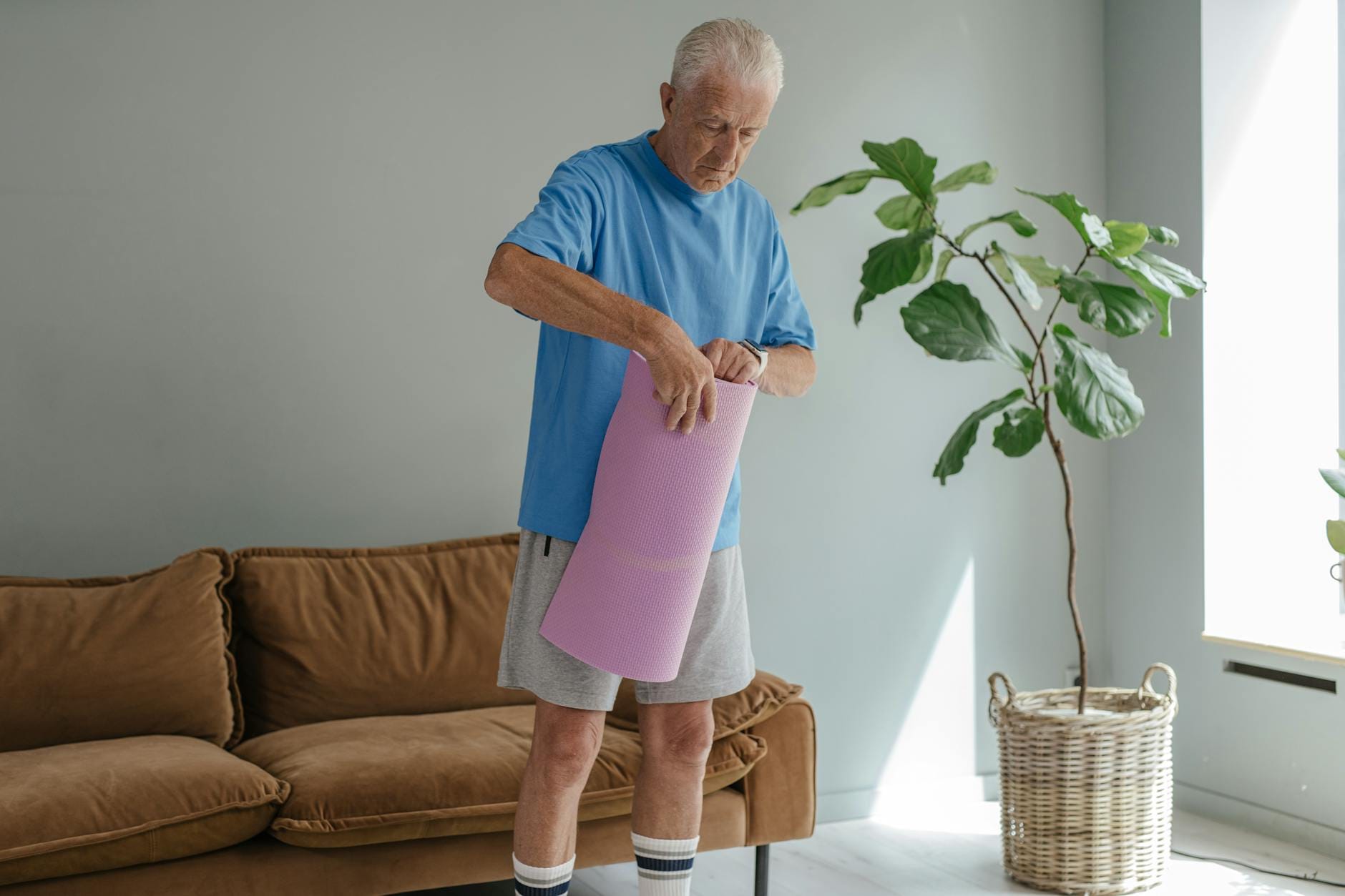

Try this right now before you read another word.
Stand up from your chair. Move near a wall. Lift one foot off the floor — no holding on — and start counting.
How long did you last?
- 30+ seconds: Excellent balance for your age — but keep reading, because this still applies to you.
- 10–29 seconds: Average for someone over 60, but “average” in this category is genuinely dangerous.
- Under 10 seconds: You are at measurable fall risk right now — and statistically, most people reading this fall into this group.
Here’s why this matters more than most people realize: Falls are the #1 cause of accidental death in Americans over 65. Every year, more than 36,000 older adults die from fall-related injuries — more than car accidents, more than drowning. For every death, there are hundreds of hospitalizations, broken hips, nursing home admissions, and the quiet beginning of lost independence.
But here is the part your doctor likely hasn’t told you, because it changes everything:
Your brain’s balance system responds to targeted training at any age. A landmark study published in the Journal of Aging and Physical Activity found that adults over 65 who performed focused balance exercises for just 8 weeks showed statistically significant improvements in both static balance (standing still) and dynamic balance (moving). Improvements that directly correlated with fewer falls in the following year.
Five minutes every morning. That is the investment. The return is staying on your feet, staying independent, and staying out of the hospital.
Why Your Balance Collapses After 60 — The Real Explanation
Balance is not one system. It is a constant, high-speed conversation between three separate systems in your body, each sending real-time data to your brain thousands of times per second. After 60, all three begin to fail at the same time.

System 1: Your Vestibular System (The Inner Ear)
Deep inside your inner ear sit tiny fluid-filled canals lined with microscopic hair cells smaller than the width of a human hair. When you tilt your head, turn, or step, the fluid shifts, bends those hair cells, and sends electrical signals to your brain telling it exactly which direction you’re moving and at what speed. Your brain uses this data to make continuous micro-corrections that keep you upright.
After 60, both the fluid viscosity and the hair cells themselves deteriorate. Signals get slower. Some hair cells die and are never replaced. The result: your brain receives delayed, weaker, sometimes contradictory information about where your head is in space. You may not notice it in daily life — until a sudden movement catches you off guard and your recovery reflex fires too slowly.
System 2: Visual Processing
Your eyes aren’t just for seeing. They are continuously scanning your environment and feeding spatial data directly to your brain’s balance centers. Depth perception, contrast sensitivity, peripheral vision — all of this contributes to balance in ways most people never realize until it starts failing.
After 60, visual acuity declines, depth perception becomes less reliable, and — critically — the time it takes your eyes to adapt when moving from a bright room to a dim hallway increases significantly. That half-second delay when you walk from a lit kitchen into a dark hallway? That is when a disproportionate number of falls happen. Your brain is making balance decisions based on stale, still-adjusting visual data.
System 3: Proprioception — Your Body’s Internal GPS
This is the one almost nobody talks about, and it may be the most important of the three.
Proprioception is your body’s internal GPS: a network of nerve receptors embedded in your muscles, tendons, and joint capsules that continuously reports body position to your brain. Right now, without looking, you know exactly where your feet are, how your weight is distributed, and whether you’re leaning slightly to one side. That knowledge comes entirely from proprioceptive signals — not from your eyes, not from your inner ear.
After 60, nerve conduction velocity slows by 15–20%. This means your brain is receiving slightly stale information about where your foot is, how your ankle is angled, and whether your center of gravity has drifted past the point of safe recovery. By the time your brain registers that you’ve stepped on an uneven surface, your window to correct it has narrowed dramatically.
When all three systems degrade simultaneously — and after 60, they do — the compounding effect is dramatic. A stumble your 50-year-old self would have corrected automatically becomes a fall at 67. This is not aging passively. This is three systems quietly failing while you go about your day.
The critical insight from current neuroscience: all three systems respond to deliberate, consistent training. Your brain can rebuild the neural pathways that make balance automatic. Physical therapists call it balance training. Neuroscientists call it neuroplasticity. What matters is that it works — and it doesn’t require a gym, equipment, or more than five minutes.
The 5-Minute Morning Balance Routine
Every exercise below was selected based on evidence from validated fall-prevention programs used in university research and hospital rehabilitation settings. Each targets a specific weakness in the three-system balance network described above.
Do this routine every morning, ideally right after waking up. Always perform near a wall or sturdy chair — not because you’ll need it most of the time, but because it changes your brain’s threat response, allowing you to focus on the exercise rather than survival instinct.
Exercise 1: Single-Leg Stand
Targets: Proprioception + vestibular integration | Time: 60 seconds

How to do it: Stand facing a wall with your fingertips lightly touching it for psychological safety (not actually using it for support). Lift your right foot slightly off the floor — even one inch is sufficient to begin. Keep your standing knee slightly soft, never locked. Fix your gaze on a single stationary point directly ahead at eye level. Hold for up to 30 seconds. Set your foot down, then repeat on the left side. Complete two rounds on each foot.
What you’re actually training: The moment you lift one foot, approximately 200 micro-muscles in your standing ankle and lower leg begin firing in rapid, coordinated sequences. Your brain is simultaneously receiving and processing signals from your ankle joint receptors, your calf muscle spindles, and your foot’s pressure receptors. Every wobble you feel is not weakness — it is your nervous system actively recalibrating. This is the training effect.
Progression for weeks 3 and 4: Close your eyes. Even 5 seconds with eyes closed delivers a training stimulus equivalent to 30 seconds with eyes open, because it eliminates your most dominant balance input and forces your vestibular and proprioceptive systems to compensate entirely on their own. This is exactly the scenario that happens when you step into a dark hallway.
Advanced variation: Stand on a folded bath towel or a piece of foam. The unstable surface dramatically amplifies the challenge to your ankle proprioceptors and accelerates neural adaptation.
Exercise 2: Heel-to-Toe Walk (Tandem Gait)
Targets: Dynamic balance + lateral stabilizers + gait pattern | Time: 60 seconds

How to do it: Find a straight line — a hallway edge, a line of floor tiles, or a strip of tape you’ve placed on the floor. Place the heel of your front foot so it touches the toes of your back foot. Step. Place the next heel so it touches the previous toes. Walk 20 steps forward this way, then 20 steps back. Move slowly. Keep your arms slightly extended at your sides for balance. Look forward — resist the urge to look down at your feet.
What you’re actually training: Normal walking uses a base of support approximately 4–6 inches wide. The tandem walk reduces that to nearly zero, forcing the muscles along the outsides of your hips, knees, and ankles — your lateral stabilizers — to engage at levels they almost never reach in normal daily movement. These are precisely the muscles responsible for the sideways catch when you stumble.
The research evidence: The tandem walk is a core component of the Otago Exercise Programme, one of the most rigorously studied fall-prevention protocols in the world. Published trials have shown the Otago Programme reduces fall rates by up to 35% in community-dwelling adults over 65. The tandem walk appears in virtually every validated fall-prevention protocol worldwide for good reason: it works.
Exercise 3: Side-to-Side Weight Shifts
Targets: Lateral stability + hip abductors + center-of-gravity control | Time: 60 seconds

How to do it: Stand with feet hip-width apart, both hands resting lightly on a chair back or fingertips touching a wall. Slowly — taking a full 3 seconds — shift all of your body weight onto your right foot until you could lift your left foot off the floor without moving your right. Feel your right glute, outer hip, and ankle muscles engage firmly. Hold for 5 full seconds. Then slowly shift to your left side over 3 seconds. Hold 5 seconds. Repeat 6 times on each side.
Why slow matters — a lot: Fast weight shifts use momentum. Slow, controlled shifts force your neuromuscular system to maintain precise control without any assist from inertia. The neural pathways you are building with slow movement are exactly the pathways that fire when you reach for something on a shelf and your weight unexpectedly shifts — or when you step off a curb that was lower than you expected.
What you’re actually training: The majority of falls happen during lateral weight transfer — turning around, stepping sideways, reaching across your body. The hip abductors and lateral ankle stabilizers are the primary muscles involved in these movements, and they are among the earliest and fastest to weaken with inactivity. This exercise specifically reloads those systems.
Exercise 4: Backward Walking
Targets: Posterior muscle chains + catch reflex + spatial awareness | Time: 60 seconds

How to do it: Use a clear hallway with walls on both sides. Walk backward slowly and deliberately for 20 steps — lifting each foot cleanly rather than shuffling. Turn carefully and walk forward 20 steps. Focus on smooth, controlled steps. Keep your core lightly engaged.
What you’re actually training: Forward walking is so deeply habituated that your brain processes it on autopilot, using minimal conscious balance resources. Backward walking disrupts every automatic pattern, forcing your brain to consciously engage balance and coordination circuits. It activates your hamstrings, glutes, and posterior calf muscles in sequences that are never reached during normal forward gait. More importantly, it builds what physical therapists call the catch reflex — the speed and coordination with which your body recovers from an unexpected backward stumble.
The research: A 2019 study published in Gait and Posture found that regular backward walking training significantly improved forward balance stability in older adults — not just backward balance. The cross-training effect on the nervous system is substantial.
Safety: Always use a hallway with walls on both sides within arm’s reach for your first two weeks. Do not attempt outdoors until you are fully confident with the movement indoors. Never do this exercise in socks on hardwood floors.
Exercise 5: Sit-to-Stand Without Hands
Targets: Leg strength + functional independence + transfer mechanics | Time: 60 seconds, 5 repetitions

How to do it: Sit at the edge of a sturdy, non-wheeled chair with your feet flat on the floor and hip-width apart. Cross your arms over your chest or extend them forward as a counterbalance. Without pushing off the armrests, stand fully upright. Then sit back down slowly — control the descent over a full 3–4 seconds. Repeat 5 times.
The slow descent is not optional: The eccentric contraction (muscle lengthening under load) during the controlled sit-down builds more strength than the standing up phase. It also trains your nervous system to manage controlled deceleration — which is exactly the skill that prevents you from dropping into a chair or onto the toilet instead of sitting down in a controlled, safe way.
The science behind why this exercise is extraordinary: In 2012, a study published in the European Journal of Preventive Cardiology followed 2,002 adults aged 51–80 and tracked their ability to sit and rise from the floor without using their hands, knees, or arms. Those who scored the lowest were 5 to 6 times more likely to die within the next 6 years than those who scored the highest — after controlling for age, sex, and BMI. The same principle applies to chair sit-to-stand. It is one of the single most predictive tests of functional independence available without equipment.
Modification: If 5 unassisted reps is currently impossible, start with one hand on one armrest. Progress to fingertips only. Then no hands. The goal is gradual progression, not perfection from day one.
Make Your Home Safer — Immediately

Exercise rebuilds your balance system over weeks and months. Your home environment poses a risk right now, tonight. Environmental modifications and physical training work in parallel — you need both.
Remove every throw rug in your home. This is the single most impactful environmental change you can make. Throw rugs are involved in a disproportionate number of home falls because the edge catches a shuffling or slightly dragging foot while the rug itself slides on the floor underneath. There is no throw rug beautiful enough to be worth a fractured hip. Remove them today.
Install motion-sensor night lights on every path from your bedroom to the bathroom. The majority of nighttime falls happen between midnight and 4am, when you are moving from a dark, comfortable bedroom through a dark hallway to a brightly lit bathroom. Your pupils can’t adjust that fast. Motion-sensor lights that turn on the moment you swing your feet off the bed cost less than $10 and require no tools to install.
Add grab bars in the shower and adjacent to the toilet. The bathroom is statistically the most dangerous room in your home for falls. Grab bars reduce the leverage required to sit and rise, give you something firm to hold if you slip, and — perhaps most importantly — change the way your brain perceives the situation. When you know there’s something solid to hold, your body relaxes, moves more fluidly, and takes the step without the hesitation that itself causes stumbles.
Review your medications with your physician and specifically ask about fall risk. Blood pressure medications, sleep aids, antihistamines, antidepressants, muscle relaxants, and many other commonly prescribed medications list dizziness, orthostatic hypotension, and balance disruption as known side effects. Polypharmacy — being on multiple medications simultaneously — multiplies this risk in ways that are not always predictable. Ask your doctor directly: “Do any of my current medications increase my fall risk?” Many physicians will not raise this proactively unless prompted.
Evaluate your footwear. Loose slippers, socks on hardwood floors, and shoes with worn or smooth soles are among the most common fall factors identified in retrospective fall analysis. Wear shoes with firm, non-slip soles — inside the house, not just outside. A shoe with a small, firm heel and good ankle support is not glamorous, but it is functional.
Your 30-Day Balance Challenge
Here is exactly what I want you to do:
- Right now: Take the one-leg stand test on each foot. Write down the date and your time on each side. This is your baseline.
- Tomorrow morning: Do the 5-minute routine for the first time. Schedule it immediately after an existing habit — brushing your teeth, making coffee — so it gets done.
- Today: Walk through your home and identify your three highest-priority fall hazards. Fix at least one before you go to bed tonight.
- 30 days from now: Retake the one-leg stand test. Note the difference.
The people who read articles like this and don’t act on them are the same people who, 18 months later, are in physical therapy after a fall, rebuilding capabilities they could have maintained with 5 minutes a day.
You are reading this before that happens. That is everything.
Your brain can adapt. Your muscles can strengthen. Your coordination can improve. Not despite your age — just more deliberately because of it. Start tomorrow morning. Five minutes. Near a wall.
Which exercise was hardest for you today? Leave a comment below — I personally respond to every comment and will give you a specific modification based on your situation. You’re not in this alone.
How Often Should Seniors Do Balance Exercises?
The American College of Sports Medicine (ACSM) recommends that older adults perform balance training at least 2–3 days per week. However, for seniors at elevated fall risk, daily practice of gentle balance exercises delivers the fastest results.
A landmark 2023 review published in The Lancet found that structured balance training performed at least 3 times per week reduced fall-related injuries by 38–42% in adults over 65 — significantly better than those who exercised less frequently.
Recommended Weekly Schedule
| Day | Focus | Duration |
|---|---|---|
| Monday | Static balance (single-leg stand, heel raises) | 10–15 min |
| Wednesday | Dynamic balance (walking heel-to-toe, side steps) | 15–20 min |
| Friday | Full routine (all 10 exercises above) | 20–25 min |
| Daily (optional) | 5-minute morning balance check (standing on one foot while brushing teeth) | 5 min |
How Long Before You See Results?
Many seniors want to know: how quickly will my balance improve? The research is encouraging:
- 2–3 weeks: Most seniors notice improved confidence standing and walking on uneven surfaces
- 4–6 weeks: Measurable improvements in single-leg stand time (a key clinical balance test)
- 8–12 weeks: Significant reduction in actual fall frequency, confirmed by multiple randomized controlled trials
A 2024 study in the Journal of Aging and Physical Activity followed 312 adults over 70 through a 12-week balance program. At the end, participants showed a 51% improvement in balance scores and reported feeling “much more confident” when moving around their homes.
Warning Signs to Stop and See a Doctor
While balance exercises are safe for most seniors, stop immediately and consult your doctor if you experience:
- Sudden dizziness or vertigo during any exercise
- Pain in your hips, knees, or ankles that worsens with movement
- Numbness or tingling in your feet (may indicate neuropathy)
- Shortness of breath or chest tightness
Medicare covers physical therapy for balance disorders — if you’re struggling, ask your doctor for a referral to a physical therapist who specializes in fall prevention. Under Medicare Part B, physical therapy is covered after your $283 annual deductible, with 80% of approved costs paid by Medicare.