
After 60, Your Legs Are Quietly Disappearing — And Most Doctors Aren’t Telling You
Here is a fact that should alarm every person over the age of 60: without deliberate intervention, adults lose 3–8% of their muscle mass per decade starting in their 30s. After 60, that rate doubles. By 70, the average sedentary adult has lost 30–40% of the peak muscle mass they had at 30. And the leg muscles — your quadriceps, hamstrings, calves, and glutes — are hit hardest of all.
This condition has a name: sarcopenia. And the research connecting it to serious health outcomes is unambiguous. A landmark 2020 study in the Journal of Cachexia, Sarcopenia and Muscle found that sarcopenic older adults had a 2.3-fold increased risk of all-cause mortality compared to those with healthy muscle mass. Another study in Age and Ageing found that low grip strength — a proxy for overall muscle health — was a stronger predictor of cardiovascular mortality than systolic blood pressure.
This is not about aesthetics. This is about how long you live, how well you live, and whether you stay out of a nursing home in your 80s.
Why the Legs Go First — The Biology of Lower Body Muscle Loss
The legs contain the largest muscle groups in the human body. They also contain a high proportion of Type II fast-twitch muscle fibers — the power-generating fibers that fire during quick movements, sudden direction changes, and catching yourself when you stumble. These fibers are preferentially lost with age and inactivity.
What drives this loss?
- Declining anabolic hormones: Testosterone, growth hormone, and IGF-1 all drop significantly with age. These hormones are the chemical signals that tell muscle tissue to maintain and rebuild itself. When they fall, muscles receive a quieter signal to stay the same — and a louder signal to atrophy.
- Anabolic resistance: Even when seniors eat adequate protein, their muscles are less efficient at using it. The same gram of protein that triggers muscle protein synthesis in a 25-year-old has a blunted effect at 70.
- Chronic low-grade inflammation: Elevated markers like IL-6 and TNF-alpha — common in aging, obesity, and metabolic disease — actively break down muscle tissue. Researchers call this “inflammaging.”
- Reduced neural drive: As motor neurons in the spinal cord die off with age, the surviving neurons must take over for larger territories of muscle fiber. This rewiring is imperfect and contributes to weakness and coordination loss.
The Consequences Beyond the Gym
Weak legs don’t just mean slower walking. The downstream consequences are far-reaching:
Falls and fractures. Leg strength, particularly quadriceps strength, is the primary determinant of whether you stumble and recover or stumble and fall. The Otago Exercise Programme demonstrated that leg strengthening exercises reduced fall-related injuries by up to 35% in high-risk seniors.
Metabolic disease. Skeletal muscle is the body’s largest glucose-clearing organ. Muscle contraction drives glucose from the bloodstream into cells — independently of insulin. Every pound of muscle lost increases insulin resistance, raising the risk of type 2 diabetes.
Cardiovascular disease. A 2016 study in the European Journal of Preventive Cardiology found that low leg muscle strength was independently associated with increased risk of coronary artery disease, even after controlling for traditional cardiovascular risk factors.
Cognitive decline. This one surprises people. Muscle contractions release a protein called irisin that crosses the blood-brain barrier and stimulates BDNF (brain-derived neurotrophic factor) — essentially fertilizer for brain cells. Regular leg exercise is associated with larger hippocampal volume and reduced dementia risk in multiple longitudinal studies.
Assessing Your Leg Strength Right Now
Before starting any program, get a baseline. These three simple tests — used by researchers and physical therapists worldwide — will tell you where you stand:
The 30-Second Chair Stand Test
Sit in a standard chair without armrests (seat height approximately 17 inches). Cross your arms over your chest. Stand fully upright and return to seated — that’s one repetition. Count how many you complete in 30 seconds. For adults aged 65–69, fewer than 12 repetitions indicates below-average leg strength. For 70–74, fewer than 11. Under 75 and 80 respectively for ages 75–79 and 80+.
The Timed Up and Go (TUG) Test
From seated in a chair, stand up, walk 10 feet at your normal pace, turn around, walk back, and sit down. Time the entire sequence. Under 12 seconds is normal for most seniors. Over 20 seconds indicates significant fall risk and warrants a formal physiotherapy assessment.
Single-Leg Stance
Stand on one leg, eyes open, near a wall for safety. Can you hold it for 10 seconds? For 30? Research shows that healthy adults under 70 should be able to hold a one-legged stance with eyes open for at least 30 seconds. The inability to hold 10 seconds has been associated with a doubled fall risk.
The 5 Best Leg Strengthening Exercises for Seniors
These exercises are selected based on the strongest research evidence for effectiveness, safety, and functional carry-over to daily activities. Start with 2 sets of 8–10 repetitions and progress gradually.
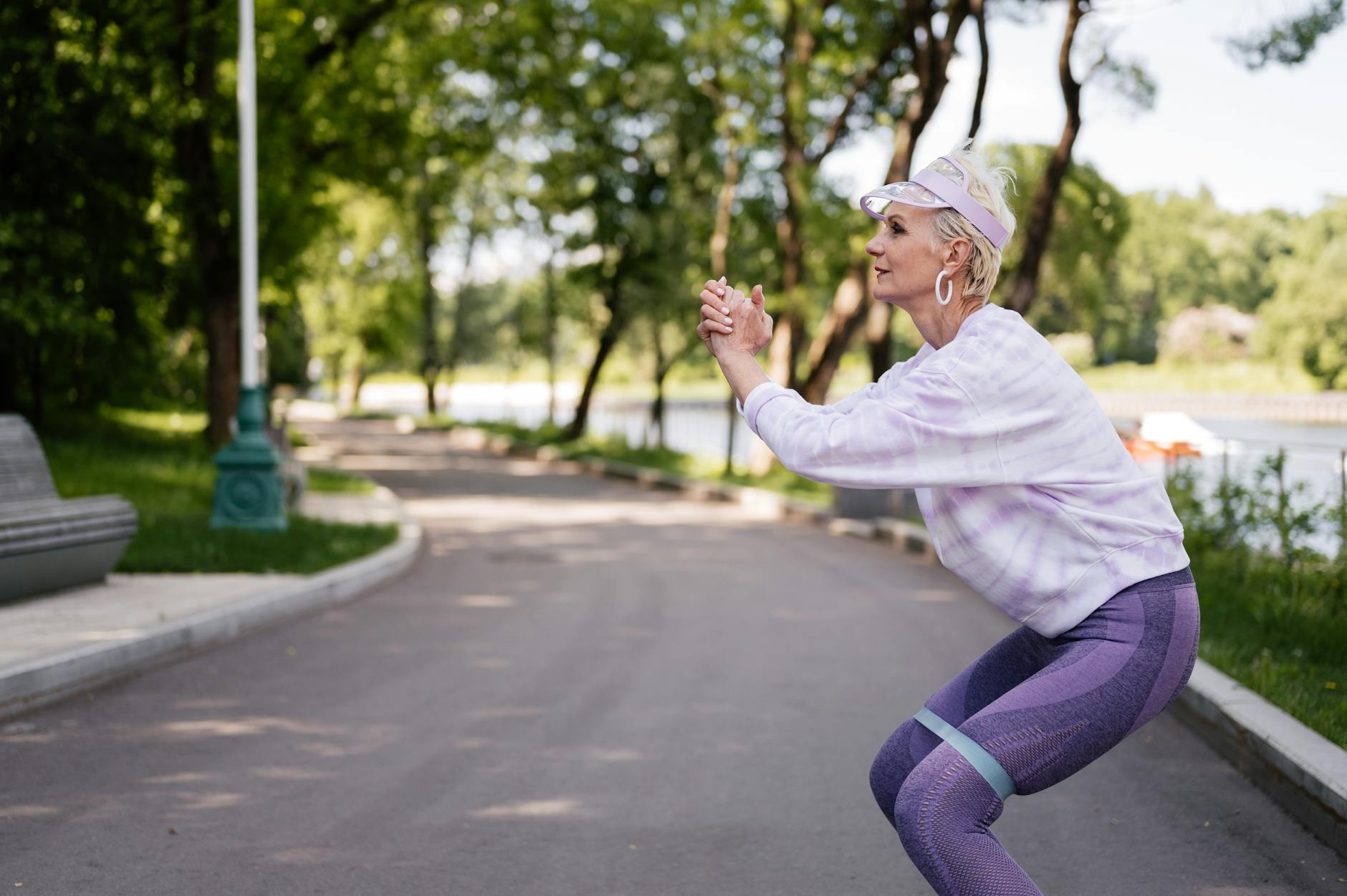
Exercise 1: Sit-to-Stand (Chair Squats)
The most functional exercise for seniors. It directly trains the quad, glute, and hamstring pattern used to get out of chairs, cars, and off toilets. Stand from a chair using only your legs — no pushing off with your hands. Control your descent slowly back into the chair (3 seconds down). This eccentric loading is where much of the strengthening stimulus comes from. Progress by using a lower surface or adding a pause at the bottom.
Exercise 2: Step-Ups
Use a stair step or a low platform (6–8 inches high). Step up with one leg, bring the other leg up, step back down in a controlled manner. This mimics climbing stairs and builds single-leg strength that directly transfers to fall prevention. Hold the wall or railing for balance initially. Progress to no support, then increase step height.
Exercise 3: Wall Squats (Isometric Hold)
Back flat against the wall, feet 12–18 inches out, lower yourself until thighs are parallel to the floor (or as low as comfortable). Hold the position. Start with 10-second holds and work toward 30–60 seconds. Isometric holds build strength without joint movement — ideal for seniors with knee or hip pain during dynamic exercises.
Exercise 4: Calf Raises
The calf muscles (gastrocnemius and soleus) pump blood back up from the legs to the heart — they are sometimes called the “second heart.” Weak calves contribute to poor circulation, swelling, and falls. Stand at a counter for support, rise onto your toes, hold 1 second, lower slowly. Work toward 3 sets of 15. Progress to single-leg calf raises as strength improves.
Exercise 5: Glute Bridges
Lie on your back, knees bent, feet flat on the floor. Press through your heels to lift your hips toward the ceiling until your body forms a straight line from knees to shoulders. Hold 2 seconds at the top, lower with control. The glutes are frequently the most underdeveloped major muscle group in seniors — and they are critical for hip stability, posture, and protecting the lower back. Progress to single-leg bridges.
The Protein Imperative: Eating to Rebuild
Exercise creates the stimulus for muscle growth. Protein provides the raw material. Most seniors are critically under-eating protein — often consuming half what they actually need for muscle maintenance.
The current research consensus, led by the PROT-AGE study group (published in Journal of the American Medical Directors Association), recommends 1.2–1.6 grams of protein per kilogram of body weight per day for older adults — nearly double the outdated RDA of 0.8g/kg. For a 70kg (154 lb) person, that’s 84–112 grams of protein daily.
Critically, protein distribution matters as much as total intake. Research by Dr. Donald Layman and colleagues demonstrated that spreading protein across 3 meals (at least 25–30g per meal) — rather than consuming most of it at dinner — produces significantly greater muscle protein synthesis. A whey or leucine-rich protein supplement within 30 minutes of resistance exercise further maximizes the anabolic response.
High-quality protein sources: eggs, chicken, fish, Greek yogurt, cottage cheese, legumes (combined with grains for complete amino acid profiles), and lean beef.
How Often? How Hard? The Right Progressive Overload for Seniors
Muscle responds to challenge. If you do the same exercise at the same weight with the same reps indefinitely, adaptation stops. This is the principle of progressive overload — you must incrementally increase the difficulty over time to continue gaining strength.
For seniors, progression should be conservative but consistent:
- Aim for 2–3 resistance training sessions per week with at least one rest day between sessions
- Increase repetitions first (e.g., from 8 to 12), then increase resistance or difficulty
- Work to the point of moderate fatigue (your last 2 reps should feel genuinely challenging) but stop short of pain
- Track your workouts — even a simple notebook record prevents the common trap of unconsciously doing the same thing session after session
Soreness 24–48 hours after exercise (DOMS — delayed onset muscle soreness) is normal and a sign of adaptation. Sharp pain during exercise, or pain in joints rather than muscles, is a signal to stop and reassess.
The 12-Week Milestone
Research consistently shows measurable strength gains in seniors after 6–12 weeks of consistent resistance training — even in adults in their 80s and 90s. A landmark study at Tufts University led by Dr. Maria Fiatarone demonstrated that nursing home residents aged 86–96 increased leg press strength by 174% and walking speed by 48% after just 8 weeks of progressive resistance training.
You are not past the point of rebuilding. Your muscles are waiting for the signal. The question is whether you give it to them.
Start Today: A Simple First Week
If you’ve been sedentary, here is your Week 1 prescription — no equipment required:
- Monday: 2 sets of 8 chair stands + 2 sets of 10 calf raises
- Wednesday: 2 sets of 10 glute bridges + wall squat hold for 2 × 15 seconds
- Friday: 2 sets of 10 step-ups (6-inch step, holding railing) + 2 sets of 8 chair stands
That’s 20–25 minutes. Three times a week. The research says it’s enough to begin reversing years of decline. The compound interest of muscle maintenance pays dividends for the rest of your life.
Know someone who keeps saying they’re “too old” to exercise? Share this with them. The science says otherwise — emphatically.