
Medicare Advantage plans have to cover the same Part A and Part B services as Original Medicare. The extras are different. Dental caps, OTC cards, meal benefits, fitness networks, and Part B premium “givebacks” are optional. Plans can change them every January 1.
That is the quiet part of Open Enrollment. The monthly premium can stay $0 while the benefit you actually use gets smaller. Open Enrollment for 2027 coverage runs October 15 to December 7, 2026. Changes generally start January 1, 2027.
I’m a researcher who reads plan documents and official Medicare pages for readers. I am not a licensed insurance agent. Use this with Medicare Plan Finder and free help from your SHIP counselor. I will not invent cuts for a specific insurer or county. Your Annual Notice of Change (ANOC) is the document that matters for your plan.

What national data already showed for 2026
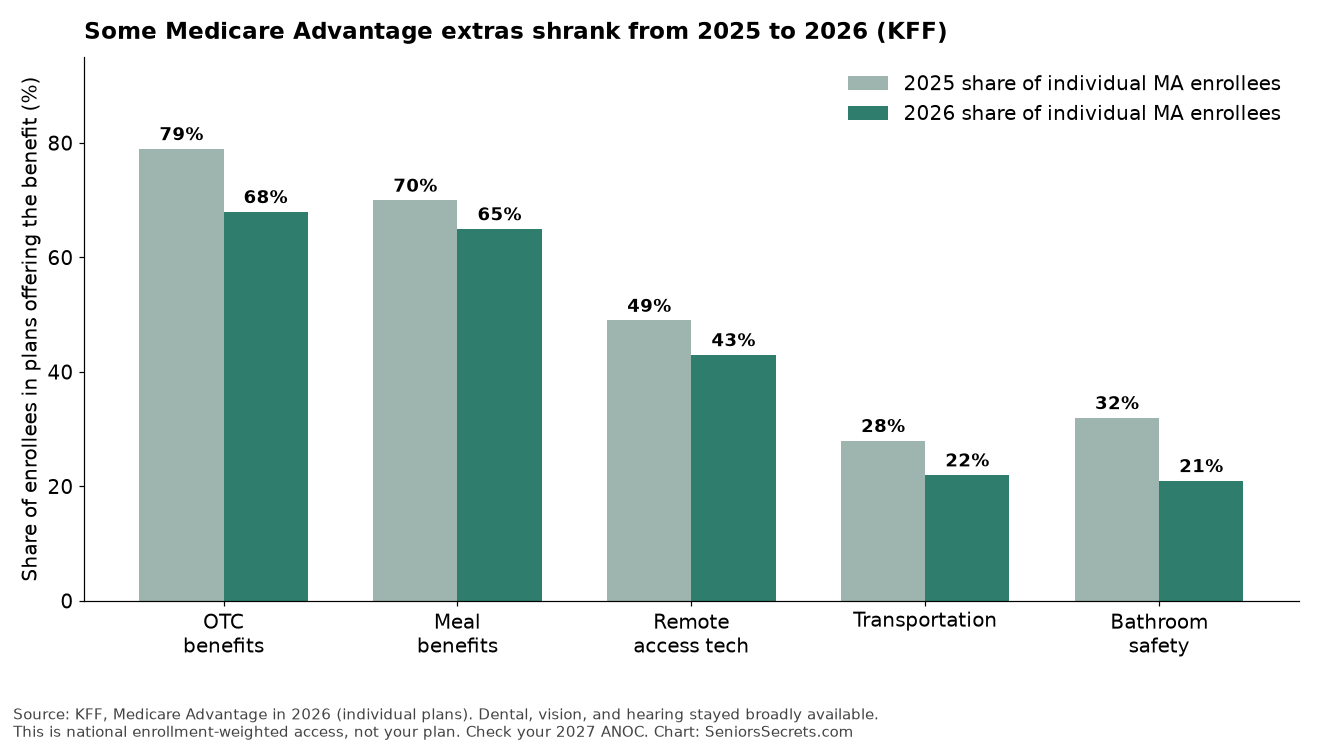
KFF’s Medicare Advantage in 2026 brief is the clearest public snapshot of how extras moved from 2025 to 2026 for people in individual (non-SNP) plans:
| Extra benefit | Share of individual MA enrollees in plans offering it, 2025 | 2026 |
|---|---|---|
| Over-the-counter (OTC) benefits | 79% | 68% |
| Meal benefits | 70% | 65% |
| Remote access technologies | 49% | 43% |
| Transportation benefits | 28% | 22% |
| Bathroom safety devices | 32% | 21% |
KFF also reported that access to dental, vision, and hearing stayed broadly stable at very high levels, and fitness benefits remained common. Stable “access” does not mean your annual dollar limit or provider network stayed the same. A plan can still cut a dental max from $2,000 to $1,000 while counting as “offering dental.”
About 31–32% of individual-plan enrollees were in plans that reduce the Part B premium (often marketed as a giveback). Many of those reductions were under $10 a month; a smaller share got $100 or more off. Details live in our Medicare giveback benefit guide.
What CMS is saying about 2027 (and what it does not promise you)
CMS has described the 2027 Medicare Advantage and Part D landscape as broadly stable in its fall enrollment materials, including a projected drop in the enrollment-weighted average MA premium and a statement that supplemental benefit offerings such as hearing, dental, and vision are expected to remain stable (CMS press release on 2027 MA and Part D stability).
“Stable” at the national marketing level is not a guarantee for your plan ID. Insurers still file different benefit packages by county. Some plans exit markets entirely. If your carrier is leaving, treat that as a forced shop, not a rumor. Our Clear Spring Health exit guide walks through what an exit notice means.
Industry analyses of Plan Finder and landscape files also report tighter dental allowances and Part B givebacks at some large carriers for 2027. Those reports are useful as a signal to read your ANOC, not as a substitute for it. I will not list invented plan-by-plan cut amounts here.
Core medical vs extras (do not confuse them)
Must still cover (with plan rules): Part A and Part B services, subject to the plan’s network, prior authorization, referrals, and cost sharing. Nearly all MA enrollees are in plans that use prior authorization for some services (KFF: about 99% in 2026).
Can shrink or vanish: OTC dollar amounts, dental annual maximums and major services, vision hardware limits, meal delivery episodes, non-emergency rides, fitness networks, flexible spending cards, and Part B premium reductions.
Also check every year: drug formulary and pharmacy network, specialist and hospital network, medical deductible, and the out-of-pocket maximum for Part A/B services. KFF put the average in-network MA out-of-pocket limit around $5,421 in 2026 (plans can set lower or higher amounts within CMS caps).
As of October 4, 2026, the 2027 Part B premium and deductible are not announced. For budgeting, the official 2026 figures remain $202.90 monthly and $283 deductible (CMS). A giveback is a reduction against that Part B premium, not a free lunch on everything else.
How to spot cuts in your ANOC (do this first)
Medicare’s upcoming plan changes / ANOC page explains that the Annual Notice of Change shows how premiums, benefits, and costs change for the coming year. Plans generally mail it in September.
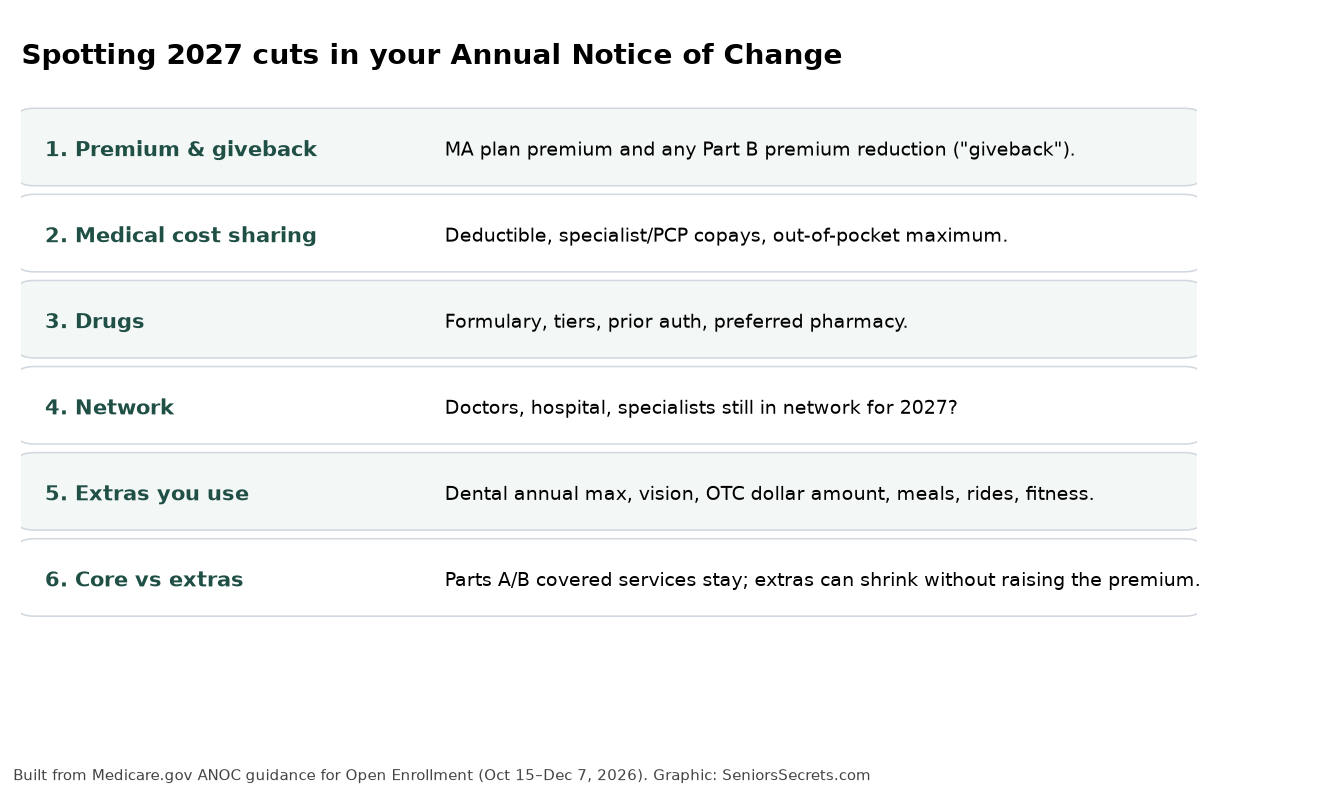
Highlight these lines for 2027:
- Monthly plan premium and any Part B premium reduction
- Medical deductible, specialist/PCP copays, and out-of-pocket maximum
- Your drugs: still covered, same tier, new prior authorization or step therapy?
- Doctors, hospital, pharmacy still in network?
- Extras you actually use: dental annual max, vision, OTC amount, meals, transportation, fitness
- Any service-area or plan-exit language
For a fuller line-by-line read, use Your Medicare Annual Notice of Change for 2027. If the ANOC never arrived, call the member services number on your card now. Then work the 2-week Open Enrollment prep checklist before you click Enroll.
What to do during Open Enrollment (Oct 15–Dec 7, 2026)
- Finish the ANOC pass before you fall for a $0-premium pitch.
- Enter every drug and pharmacy into Medicare Plan Finder. Sort by estimated yearly cost, not premium alone.
- Confirm two or three doctors and your hospital for 2027 network status.
- Compare total yearly cost of staying vs switching, including the extras you use.
- Watch the deadline. Your new plan must receive your request by December 7. Waiting until the last day is one of the Open Enrollment mistakes that create January surprises.
- If you want Original Medicare instead, check Medigap underwriting before you drop Advantage. Open Enrollment is not a Medigap open window. See switching to Original Medicare and the broader Medicare Advantage 2027 Open Enrollment guide.
Use leftover 2026 extras (OTC, dental, vision) before December 31 if your plan does not roll them over. That is separate from choosing 2027 coverage.

If your plan is leaving, not just cutting
A benefit cut and a plan exit are different situations with different rights. If your plan’s contract isn’t renewed for 2027, you should get a non-renewal letter in early October (plans must mail it at least 90 days before coverage ends). That letter matters, so keep it.
What you can do, per Medicare.gov’s Special Enrollment Periods page:
- Pick a new plan during Open Enrollment (Oct 15–Dec 7). Coverage starts January 1.
- Use the special window from December 8 to the last day of February. You can still join another Advantage or drug plan. If you don’t, you’re moved to Original Medicare when the plan ends, and you’d need to join a separate Part D plan yourself.
- Buy Medigap with no health questions. When an Advantage plan leaves Medicare or stops serving your area, you have a guaranteed right to buy a Medigap policy if you switch to Original Medicare. Medicare.gov’s Medigap timing page says to apply as early as 60 days before your plan coverage ends and no later than 63 days after.
My advice: don’t wait for the February deadline. A choice made in January starts February 1, which can leave you with a month of no drug coverage. If you’ve been stuck in Advantage because a health condition made Medigap hard to get, an exit is one of the few times you can switch with no underwriting, so price a Medigap plan before you default into another Advantage plan.
Frequently asked questions
Are Medicare Advantage plans “quietly cutting benefits” in 2027?
Some extras have already narrowed in national data for 2026, and CMS still expects supplemental categories like dental, vision, and hearing to remain widely available in 2027. Whether your plan cuts OTC dollars, dental limits, networks, or givebacks is a plan-specific question answered by the ANOC and Plan Finder, not by a headline.
If the premium is still $0, did anything change?
Maybe. Plans often protect the headline premium and adjust cost sharing, formularies, networks, or extras. A $0 premium with a higher specialist copay and a smaller dental max is still a cut for heavy users.
Should I leave Medicare Advantage if extras keep shrinking?
Only after you price the alternative. Original Medicare plus Medigap can be more predictable for medical bills, but Medigap has its own premiums and underwriting rules outside the federal Medigap Open Enrollment window. Run the numbers with SHIP before you switch.
What if my plan is leaving my area?
That is a coverage loss situation with special timing rules. Read the notice, call 1-800-MEDICARE or SHIP, and compare 2027 options in Plan Finder. Do not wait until January.
Sources
- KFF: Medicare Advantage in 2026 (premiums, OOP limits, supplemental benefits)
- Medicare.gov: Upcoming plan changes (ANOC)
- Medicare.gov: Plan Finder
- CMS: Medicare Advantage and Part D programs expected to remain stable in 2027
- CMS: 2026 Part B premium $202.90 and deductible $283
- SHIP – free local counseling
Related guides